The men opening doors for women in the Asal economy
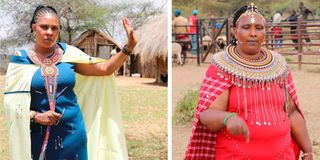
Rosemary Piranto (left), an apiculture farmer specialising in organic honey, and Christine Leseewa, a livestock trader, at Kisima Livestock Market in Suguta, Samburu West.

What you need to know:
- Christine Leseewa and Rosemary Piranto are among women building successful businesses with support from men.
- From livestock trading to beekeeping, women in Samburu and Laikipia are challenging long-standing economic barriers.
For decades, two industries in Kenya's arid and semi-arid region (Asal) have belonged almost entirely to men: livestock trading and beekeeping. Ownership, access to markets, even the right to be taken seriously as a trader- all of it ran through men.
That is beginning to change. And in Samburu and Laikipia counties, some of the men who once held the gate are now the ones holding it open.
Christine Leseewa knows what it cost her to walk through. Several years ago, she told relatives and friends she was going into the livestock business. They were doubtful. The trade was male territory, they said, and had been for as long as anyone could remember.
She went ahead anyway. Today, she is one of the few women in Samburu County trading livestock for a living, buying goats from farmers in Wamba, Baragoi, Archers Post, South Horr and Suguta Marmar, then selling them on to buyers from Nairobi, Nakuru and Thika.
The margins are real money. Christine says she makes between Sh2,000 and Sh5,000 profit per goat, depending on the season. On a good week, selling across three markets, she moves around 210 goats, an average profit of roughly Sh600,000.
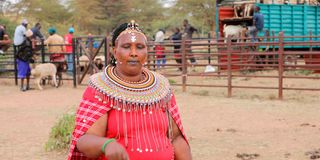
Christine Leseewa at Kisima Livestock Market in Suguta, Samburu West, on February 18, 2026.
She credits the men around her for much of that success.
"Men have been very supportive of my livestock business venture. From the market leadership to my buyers and sellers, who are all men, they have all been kind to me. They never discriminate against me even though I am a woman in a male-dominated field," Christine says.
About 300 kilometres away, in Laikipia, Rosemary Piranto's story runs on a similar current.
She started keeping bees in 2018 with five hives. She now has 618, spread across Ilmotiok, Loshaiki, Musul, Soit Oitashe and Karrum villages, each yielding eight to twelve kilograms of honey per harvest, three harvests a year.
She sells at Sh1,500 a kilogram, Sh750 for half a kilo, Sh450 for 400 grams, through her shop in Nanyuki town and to buyers further afield. In a good month she takes home Sh80,000 to Sh100,000. In a strong season, once all the honey is sold, her earnings can top Sh2 million.
Her husband, Piranto Ole Mosiany, has made a habit of finding her opportunities, training in apiculture, in beehive construction, and pushing her to take them.
"I have been linking my wife to training opportunities that touch on apiculture whenever I come across them. I also allow her to attend them since I want her to grow and get the necessary exposure. Women are equal to the task; what they need is support and encouragement," he says.
That training in beehive-making opened a second income stream: Rosemary now sells hives to other farmers and to NGOs. Piranto also helps market her honey online.
"Women have great potential in business and should be fully included in efforts aimed at promoting economic empowerment," he says.
Neither woman's success happened in spite of the men around her. It happened because of them.
That is not the usual story told about gender and economic power in the Asal counties, where patriarchy and custom have long kept women out of business, farming and independent income altogether. But it is becoming a more common one.
Albert Wanjohi, Samburu County's director of gender, says the shift is visible on the ground.
"Change is taking place, with increasing numbers of women engaging in business and agricultural activities to improve their livelihoods. Encouragingly, their male partners are also supporting their efforts to achieve greater economic independence," he says.
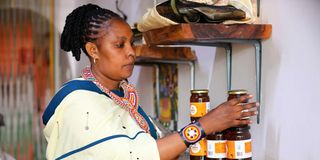
Rosemary Piranto, an apiculture farmer specialising in organic honey, with some of her packaged honey at her shop in Nanyuki town on February 26, 2026.
He is careful not to overstate it. Low literacy among women, limited access to capital and patchy political will remain real barriers, he says. His office is pushing awareness of funding avenues like the Women Enterprise Fund and the Access to Government Procurement Opportunities programme, support that matters most when the men closest to these women are already making room for them to use it.
What Christine's market committee and Rosemary's husband have in common is small, specific and repeatable: a chairman willing to vouch for one trader in one market; a husband willing to pass on a training flyer and mind the shop while his wife attends. Neither required new policy. Both required one man deciding to use whatever standing he already had to make space for a woman to trade, sell, and keep what she earned.
That may be the more useful lesson here, not that patriarchy is ending in Samburu and Laikipia, but that it bends fastest at the points where individual men choose to push.