The missing third: 15 years of struggling with gender balance
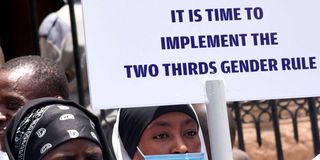
Women march through Nairobi on September 23, 2020, backing Chief Justice David Maraga's call to dissolve Parliament over its failure to implement the constitutional two-thirds gender rule.

What you need to know:
- Today marks exactly 15 years since Kenyans voted for a new Constitution that promised women a fair share of leadership.
- Three presidents—Kibaki, Uhuru, and Ruto—have all broken this promise.
- Women are still waiting.
Today marks exactly 15 years since Kenyans voted for a new Constitution that promised women a fair share of leadership.
You know how politicians promise heaven during campaigns, then disappear after elections? Well, here's the biggest broken promise in Kenya's history—15 years and counting.
The simple promise that became a big lie


In 2010, Kenyans said "Yes" to a new Constitution. Politicians told women: "This time will be different. You'll get your fair share of leadership."
The rule was simple: In every 10 government positions, at least three must go to women. Not asking for much, right? Just three out of 10.
But guess what? 15 years later, women are still waiting.
It's like your neighbour promising to fix your broken fence for 15 years. Every year, he brings tools, makes noise, talks about it—but your fence stays broken.
Chapter 1: President Mwai Kibaki's time (2010-2013) - When good ideas die young
Back then, Parliament looked like a men's club. Out of 222 MPs, only 22 were women. That's like having a harambee meeting where only two women show up among 20 men. Would that harambee represent everyone fairly?
In 2011, the Kenya Law Reform Commission and the Interim Independent Electoral Commission suggested a solution: "Let's take turns. This election, Kiambu elects a woman. Next election, Murang'a elects a woman." Fair and simple.
But male politicians strongly objected to this constituency rotation proposal: "What if I want to run in my home constituency but you say it's designated for women candidates only? These regular MP seats are ours!"
They killed the idea faster than you can say "tea break."
Chapter 2: Uhuru's promises (2013-2022) - Ten years of emptiness
President Uhuru took over. He had 10 years—10 whole years!—to fix this. The Supreme Court even gave him a deadline: August 27, 2015. "Pass the law by then, or else …"
On the day Parliament was supposed to vote on the bill that would implement the gender rule, MPs claimed they were "too few" to vote. But somehow, these same MPs always showed up when discussing their salaries and allowances!
The court fights back
Angry judges kept ordering: "Do your job!" But Parliament treated court orders like junk mail—ignored them completely.
One judge, Justice John Mativo, got so frustrated in March 2017, he said: "Fix this in 60 days or face the music." Parliament's response? They appealed the case! Like a student who fails an exam then argues with the teacher.
But even their appeal failed spectacularly. In April 2019, the Court of Appeal threw out Parliament's case, saying MPs had shown no genuine effort to pass the gender law.
The judges noted: "It is a matter of public notoriety that none of those constitutional amendment bills has ever been debated or considered by Parliament seriously; they have all been lost due to lack of quorum in the National Assembly."
The many failed bills
Over Uhuru's 10 years in power, Parliament tried 11 different times to pass this law. Eleven times! That's like failing your driving test 11 times and still claiming you're a good driver.
Some bills were serious attempts. Others were jokes meant to confuse everyone. The worst was the "Chepkonga Bill" in April 2015, named after Samuel Chepkonga, the Chairman of Parliament's Justice and Legal Affairs Committee.
This sneaky bill had a devious plan: change the Constitution itself to make the gender rule "progressive"—meaning it could be delayed forever with no deadline.
Instead of finding ways to implement the rule, they wanted to rewrite the Constitution to remove any urgency. The committee hoped that by changing the constitutional wording, Parliament would never face any pressure to actually give women their fair share.
It was like a student asking the teacher to change the exam rules permanently because they didn't want to study. Even though 178 MPs supported this escape route, they failed to meet the set threshold for passing the constitutional amendment. Woman representatives felt deeply betrayed and demanded the bill be withdrawn completely.
Chapter 3: The brave judge (2020) - "Enough is enough!"
By 2020, the then Chief Justice David Maraga was fed up. He wrote to President Uhuru Kenyatta: "These MPs are breaking the law. Send them home!"
It was like a village elder telling troublemakers: "If you can't follow village rules, get out of the village!"
Women marched on Nairobi streets on September 23, 2020, supporting Maraga's bold move. Finally, someone was fighting for them!
But President Uhuru Kenyatta ignored the Chief Justice, a man who in 2018 annulled his re-election over irregularities committed by the electoral commission. Parliament kept sitting, completely ignoring everyone.
Chapter 4: William Ruto's sweet promises (2022-Now) - Same script, new actor
During campaigns, President William Ruto made the biggest promise ever.
On June 10, 2022, at Nyayo National Stadium, he signed the Kenya Kwanza Women's Charter and declared: "Half my Cabinet will be women! I'll fix this gender thing in three months!"
"Women will become equal partners. Women will have an equal voice and will occupy equal positions in the highest decision-making organ. We will get rid of the culture of tokenism and ensure they are also at the table with other Kenyans," he said.
Women believed him. Big mistake.
What he actually did:
Cabinet: Only seven women out of 22 (That's like promising to share ugali equally, then giving women a slice or two)
Principal Secretaries: Only 11 women out of 51.
In 2023, he formed a committee called the Two-thirds Multi-Sectoral Working Group, co-chaired by Daisy Amdany, Executive Director Crawn Trust, to study the problem. They worked hard and gave their solutions in February 2024.
"Once the desired changes are made in the Constitution and the various laws, Parliament will be required to nominate additional women MPs to bridge the existing gap and make it compliant with the gender rule," Ms Amdany explained.
But their report, which was handed to Parliament in April 2024, disappeared like sugar in tea.
"By now it should have been tabled on the floor of the House, which has never happened. When we try to find out about progress, we are asked which report and later told that it is missing. This clearly shows that people are playing games on women," Ms Amdany said.
The lies politicians tell
Lie 1: Adding women MPs costs too much money.
Truth: If women were elected fairly, no extra MPs needed. Zero cost.
Lie 2: Voters don't want women leaders
Truth: Rwanda has more women MPs than men. If they can do it, why can't Kenya?
Lie 3: We need more time
Truth: 15 long years isn't enough time? Really?
What's really happening
Githunguri MP Gathoni Wamuchomba tells it straight:
"It's very unfortunate that the promise of giving the country a 50-50 gender-equal Cabinet has not been honoured, and appointments to parastatal leadership are very much wanting, with gender parity within counties missing."
“Look at Parliament committees. Only two women chair important committees. The rest are given assistant roles”—like letting women cook but not decide the menu.
The cost of keeping women out
When women can't lead, who suffers? Everyone.
Hospitals lack medicines for pregnant mothers, children walk long distances to school because nobody prioritises education, domestic violence cases get ignored, and markets lack proper facilities for women traders.
These problems affect entire families, not just women.
Women fight back
Tired of lies, women's groups have recently written to Chief Justice Martha Koome: "Dissolve Parliament! They've had 15 years!"
Groups including Crawn Trust, Creaw, WeAre52pc, and lawyer Elizabeth Kabari signed the petition.
Ms Amdany supports this: "We fully support calls for the dissolution of Parliament since justice delayed is justice denied. Parliament must do its job as required by the Constitution or go home. We have a legal basis to ask for its dissolution. We need women at the National Assembly as it is where laws are made."
Why men should care too
Lucy Ojiambo, a gender expert, explains: "The gender rule is about either gender and Kenyans should not interpret it to mean women are coming to take all the seats. In future, women could be more in Parliament and in leadership than men."
She adds: "We need to have faith-based advocacy for the gender rule. The church needs to play an integral role to help achieve the gender rule. Women should also cultivate sisterhood to help and support a sister who offers herself to run for a leadership position."
Smart families know that when mama succeeds, the whole family benefits.
The shameful truth
After 15 years, here's where Kenya stands:
Kenya's parliamentary record:
- President Mwai Kibaki time: Only 9.9 per cent women MPs (22 out of 222)
- President Uhuru Kenyatta time: About 20 per cent women MPs
- Today: About 22 per cent women MPs
Other countries:
- Rwanda: 56 per cent women leaders
- Tanzania: 36 per cent
- Uganda: 35 per cent
Kenya is like the slowest student in class, still struggling with basic math while others have moved to university.
The bottom line – Keep the promises!
Fifteen years of promises. Fifteen years of excuses. Fifteen years of treating women as if their concerns don't matter. It's like a floundering matatu driver who keeps saying "We're almost there" while driving in circles.
Politicians have mastered the art of not saying the truth:
- They form committees (that do nothing)
- They write reports (that disappear or never implement)
- They make speeches (full of empty words)
- They promise change (that never comes)
- They promise women (and deliver for men)
Ms Amdany says enough! "This clearly shows that people are playing games on women."
But Lucy Ojiambo keeps hope alive: "What we see as a mirage is very much within our reach since the Constitution entrenches the gender rule."
The big question:How long will Kenyan women accept these lies?
The Constitution says women deserve fair representation. Fifteen years later, that promise remains a joke. It's time to ask: If politicians can't keep simple promises to half the population, why should we trust them with anything?
The choice is simple:Demand the truth.
After 15 years, enough is enough. The biggest constitutional promise has become the biggest constitutional lie. When will Kenya stop lying to its women?
[email protected]; Additional reporting by Kamau Maichuhie


