Too young to mother: Poverty, broken families and poor access to care fuel Meru's teen pregnancy crisis
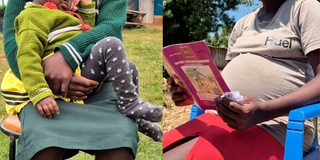
Emmah Maina* (left), a Form Four student, with her two-year-old child, while Esther Wanjiru*, a 17-year-old Form Three student who is eight months pregnant, reviews her 'Mother and Child Health' handbook. Both are from Meru County, which faces one of Kenya’s highest teenage pregnancy rates, with nearly one in four girls becoming mothers before 19.

What you need to know:
- Meru County has one of the country's highest teenage pregnancy rates at 24 per cent—nearly double the national average of 15 percent—with girls as young as 10 giving birth.
- The crisis is driven primarily by poverty, as families unable to afford school fees, forcing desperate girls to drop out.
- While rescue centres and healthcare programmes are providing support to young mothers, the cycle continues with 28 per cent of mothers delivering in county facilities still being teenagers.
The schoolbooks lie forgotten in a tattered bag, their pages unturned for months. Dreams of nursing uniforms and breaking generational poverty have been replaced by the weight of impending motherhood at seventeen. This is not a story of choices made freely, but of circumstances that cornered young girls into paths they never imagined walking.
Esther Wanjiru* sits quietly under the shade of a tree near her homestead in Kagiju village, Imenti North, just weeks away from giving birth. Her eyes hold a mix of strength and sorrow—too much for someone her age. At 17 and in Form Three, she had once dreamed of wearing a nurse's uniform, serving patients with compassion, and lifting her family out of poverty. Those dreams now feel like distant memories.
"This is not the motherhood I imagined," she admits softly.

Wanjiru's journey to this moment began with a familiar struggle in Kenya—the inability to afford school fees.
"I couldn't afford school fees. I used to be sent home and would stay there for a whole month. By the time I went back, others had already moved ahead with their studies, so I would just end up staying home," Wanjiru explains tearfully.
"My mother is unemployed, and my father works in a quarry. He earns Sh100 a day, which we use to buy food, but even then it's not enough. Sometimes we go to bed hungry. There were days I went to school without eating. Our farm is small, so even when we plant crops, it's not enough to feed us and pay my school fees."
"I didn't attend school for the whole third term last year because I was sent home for lack of fees. I stayed at home and became so stressed. I started feeling like my parents didn't care about my education anymore."
This sense of abandonment led Wanjiru to search for alternatives when her elder cousin suggested they attend a party hosted by a group of young men. What seemed like a harmless night out quickly transformed her struggle for a better life into a painful ordeal.
"Some boys came and took us out. I didn't even know them, but my cousin did. They took us to a pub where we drank alcohol, and that's how I ended up pregnant. I don't even know who the father is," she recounts.
"I didn't want my mom to find out I was pregnant because I didn't want to stress her. I was afraid that if she found out, she might be shocked and even abandon us, so I kept it a secret and went back to school. But I hadn't paid school fees, and eventually the teacher found out. I was sent home and told not to come back, not even to the school gate."
After her mother discovered the pregnancy, she encouraged Wanjiru to seek medical attention. Wanjiru began attending antenatal care where she received youth-friendly services tailored to support expectant teenage girls. Now nearing her due date, she has only one clinic visit remaining—a visit that could coincide with her delivery.
"Right now, I don't even have friends. Even the ones I used to hang out with have distanced themselves from me. I feel alone. But in my family, we're okay, even though we're going through challenges," she reflects.
"If I can get someone to take care of my baby, I can leave him with my mum and go back to school, because this wasn't my plan. My plan was to finish school, get good grades, and continue with my education."
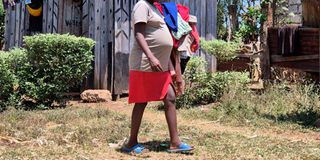
Esther Wanjiru*, a 17-year-old Form Three student, is eight months pregnant with her education disrupted by the pregnancy.
Just a few metres from Wanjiru's home lives 16-year-old Mercy Anyango*, a Form Four student at the same school Wanjiru attended. At four months pregnant, Mercy's story echoes the harsh realities faced by many teenage girls in the area, where early pregnancy has become more of a norm than an exception.
"I was sent home many times because I couldn't pay school fees. I would stay at home for almost two months, then come back and be sent home again, even during exam time when I was supposed to be taking exams. That's when I found out I was pregnant," Anyango explains.
"I had a boyfriend the only one who was helping me with small things for school. You know, with the way the Kenyan economy is, everything requires payment. So, I ended up getting pregnant."
Unlike Wanjiru, who doesn't know the person responsible for her pregnancy, Anyango was impregnated by a fellow Form Four student—a boy who has since denied any responsibility. She admits she was unaware of the risks and consequences of engaging in unprotected sex, highlighting the critical gap in reproductive health education among teens in the county.
"I haven't started my antenatal care visits yet, but I need to start this week. It's because I don't have money, and I hear that going to the clinic is expensive. Once I get the money, I will start immediately," she says.
These individual stories reflect a broader crisis. Meru County, home to over 1.5 million people, ranks fifth out of 47 counties in teenage pregnancy, carrying one of the highest burdens nationwide.
According to the 2022 Kenya Demographic and Health Survey, the county's teenage pregnancy rate stands at 24 per cent—substantially higher than the national average of 15 per cent. Only 61 per cent of births occur in health facilities, and just 45 per cent of pregnant women attend four or more antenatal care visits.
"The main challenges are a lack of knowledge about sexual and reproductive health rights and peer pressure. Many young people think, 'If my friend has a boyfriend, then I should have one too.'
“Additionally, female genital mutilation contributes to teenage pregnancies because girls who undergo FGM often feel like adults, which can lead to early pregnancies," explains Stellah Makandi, a healthcare provider in charge of sexual and reproductive health services for adolescents and youth in Meru County.
The statistics paint an alarming picture. In 2022, the Ministry of Health ranked Kenya third globally in teenage pregnancies, revealing that one in every five girls aged 15 to 19 was either pregnant or already a mother. Even more troubling, one out of every three women attending antenatal clinics across the country was aged between 10 and 19.
In Meru County, the crisis is even more pronounced. A 2023 survey by the National Syndemic Diseases Control Council found that between January and May alone, 3,998 out of 15,389 women who sought antenatal services were adolescents, representing 26 percent—the highest rate in the country.
The trend has persisted over the years. Data shows that in 2016, adolescents made up 27 per cent of all first-time antenatal visits in Meru, rising sharply to 41 per cent in 2017 and 45 per cent in 2018. However, it is the rise in pregnancies among girls under 14 that has sounded the loudest alarm.
During the Covid-19 lockdown in 2020, the number of pregnancies among girls aged 10–14 nearly tripled from 473 in 2019 to 1,341. While the figure dropped slightly to 1,113 in 2021, it remains disturbingly high. In 2022 alone, 10,561 out of 34,808 pregnancies in Meru were among girls aged 10–19, accounting for nearly one-third of all reported cases.
For many teen girls in Meru County, pregnancy marks the end of their education. Once expectant, they are often forced to drop out of school to care for their babies, sacrificing their futures in the process. Others face harsh treatment at home, with some being rejected by their families and forced to flee.
But amid the crisis, safe havens do exist. Institutions like Greenland Girls Mt Kenya Institute Rescue Centre are stepping in to fill the gap. Doubling as both school and rescue centre, it provides a lifeline for pregnant teens and young mothers. Currently, the centre is home to 90 girls who live on-site with their babies while continuing their education.
One of the residents is 16-year-old Jane Juma*, a teenage mother caring for her nine-month-old baby.
"My father couldn't afford to pay my school fees for Form One, so I joined late. I met a boy who said he would provide me with some shopping items, but only if I slept with him. I was desperate because I come from a humble family and live only with my dad, so I agreed. Unfortunately, I got pregnant," Jane narrates tearfully.
"He started insulting me and denied that the pregnancy was his. Later, my dad received a bursary, and I was enrolled in a day school. When I gave birth, my dad tried to contact the father of the child, but he denied responsibility and moved away."
Some of her friends urged her to terminate the pregnancy and warned against seeking medical care, claiming that nurses would mistreat and shame her if she went to the hospital.
Safe havens in the storm
"When I went to give birth, everything went smoothly, and I attended all the clinics. The doctor I met gave me good advice and told me not to terminate the pregnancy because I could be carrying the future of my life," says Jane.
Another teenage mother at the facility is 16-year-old Susan Chepkoech*, is caring for her six-month-old baby. A local chief brought her to the shelter five months ago after enduring repeated physical abuse from her mother at home.
"Before I got pregnant, my mother disappeared after I finished Class Eight. I was left alone without food or anyone to guide me, so life was very hard. I met a friend who gave me food, and unknowingly, I got pregnant. By the time I was joining Form One, I was already pregnant. I studied for the first term, but when I realised I was already six months pregnant, I had to stop," Susan recounts.
With no other options, she was forced to take on casual jobs to survive. She continued working until the final month of her pregnancy, doing whatever she could to make ends meet. Unlike Jane, Susan did not receive youth-friendly services from healthcare providers.
Her experience reflects a troubling trend in the county, one that partly explains why 39 per cent of teenage mothers are not delivering in health facilities. For many, fear of stigma, mistreatment, or lack of support keeps them away from the care they urgently need.
Twenty-year-old Emmah Maina* also has her heartfelt journey of balancing her studies as a Form Four student while caring for her two-year-old child who is battling meningitis.
"At first, the father of my child provided basic needs like food, but when I got pregnant, he left me and has never been responsible since. He hasn't even wanted to see the baby," says Emmah.
"My child is experiencing delayed development milestones and needs therapy every week, but sometimes I can't take him because I don't have money."
According to Jolly Kirimi, an administrator at the rescue centre, many of the girls arrive at the institution having already lost hope. However, once they settle in and realise they are not being judged for their past mistakes, they begin to adapt. This transformation not only impacts them personally but also contributes positively to the well-being of their children.
"What we are trying to ensure is that these teen mothers don't lose the bond with their children. In the morning, they prepare them, feed them, and take them to the day-care before heading to class. At 10am, they come to breastfeed them, and then continue with their lessons," says Jolly.
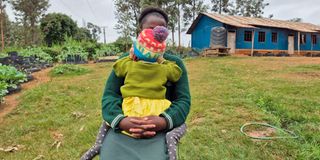
According to local stakeholders, the surge in teenage pregnancies has been driven primarily by poverty. While the county has thrived economically in some sectors, many families continue to struggle, leaving young girls vulnerable to exploitation and early motherhood. The high number of cases has also been attributed to gender-based violence.
"In Meru County, sexual violence stands at 16 per cent compared to the national average of 13 per cent, and many of the survivors are children. That's why we're seeing more minors coming to our maternity facilities for antenatal care and delivery.
“Physical violence is also high at 36 per cent, above the national average of 34 per cent, which often reflects what children go through in broken homes. FGM remains a concern too, with Meru at 19 per cent compared to 14 per cent nationally," says Judy Kawira, Meru County Coordinator for GBV Prevention and Response.
"Currently, 28 per cent of mothers delivering in our facilities are teenagers aged 15 to 19, according to the Kenya Health Information System. One major challenge is that many of our healthcare providers were trained years ago and lack updated knowledge on how to handle today's teens. As a result, young people often feel shy or judged and avoid seeking care," says Susan Kimathi, County Coordinator in charge of Reproductive Health Services.
Signs of hope
In response to these challenges, Reproductive Health Network Kenya (RHNK), in collaboration with the Ministry of Health, the Division of Reproductive and Maternal Health, Mt Kenya Trust, and Chase Africa, introduced a multifaceted initiative. The program focuses on increasing the availability of adolescent-responsive services by enhancing community engagement to create an enabling environment for young people to access accurate information and non-judgmental care.
According to the county, by July 2025, a total of 81,552 adolescents and young people have accessed youth-friendly sexual reproductive health services across 11 hospitals in 11 sub-counties, due to the ongoing advocacy. The data shows a significant increase of 9,480 adolescents and young women seeking antenatal care services in just seven months of 2025, indicating a strong shift in health-seeking behaviour.
"When RHNK came in, they helped us train our healthcare providers starting with 20 trainers across the county, and later reaching 60 providers on delivering sexual and reproductive health services. We also sensitized community health promoters to encourage teens in the villages to seek care early, because many only come to our facilities when it's too late and complications have already developed," says Susan Kimathi, county coordinator in charge of reproductive health services in Meru County.
The county has also tasked community health promoters to reshape the messaging at the grassroots level, as some of these girls who would deliver outside health facilities would die due to childbirth complications.
"We've been holding community dialogues and raising awareness on the importance of empowering adolescents and youth. Parents are learning that even when consent is needed, it's crucial for teens to access services at health facilities. I'm happy to say we're seeing progress—more teenagers are coming for antenatal care services. Some girls couldn't even leave their homes due to stigma, but now they're showing up because healthcare providers are trained to support them," says Ketty Gitonga, Project Manager for Adolescent Reproductive Health and Sexual Rights at Mt Kenya Trust.
"I've now come to understand the community better, and we've built a strong connection. The youth face many challenges, especially due to drug use. In some communities, you even find siblings becoming more like friends in the wrong way, but we talk to them a lot and try to guide them," says Jane Njoki, a community health promoter.
However, there are still cases of girls delivering outside health facilities, accounting for 39 per cent. At least 45 per cent of young adolescent pregnant women have attended four or more antenatal care visits.
Notably, 93 per cent of youth reported an improvement in the quality of services received, indicating that the interventions not only increased access but also improved client satisfaction and trust in the health system. Many of the young adolescent girls cite harassment at health facilities, poor treatment, and stigma from the community as ongoing challenges.
"We encourage young people to come for services because they have special needs. Many youths might have STDs but face barriers that prevent them from seeking help or sharing their status. HIV rates among youth are rising, partly because they don't come for testing or bring their partners for testing," says Stellah Makandi, health worker in charge of sexual and reproductive health services for adolescents and youth.
Progress and new concerns
A recent county survey reveals a sharp uptick in the number of adolescents and young women aged 10 to 24 accessing family planning services between 2024 and July 2025. Services for the 10–14 age group rose by over 50 per cent, while the 15–19 age group saw a seven-fold increase from 530 to 3,934 clients. The most significant rise was seen among young women aged 20–24, jumping from 1,619 to 11,279 within the same period.
However, alongside this progress, health officials have flagged a troubling trend—a rise in new HIV infections among girls aged 10–14 and young men aged 20–24. This pattern points to an emerging area of concern that goes beyond reproductive health, highlighting deeper vulnerabilities related to early sexual activity, inadequate protection, and potential exploitation. The data presents a dual narrative of progress in access, but also of persistent risks that demand urgent, targeted interventions.
"Many young girls aren't afraid of HIV; they fear pregnancy, so they misuse family planning methods like the emergency pill. Guidelines say it should be taken only once a year in emergencies, but some girls use it like candy.
“Our policies also make it difficult to discuss family planning with children, yet we know they are sexually active. We need to teach them how to use these methods correctly, or infertility rates will rise in the future," says Judy.
These collaborative efforts aim to break the cycle of early pregnancies, school dropouts, and poverty.
"We formed a technical working group that includes the gender department, education department, social protection, police, and religious and cultural leaders. This collaboration makes it easier to discuss problems, and together, we have been able to reduce these cases," says Dr Titus Mutura, acting County Director of Health Services in Meru.
Back under the tree where Wanjiru waits for her baby's arrival, the question remains: will her child have a different story to tell? The answer lies not just in individual choices, but in the collective will to address the root causes that continue to derail young dreams across Meru County.
*Names changed to protect girls' identity.


