Turkana’s trailblazers: The women redefining leadership on oil-rich land
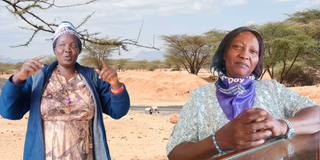
Jane Atabo (left) and Veronica Natesiro of the Lokichar Community Land Management Committee in Turkana County during an interview in Nairobi on October 9, 2025. The treasurer and chairperson, respectively, are amongst the very few women in Kenya leading community land committees.

What you need to know:
- Two Turkana women, Veronica Natesiro and Jane Atabo, are breaking barriers by leading their community’s land governance in Lokichar.
- Through the Community Land Management Committee, they ensure fair use of land and protect local rights amid oil exploration challenges.
"Bonjour!" Veronica Natesiro said as she stood to contribute to discussions on women's inclusion in land governance during a conference held in Nairobi on 8-9 October 2025, by the Food and Agriculture Organisation in partnership with multiple state and non-state entities.
At first, the greeting did not draw much attention until she introduced herself as a Turkana woman from Lokichar in Turkana South, an area known for its abundance of oil.
Then came her eloquent flow of English and an unforgettable assertion: "When there is no food on the table, there is no woman involved."
It was a striking reminder that food security cannot be achieved without women's meaningful participation and engagement.
Women in Turkana are often portrayed as perpetually suffering: living in poverty, lacking water, and deprived of education. So when Veronica presented herself as the complete opposite, everyone paid attention. French is among the 10 local and foreign languages she has mastered.
This is a woman who is one of only two in the country to chair Community Land Management Committees (CLMCs), provided for in the Community Land Act (2016). The other is in Baringo County.
She is the chairperson of the Lokichar CLMC, a position she was appointed to last year after intensely campaigning to be a member of the committee. Villages elect representatives to the 15-member committee, after which the members vote to appoint those who will form the secretariat and lead it.
This committee is the pillar of maintaining peace and harmony in relation to the use of community land.
The law obliges it to manage and administer registered community land on behalf of the respective community. It is also expected to coordinate the development of community land-use plans in collaboration with the relevant authorities and, at the same time, promote cooperation and participation amongst community members in dealing with matters pertaining to their registered community land.
And she sits at the helm of this 'precious power' that determines whether the community is stagnating or developing through the use of its land.
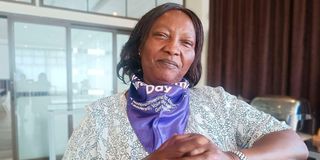
Veronica Natesiro, chairperson of the Lokichar Community Land Management Committee in Turkana County, during an interview at a Nairobi hotel on October 9, 2025. She is one of only two women in Kenya to chair such a committee.
But Veronica's journey is extraordinary. She has gone places, seen many things, and gathered a wealth of experience on people and resources.
"I spent most of my life working abroad," she says.
Born in Kakuma, Turkana West, to an army officer father and a prison warden mother, she is now married in Turkana South. She began working at the age of 25, and by 38, she had had enough of formal employment, which kept her abroad and away from her children and husband.
Soon after acquiring a certificate in nursing and midwifery, she began as a secretary with the International Committee of the Red Cross (ICRC) in the Family Reunion Office, tracing and reuniting families torn apart by conflict in Lokichogio and Southern Sudan.
For seven years, she helped reconnect those who were lost through war and displacement, a task that would shape her lifelong empathy for the vulnerable.
Her compassion led to her rise as a nutrition manager with Médecins Sans Frontières (MSF) Belgium under the United Nations Operation Lifeline in Southern Sudan. There, she managed feeding centres for malnourished children and trained young girls escaping early marriages. With MSF, she also championed women's empowerment, introducing tailoring, kitchen gardening, and catering programmes to help women earn livelihoods and gain confidence.
Later, her work took her to Chad, where she served with Action Against Hunger, combining nutrition and agriculture projects. She used song and storytelling to teach women about hygiene and health, translating Kenyan tunes into local dialects to make learning joyful and relatable.
In 2007, whilst pregnant, she received a call from her employer sending her for a mission to Mozambique. She declined and instead returned home to Lokichar to begin a new chapter as an entrepreneur. She established Hotel San Diego, the first Christian-owned restaurant in town at a time when most businesses were Somali-run, she says.
The name was borrowed from her brother-in-law's home in the United States.
During the oil exploration boom in Lokichar, Veronica secured catering contracts with Tullow Oil, sometimes cooking for up to 100 people and ferrying food to the field using company trucks.
"It was not easy," she recalls. "But I believed that hard work and honesty would open doors."
The turning point
In 2011, she heard about an upcoming training organised by a national non-governmental organisation for women in her area. The names were submitted by the area chief, and when she called to ask if she could attend, she was told she could not without an official invitation.
Determined, she ignored the chief's advice and attended. When she did, she stood and told the gathering that she was not one of the invited participants and informed the facilitator that she did not want their food or transport reimbursement but was there only to learn.
"The facilitator was very surprised. She looked at me like, 'Who is this woman?'" she remembers.
Throughout the training on women's participation in land governance, she remained active.
"I would frequently contribute and ask questions that intrigued the facilitator. They taught us how to translate land laws and governance principles into our own dialects," she says proudly.
"They gave us brochures and told us to teach others in the language they understand. That is how empowerment begins."
After the training, Veronica and her peers were supported to visit the grassroots to educate villagers on land rights. They spoke about protecting communal land, documenting boundaries, and the environmental impacts of oil exploration in Turkana. The facilitator would visit to monitor the progress and impact of their work.
As luck would have it, the facilitator later joined one of the commissions that actively engaged locals in land management, and as commissioner, appointed Veronica as a grassroots focal person. She became actively involved in engaging the community on the same.
When the time came for the Lokichar CLMC to be formed, her leadership qualities did not go unnoticed, and now her work is cut out for her.
"There's a lot of oil in my town," she says. "But with oil comes challenges: pollution, displacement, and changes in grazing and water patterns. My work is to make sure our people are not left with nothing when the drilling ends."
For Veronica, leadership is not about titles; it is about protecting the land that sustains her people.
"If we misuse our land, our children will suffer," she says. "But if we guard it, teach each other, and plan wisely, our community will thrive even after the oil is gone."
Jane Atabo, the treasurer
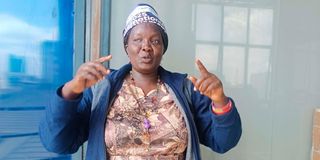
Jane Atabo is the treasurer of the Lokichar Community Land Management Committee in Turkana County, managing community funds for land registration and resource use. Photo taken during an interview in Nairobi on October 9, 2025.
Another woman serves in the Lokichar CLMC: Jane Atabo, the treasurer. Her title, however, carries more meaning than it suggests.
"I lost my husband last year," Jane begins, her voice steady despite the weight of the memory.
"He was young, only in his early 40s when he died. I told myself: 'I will not die with him. I must stand up. I am everything to my children now.'"
Her husband, once a human resources manager, had been her greatest supporter. They met when she was in Class Five. He encouraged her to try business, to build something of her own. When he passed, Jane turned that encouragement into a lifeline.
She opened a cereal shop in Lokichar, supplying food to nearby schools and households.
"It keeps my children in school," she says proudly. "Even when business is small, at the end of the day we eat."
But Jane's leadership extends far beyond her home. She is also the founder and chairperson of the Lokichar Widows Group, a registered association of women aged 60 and above who have lost their husbands and, often, their sense of belonging.
"When a woman loses her husband, she feels like there's nothing left for her," Jane explains.
"That's why I started the group, so that no woman walks alone in her grief."
The widows meet twice a month, sharing food, advice, and hope. Jane mentors them to start small businesses, access relief food, and support each other's children through school.
"I have taken in children who are not even mine," she says. "My home is open. If I have four shillings, we share it. Life must go on."
Divine appointment
When the Lokichar CLMC elections were called in 2024, Jane had no plans to contest.
"I didn't campaign," she recalls with a smile. "It was God's will. Even that day, I was at the hospital with my husband. He was still sick. But the community chose me."
Fifteen candidates were selected through a rigorous process involving village elders and community members.
"I couldn't believe it," she says. "I just stood up and said, 'If this is God's plan, I will serve faithfully.'"
The elected members then voted to fill the positions of chairperson, secretary, and treasurer.
As treasurer, Jane helps manage community funds for land registration, boundary demarcation, and resource use, including projects tied to water and grazing lands.
As Lokichar sits at the heart of Turkana's oil belt, the CLMC plays a crucial role in ensuring that benefits and compensation reach the right people.
"I keep our records clean," Jane says with authority. "We must be fair. The land belongs to everyone—men, women, widows, and the youth. No one should be left out."
Her sense of fairness is shaped by her own experiences of exclusion and survival.
"Many women come to me crying about land," she says. "I tell them, 'Don't lose hope. We will follow the right process. The law protects you now.'"
Jane laughs gently when asked about her level of education. "I never studied beyond primary school," she says. "But leadership is not about big English; it is about understanding people's needs."
Her work in the CLMC has made her a familiar figure at local offices, where she helps women apply for bursaries and welfare support. She is also the treasurer of the Chief's Welfare Committee, overseeing local development contributions.
"I move from one office to another," she says. "Chief, Constituency Development Fund, welfare—anyone who can help women. I tell them, 'These are our people; don't forget them.'"


