UN has a chance to elect its first woman chief after 80 years of male leadership
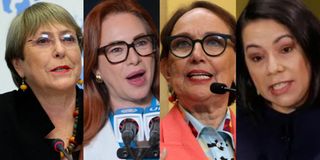
UN female secretary-general candidates - from left: Chile’s Michelle Bachelet, Ecuardo’s Maria Fernanda, Costa Rican Rebeca Grynspan and Guyana’s Carolyn Rodrigues-Birkett

What you need to know:
- With four highly qualified women contesting the United Nations secretary-general position, member states have a historic opportunity to elect the organisation's first female leader.
- The next UN secretary-general will face financial, geopolitical and technological challenges, making experience, inclusion and visionary leadership more critical than ever before.
Member countries of the United Nations should elect a woman as its secretary general. Election of a woman would reflect her vision to keep inclusion, empowerment and equality at the heart of the UN’s mission, while implementing reforms to ensure the UN is prepared to meet the challenges it faces.
There are four women out of the seven candidates vying to get the job of United Nations (UN) secretary general, and if one of them is elected, she will become the first woman to head the world body that was founded in 1945.
The four women candidates running to take over from outgoing UN chief Antonio Guterres are Chile’s Michelle Bachelet, Ecuardo’s Maria Fernanda, Costa Rican Rebeca Grynspan and Guyana’s Carolyn Rodrigues-Birkett. The men running for the job are Rafel Grossi of Argentina, Senegal’s Macky Sall and Uganda’s Olara Otunnu.


For eight decades, the UN has been in existence, nine men have served as secretary general, and not a woman has been entrusted to carry the responsibility of the highest office. That goes against the UN's expectations on inclusion, empowerment, and equality. That is why, all eyes are on every phase of the secretary-general race – to see if, for the first time, the UN will elect a woman as the head.
The UN secretary-general is not only the face of the global organisation but also representative of eight billion people in the world. The UN Charter describes the secretary-general as "chief administrative officer" of the Organisation who shall act in that capacity and perform "such other functions as are entrusted" to them by the Security Council, General Assembly, Economic and Social Council and other United Nations organs.
The challenges facing the UN and the world are plenty, and requires visionary and committed leaders. For example, the next secretary-general must deal with financial pressures at the United Nations, address and harness the power of the private sector and artificial intelligence in the world today.
The late United States Supreme Court judge Ruth Bader Ginsburg once said that “women belong in all places where decisions are being made. It shouldn’t be that women are the exception.”
We have seen women take up leadership of a number of major international organisations in the UN system and beyond, and perform beyond expectations. Countless women have done and continue to do outstanding work as heads of state and of government, private and public institutions and elsewhere. Yet still, the United Nations has never had a female secretary-general in its almost 80 years of existence.
A few examples suffice. Ms Zainab Hawa Bangura, United Nations Under-Secretary-General and Director General United Nations Office in Nairobi, is leading massive expansion, upgrade and development of Unon, the UN’s only secretariat headquarters in Africa and the Global South. The office is undergoing significant expansion, with plans that were unveiled two years ago, for Sh38.9 billion ($267.5 million) investment in conference facilities.
The expansion set to bring much-needed improvements to the Unon complex infrastructure includes two key capital projects. First is the replacement of office blocks, which includes the refurbishing of all existing office blocks and construction of six new office blocks. Second is the significant planned upgrade of conference facilities named the Gigiri Master Plan.
Ms Sanda Ojiambo, the Chief Executive Office and Executive Director of the UN Global Compact that encourages businesses and companies worldwide to adopt sustainable and socially responsible policies, has steered the organisation in a way that has helped it increase its global footprint and increase its relevance.
At the same time, former German foreign minister Annalena Baerbock was the fifth woman overall to lead the UN General Assembly, and one of the youngest people to ever have that role. During her tenure, which will elapse in September at the next Assembly, she worked towards making the organisation more efficient and effective, advancing the 2030 agenda for sustainable development and endeavoured to make the Assembly more inclusive.
Putting a woman at the head should not be seen as an act of charity. The United Nations must respond to the call, and elect a woman to run the world body. Four great female candidates have been put forward – and the UN should elect the best woman for the job.
Michelle Bachelet was elected president of Chile on two occasions (2006–10 and 2014–18). She was the first female president of Chile. Also, she was the first under-secretary-general and executive director of the UN Women, which was established in 2010 by the United Nations General Assembly. Until 2022, she was the chief of the UN Human Rights office.
Rebeca Grynspan has served as vice president of Costa Rica, and the Secretary-General of the United Nations Conference on Trade and Development and as United Nations Under-Secretary-General and Associate Administrator of the United Nations Development Programme (UNDP).
Maria Fernanda was the first woman from Latin America and the Caribbean to be president of the United Nations General Assembly (2018-19). She was the first woman to become the permanent representative of Ecuador to the United Nations (2008).
Carolyn Rodrigues Birkett has served as Permanent Representative of Guyana to the United Nations. She previously became the first woman and highest-ranking indigenous person to serve as Guyana’s foreign minister.
As former UNDP administrator, Helen Clark recently remarked, “Yes! It is time for a woman secretary-general of the United Nations. This year, the UN Member States can make that choice and show that the world’s top diplomatic post is open to all. After 81 years and nine male secretaries-general, it’s surely time.”
The writer is a public policy analyst([email protected]).