Unbowed in Wajir: The women standing up to sexual violence
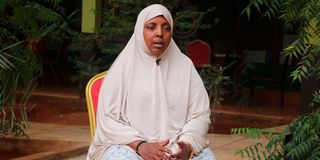
Fatuma Abdi, a human rights and gender activist, speaks in Wajir town on September 9, 2025. She has been at the forefront of fighting sexual and gender-based violence in the county.

What you need to know:
- Fatuma Abdi and Halima Bachola lead a determined fight against rising SGBV in Wajir County.
- Despite death threats, they push cases to court and provide counselling for survivors.
- Their efforts have secured five convictions since 2016 and spotlighted the urgent need for a rescue centre for victims.
The memory is as sharp as the day it happened. Fatuma Abdi was in Class Six, a young girl living with polio, when a moment of casual cruelty changed the course of her life.
“I overheard the District Commissioner tell a man with a disability that talking to such a person was nothing but a waste of time,” she recalls. “It ignited the advocacy fire in me, and I still carry it today.”
From that instant, Fatuma chose a path of defiance. Now a trained paralegal and co-founder of the Arid Areas Paralegals Network, she has spent more than two decades fighting for the rights of girls, women and people living with disabilities in Wajir County. Her work has focused on ending sexual and gender-based violence and dismantling the Maslaha system—a traditional mechanism that shields perpetrators from the law.


“What gives me joy is when I see a case reach court,” she says, her face breaking into a smile. “I jump with happiness when justice is served. Helping survivors of sexual violence access justice gives me the greatest satisfaction.”
Threats and resolve
The struggle has never been easy. Fatuma speaks calmly of the death threats that have followed her advocacy.
“In 2015, two armed men came to my home and warned me to stop following sexual violence cases,” she says. “They told me I was too young to die. One even said that if he ever saw me in Nairobi, I would be dead meat.”
She never wavered. “Despite the threats, I have stayed put. I remain vocal in fighting these vices in the community.”
Since 2016, Fatuma has helped survivors report cases that have led to five convictions in the Wajir law courts, losing only one case since 2015. Among the most striking was the 2022 conviction of Chief Kalimoi Shale.
The chief was sentenced to 40 years in prison and ordered to pay a fine of Sh500,000 for repeatedly raping an 18-year-old girl and circulating her nude images on social media. He had attempted to force the survivor into an out-of-court settlement.
Beyond legal aid, Fatuma offers counselling to survivors struggling with trauma. “Many need psychosocial support,” she says. “We lack a rescue centre, and that makes it harder to help them heal.”
Also read: Why GBV survivors struggle to get justice
Fatuma is not alone in this fight. Halima Bochola, a fellow human rights and gender activist, shares her alarm at the scale of abuse.
“There is a lot of defilement, rape, sodomy and domestic violence against women and girls,” Halima says. “The prevalence of sexual violence in Wajir County is very high. Many cases are never reported because the community is so discreet.”
Halima points an accusing finger at some of the elders. “They ask us what we gain when we report to the police. Elders shield the perpetrators and allow the vices to continue. Nothing will stop a sex pest from violating more girls and women if this continues.”
She is especially troubled by rising incest cases. “Survivors rarely get justice,” she says. Like Fatuma, she calls for an urgent rescue centre to protect survivors. “The lack of one derails our efforts. Survivors are forced to return to homes where perpetrators roam freely. It humiliates and stigmatises them.”
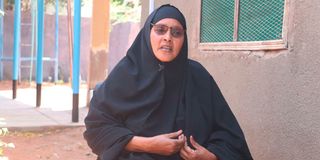
Halima Bachola, a human rights and gender activist, speaks in Wajir town on September 12, 2025. She has been at the forefront of fighting SGBV in the county.
Together, the two activists confront entrenched patriarchy and masculinity, often perpetuated by male elders. They focus on leaders who champion the Maslaha system, running awareness campaigns to show elders the harm sexual violence causes and what the law demands.
Their work is relentless: identifying cases of sexual violence, reporting them to police, ensuring survivors receive medical attention, and following up until suspects appear in court.
Counting the cases
The figures reveal the challenge. Wajir East Sub-County Police Commander Aliyow Buri reports 27 cases of sexual and gender-based violence so far this year—16 defilement cases, eight rapes and three attempted rapes.
“Once we receive cases of sexual violence, we ensure the files are processed and forwarded to the DPP for approval and prosecution,” Buri says. “The work of the police is to protect and ensure justice prevails so survivors fully get justice.”
Tradition and cultural practices are often blamed for fuelling gender-based violence. Yet some elders are beginning to speak out.
Mohammed Abdillahi supports the activists’ work. “If a girl or woman is sexually violated, the case must go to court and the perpetrators face the law,” he says. “Elders have a role to play by ensuring they do not shield perpetrators through traditional dispute resolution.”
For Fatuma, the mission remains deeply personal. “The urge to help survivors get justice gives me strength,” she says.
Her quiet determination, and that of women like Halima, is changing the conversation in Wajir. The Maslaha system is under pressure. Elders are no longer sitting easy.
The journey that began with a young girl overhearing a single cruel remark continues to shake the foundations of silence and impunity—one case, one survivor, one hard-won conviction at a time.


