US-Iran conflict: Pregnant women forced into unsafe deliveries as war disrupts healthcare
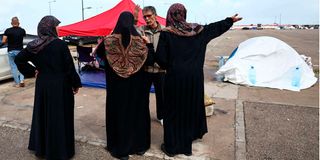
A displaced man from the southern Lebanese town of Nabatieh speaks with displaced women at a donations stand set up to provide relief to those sheltering in Beirut, on the day Muslim worshippers marked Eid al-Fitr prayers. Millions of people, including hundreds of thousands of women and girls, have been uprooted by the escalating US-Israeli conflict with Iran. Beirut, Lebanon, March 20, 2026.

What you need to know:
- Pregnant women, mothers and girls face rising violence, displacement and fear amid escalating Middle East conflict crisis.
- Aid disruptions and insecurity leave women without healthcare, protection or dignity in war-torn regions across the region.
Four days after her Caesarean delivery, a woman in Lebanon was lying on a pavement, still in pain, unable to properly care for her surgical wounds, with her new-born beside her. She had nowhere else to go.
Nour Kassab, the gender and protection coordinator at Care International in Lebanon, was there when it happened.
"The woman should be resting and recovering in a safe place, but she told us she was still in pain and could not properly care for her surgical wounds. Seeing a mother trying to protect her new-born while living on the street is heart-breaking," she said.


That scene, wrenching as it is, has become one of many playing out across the region since the United States and Iran went to war on February 28. For women and girls, the conflict has brought a particular kind of suffering, one measured not just in casualties, but in collapsed maternity wards, interrupted pregnancies, and the collapse of the basic protections that keep them safe.
Women navigating the war are reporting profound and conflicting emotions ,deep fear, exhaustion, and the specific dread that comes with not knowing whether the help they need exists or can reach them. According to a communication by Iran's Ministry of Health released on March 22, 223 women have been killed and 2,729 wounded since the fighting began three weeks ago. Separately, a strike near a girls' school close to an Islamic Revolutionary Guard Corps base resulted in the deaths of approximately 110 children, according to Iranian authorities.
The United Nations High Commissioner for Refugees says as many as 3.2 million people ,representing between 600,000 and one million Iranian households ,have been displaced since the war began. More than 800,000 people in Lebanon alone have fled their homes, sheltering in schools, streets and cars as shelters fill beyond capacity. Over 1,300 people have been killed in Iran, including children.
The humanitarian consequences for women and girls have been severe. The United Nations Population Fund (UNFPA) has raised the alarm over the impact of the conflict, which has reached well beyond the immediate theatre of war. Disruptions to critical maritime routes and airspace closures have delayed the delivery of essential supplies to many countries.
UNFPA executive director Diene Keita said among the delayed items are mobile maternity hospitals, life-saving equipment to support safe deliveries, and supplies for survivors of sexual violence.
"Our teams are deploying mobile clinics to bring integrated health and protection services to displaced women, distributing dignity kits containing essential hygiene supplies for women and girls, and working to keep safe spaces for them operational wherever possible. Our priorities are clear: even in the midst of a crisis, every woman must be able to give birth safely and every woman and girl must be protected from violence," Keita said.
UNFPA estimates that in Iran, Jordan, Lebanon, the occupied Palestinian territory and Syria, more than 1.6 million pregnant women are living under the threat of this conflict. In Lebanon alone, more than 69,900 women are currently pregnant as displacement and bombardment intensify.
Care International says displaced women are giving birth in schools, cars and overcrowded shelters, with no privacy, no clean water and no medical support. Nour Beydoun, the organisation's regional adviser on women, girls and protection in emergencies, says these conditions do not only risk lives, they strip women of their dignity. The psychological impact on women and families, she adds, is immense, with displaced women and girls facing escalating risks of gender-based violence, sexual exploitation and abuse, and trafficking.
People fleeing the fighting have often left with little more than the clothes on their backs. Roads have become unsafe, transport has been disrupted, and health facilities are running short of fuel, medicines and hygiene supplies, making it increasingly difficult to reach care.
UN Women has condemned the military strikes against Iran and the subsequent escalation across the region, saying civilian populations, including women and girls, have been placed at immediate risk.
"Women and girls everywhere have the right to live in safety and in peace, free from violence and discrimination. Escalating hostilities disrupt essential services, increase the risk of gender-based violence, and further constrain and endanger women-led organisations and first responders," the organisation said in a statement.
United Nations Secretary-General António Guterres has called on the United States and Israel to end the war, warning that the conflict risks spiralling out of control and causing severe suffering for civilians. In a statement, he warned of devastating humanitarian consequences if the fighting continued, stressed the urgent need to pursue negotiations, and cautioned that military action could trigger broader instability across the region and beyond.
Thousands of schoolgirls have been displaced, and the ongoing violence has severely compromised humanitarian aid efforts. The situation remains fluid, with large numbers of temporary displacements as intense fighting continues.


