When I campaigned as Joyce, they said, 'No, you are Bensuda!' So I made it official
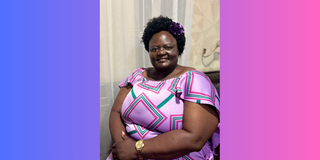
Homa Bay Woman Representative Joyce Atieno Bensuda at Wilson Airport, Nairobi, on August 7, 2025.

What you need to know:
- Dr Joyce Bensuda, Homa Bay County's Woman Rep is known locally as "Opug Nyasungu" for her steady, principled approach to leadership.
- While defending the woman rep position against critics, she advocates authentic women's political leadership.
In Luo culture, being called Opug Nyasungu (the English Tortoise) may sound unusual as praise for a politician. But for Dr Joyce Atieno Osogo Bensuda, the Homa Bay woman representative, the nickname captures something vital about her leadership: steady, resilient, and unshakeable in purpose.
“The tortoise is steady, strong,” she explains. “People saw that firmness in how I carry myself.”
Her other moniker, Bensuda—now officially on her national ID—has a different origin. “People said I advocate like a lawyer. They compared me to Fatou Bensouda, the Gambian lawyer and former ICC Prosecutor. It stuck everywhere—university, Kibuye market where I did research, even in my church. When I campaigned as Joyce, they told me, ‘No, you are Bensuda!’ So I made it official.”


It is past 10pm at Wilson Airport’s VIP lounge when Bensuda reflects on her journey, her eyes a mix of sorrow and determination. She has just returned from paying her last respects to her political mentor, Phoebe Asiyo, in Homa Bay. “Mama Asiyo believed in service,” she says softly. “She pushed me, convinced Governor Anyang’ Nyong’o to release me for politics when he didn’t want to lose me from Kisumu County’s Roads department. That belief fuels me.”
From educator to representative
Her path to politics was anything but straight. Influenced early by her grandfather, Joseph Orko, who insisted “a woman should be a teacher.” Bensuda built a formidable academic record: A P1 teaching certificate, a Bachelor of Education in Geography and History, a Master’s and PhD in Project Planning and Management, several computer certifications, and now, a Bachelor of Laws at the University of Nairobi.
“I’m studying law because I’m a lawmaker. I need to understand the laws we pass and whether we’re doing it right,” she says. “Besides, I always dreamt of being a lawyer. Now, I want to be a true community advocate.”
Leadership came naturally. “From nursery, I was head captain. Head girl in primary. Head captain in college. This isn’t new because of 2022—it’s in me. I see myself as a natural champion.”
Before joining Parliament, she served as County Executive for Roads, Transport, and Public Works in Kisumu under Prof Nyong’o, an appointment that surprised many. “Roads are seen as a man’s job. But I tackled it head-on, reviving broken vehicles, restructuring the department, and starting machine-based road maintenance that employed the youth.”
She acquired lorries, excavators, and graders, and secured Sh200 million for a low-bituminous road in Seme through a deal with the National Youth Service. “I didn’t disappoint the governor. That’s why he didn’t want me to leave for Homa Bay politics. Mama Phoebe Asiyo had to convince him on the last day.”
The 10-point blueprint
When she entered the 2022 woman rep race, she brought what she calls her “battle-tested blueprint”—a 10-point agenda developed long before her nomination. “I studied feasibility, checked baselines, and identified the gaps in the county. That way, I avoided overlap with other elected leaders,” she explains.
At the heart of her agenda is education. Her Mama County Back to School programme channels millions in bursaries into constituencies, including Sh10 million in Suba South and Rangwe. She equips girls with dignity packs—pads, soap, and underwear—under Bensuda Pad a Girl, and supports boys with hygiene packs under Bensuda Bathe a Boy. She mentors students and educates parents on health and violence prevention.
Environmental conservation runs parallel. Before her election, she planted 11,000 trees. Today, nearly every public primary school in Homa Bay has a Bensuda Tree Forest, with at least 100 trees. She distributed 11,000 fruit seedlings in Kasipul in a single day, followed by 27,000 more across schools. Her signature green BensudaSolid Waste bins are becoming a familiar sight. “I aspire to walk in Wangari Maathai’s footsteps,” she says.
Water infrastructure is another priority. “A woman without water sees her world crumble,” she notes. So far, she has distributed over 200 large tanks, each holding 5,000–10,000 litres. Her pride project is a solar-powered borehole at Kanyadoto Primary, designed to serve the school, a secondary school, a church, and the surrounding community.
On economic empowerment, she is building boda boda shades—five already completed, with a sixth underway—offering youth rentable kiosks and meeting spaces. She has launched modern markets, including the first ever in West Kabondo and a 500-trader hub in Ndhiwa Kwabwai, opened by Ida Odinga. These markets have lockable stalls, water, PWD-friendly toilets, lighting, drainage, and showers. “Don’t go home smelling of fish! Clean up first. This is your office,” she urges traders.
Her passion projects include lactating rooms for working mothers. “Mothers, bring your infants! But I need partners—NGOs, donors—to build more. My vision is vast, my funds finite.”
Technology is another focus. As a member of Parliament’s Communication Committee, she has delivered 100 computers to Mageta Technical, over 25 to Tom Mboya University, and ICT labs in schools. She has distributed millions in grants to small businesses, motorbikes, salon kits, welding machines, and water tanks to youth and women’s groups. On food security, she has supplied truckloads of rice, beans, and porridge flour to schools and vulnerable families.
Her inclusion agenda shines through scholarships for 50 students with disabilities, countywide bursaries, and wheelchairs and crutches for PWDs. “I even championed hiring one PWD in the county government. They are absolutely my people,” Bensuda affirms.
Voices from the ground
The impact of Joyce Bensuda’s leadership resonates differently across Homa Bay.
Paul Oswago, a shoe vendor in Ndhiwa, praises her visibility. “She has distributed water tanks, planted trees in schools, and built two modern markets with promises of more,” he says, calling her mama shupavu kwa uongozi—a resilient leader. He adds that she has also provided boats for fishermen. “How do we know it’s her? She calls the wananchi to witness every launch, and she brands everything she builds.”
Alex Ogoro, a boda boda rider, corroborates the construction of boda boda shades in Oyugis and Homa Bay town, along with the widespread supply of sanitary towels. “We, the boda guys, are often called to accompany her to these projects, so we see the work first-hand,” he says.
But not all feedback is glowing. Daniel Omondi, a taxi operator, describes her as inaccessible. “You’ll mostly see her when another leader invites her to a meeting. Reaching her directly is hard,” he laments. While he acknowledges she has “outdone her predecessor,” he perceives a heavy concentration of projects in Rachuonyo East, speculating it may be linked to a 2027 political contest.
Bensuda herself admits accountability has been a challenge. Her tone hardens when discussing sanitary pad distribution. “Pads vanished in Ndhiwa because I didn’t have a proper accountability system. The records are a mess. That must never happen again.”
Defending the office
Proposals to scrap the woman representative position ignite fierce defiance. “If a leader fails, vote them out! Don’t attack the seat itself,” she snaps, insisting the role is misunderstood.
“This is not the governor’s job,” she stresses. “Paying school fees for girls, distributing umbrellas, dignity kits—this is affirmative action. Demanding that I build highways or hospitals is illogical. The law forbids it, and the funds don’t exist.”
The suggestion that the role is merely symbolic draws her ire. “Electing me just to ‘make up the numbers’ for women is an insult. You elected Bensuda to deliver!”
Still, she admits the title ‘woman rep’ is ambiguous. She proposes renaming it ‘County Member of Parliament’ to clarify its stature. “At events, who speaks first—the MP, senator, or woman rep? Too often, I’m just ‘all protocols observed.’ That undermines the office.”
Women, politics, and power
Bensuda also confronts the objectification of women leaders and the notion that women sabotage each other. “Men love to say women fight each other. But look at giants like Phoebe Asiyo, Grace Onyango, Mary Onyango. Their unity was real, from the heart. Today, sometimes it feels only lip-deep.”
Her message to women is blunt: “Fight for positions with your brains and your work. Let your delivery speak. Be firm, be principled. Mothers know strength, and we are the best leaders. Kenya needs more of us in every role, if we deliver and remain focused.”
The Beijing reflection
Thirty years after the Beijing Declaration, her assessment is layered. “Kenya can proudly point to progress: stronger women’s voices in politics, national debate against gender-based violence, and greater inclusion of children’s perspectives in policy. These are no small feats.”
But she tempers optimism with frustration. “The two-thirds gender rule remains a distant dream, a promise unfulfilled. Representation across corporate boards, community leadership, and political spaces is still critically low.”
Even so, her faith remains. “I believe the next 30 years will be our era of delivery. We’ve laid the groundwork. Now we must build the edifice of true and equitable representation.”
As the late-night conversation at Wilson Airport draws to a close, her mind returns to Homa Bay. The grief of losing Mama Asiyo lingers, but the mission is undimmed. “I’m not just defending my seat in 2027,” she says firmly. “I’m waiting to be announced the winner—because my work is unfinished.”
The tortoise, after all, doesn’t just win through persistence—it finishes the race. In Homa Bay County, Bensuda’s steady march continues, one deliberate step at a time.


