When marriage becomes a cage: Inside Kenya's domestic violence crisis
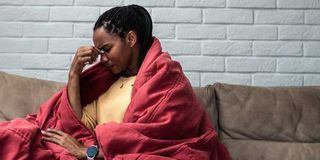
A domestic violence victim. In Kenya, domestic violence is prohibited under the Protection Against Domestic Violence Act, 2015.

What you need to know:
- Women across Kenya continue to face intimate partner violence, with poverty, controlling behaviour and social norms making it harder to escape.
- Despite laws against domestic violence, many survivors struggle to seek help because of poverty, fear, isolation and limited support.
Angel* is desperate. She has a question for me even before I explain why I am speaking to her. “Can you help me find land far away from Mt Elgon?” she asks, her voice heavy with desperation.
Angel has spent most of her life in a marriage she describes as hell. At 14, while in Class Seven, she says a man in his 20s, locally known in Bungoma County as a “killer”, forced her into marriage. That was in 2006. From the beginning, Angel says, violence became a constant part of her life.
A marriage under the shadow of a panga


She says he constantly threatened her with a panga, kicking, slapping, and hitting her with whatever was within reach. At times, she says, he threatened to cut her into pieces or kill her.
She has fled to her childhood home countless times, taking her six children with her. Yet before a night passes, she says, her husband comes looking for her, vowing to kill both her and her only surviving parent, her mother. Her father died years ago.
Eventually, her mother has told her not to return home for refuge and instead urged her to persevere in the marriage. He is part of the vigilante gang in Mt Elgon, killing and terrorising people,” she says, frightened.
“I never ask him for anything. If he sees me talking to a man, even if it is just to greet him or ask for a job, he will beat me. He always carries a panga and tells me he could kill me with it. I cannot report him. He will kill me.
Spousal violence prohibited
What Angel describes is intimate partner violence, also known as spousal or domestic violence. The United Nations defines it as a form of gender-based violence (GBV) involving physical, sexual, or psychological harm inflicted by a current or former partner or spouse.
For Angel, the violence has turned her marriage into a place of fear rather than a home. Bungoma is among the Kenyan counties with the highest reported prevalence of intimate-partner violence, alongside Embu, according to the Kenya Demographic and Health Survey (KDHS) 2022.
In Kenya, domestic violence is prohibited under the Protection Against Domestic Violence Act (2015). The law does not prescribe one blanket prison sentence or fine for domestic violence. Instead, the punishment depends on the specific offence committed and the applicable law, such as the Penal Code and the Sexual Offences Act (2006).
The law allows anyone who reasonably suspects that domestic violence is being committed, or has been committed, to report it to the police or another authority. It also provides for compensation. Where a victim suffers injury, property damage, or financial loss as a result of domestic violence, a court may order the perpetrator to pay compensation.
In deciding the amount, the court may consider the victim’s pain and suffering, medical costs, loss of earnings, and the value of property that was damaged or destroyed. It may also consider expenses incurred when a victim is forced to leave the shared home—including accommodation in a safe place or shelter, transport, moving costs, and the cost of setting up a separate household.
The court can further consider the financial circumstances of both parties and whether it is reasonable for the partner accused of the violence to contribute towards the costs.
The tough choice between survival and seeking help
Asked whether she knows there is a law that protects her from abuse, Angel says she has no knowledge of it. Even if she did, she adds, she would not know how to seek help when she struggles to feed herself and her children.
“How will I even go to the police station? What will I eat when I return from the police station?” she asks. “As I speak to you, of my six children, the three older ones have dropped out of school. We all go to the farm to do casual work to earn a living. The Sh100 to Sh150 we make a day is what we use to buy maize.”
She says her husband takes away even the little food she manages to buy. “When I buy three tins of maize and he finds them, he sells all without caring about what we will eat. I cannot ask him; otherwise, he will kill me. How will that law come here to help me?” she asks.
Painful pattern of controlling behaviour
Angel is trapped in a painful pattern of controlling behaviour — a form of intimate partner violence that the KDHS 2022 found to be widespread in Kenya, though its prevalence differs between women and men.
One in five women (20 per cent) said their current or most recent husband or intimate partner had displayed at least three controlling behaviours, compared with 28 per cent of men.
Jealousy or anger when a partner spoke to another man or woman was the most commonly reported behaviour, affecting 52 per cent of women and 64 per cent of men.
Four in 10 men (40 per cent) said their partner had wrongly accused them of being unfaithful, compared with 21 per cent of women. Meanwhile, 39 per cent of men said their partner insisted on knowing their whereabouts at all times, compared with 35 per cent of women.
Women suffer a heavier burden of violence
When it comes to violence, however, women reported a heavier burden overall. Four in 10 women (41 per cent) who had ever had a husband or intimate partner said they had experienced at least one form of economic, psychological or emotional, physical, or sexual violence from their current or most recent partner, compared with 36 per cent of men.
The consequences were also more severe for women: 51 per cent of women who had experienced physical or sexual violence sustained at least one specified injury, compared with 20 per cent of men. Yet, only 42 per cent of women and 29 per cent of men who had experienced physical or sexual violence said they had sought help.
What drives the violence
A 2025 review published through the US National Institutes of Health identifies several factors that contribute to intimate partner violence. In such environments of abuse, the researchers note, there is a struggle for power and control, with one partner using abusive behaviour to dominate the other and restrict their choices.
This can take psychological and emotional forms, including undermining a partner’s self-esteem, distorting their perception of reality through gaslighting, and cutting them off from friends, family, and other sources of support. Over time, these tactics increase dependence and make it harder for survivors to seek help, the researchers add.
Furthermore, they elaborate that traditional expectations about the roles of men and women can reinforce these power imbalances. In societies where men are expected to be dominant and women submissive, they note, such expectations can create an environment in which controlling or abusive behaviour is normalised.
The review also states that norms around masculinity can encourage some men to assert control over their partners as a way of demonstrating authority. There is also the influence of a history of abuse or trauma, which can shape later relationships. The review notes that people exposed to violence while growing up may come to see abusive behaviour as a normal way of dealing with conflict.
For some, the review notes, this can contribute to abusive behaviour in adulthood; for others, previous trauma can increase vulnerability to becoming a victim of intimate partner violence. However, there are cases where alcohol and drug use contribute to violence, the review states.
It explains that substance use can impair judgement and reduce inhibitions, potentially escalating conflict and aggressive behaviour. Similarly, it can worsen existing abuse by affecting a person’s ability to regulate their actions, communicate effectively, or empathise with their partner.
Financial pressure can also deepen existing power imbalances within relationships, the review says. Unemployment, debt, and poverty can increase stress and conflict, creating conditions in which abusive behaviour may escalate.
At the same time, economic dependence can make it harder for a survivor to leave an abusive relationship.
Isolation can further entrench abuse. The review says abusive partners may try to cut survivors off from friends, relatives, and other support networks by undermining their relationships, criticising loved ones, or restricting contact.
By weakening these support systems, the review adds, an abusive partner can make it more difficult for a survivor to seek help or leave a relationship.
Scars of the violence
Maria bears visible scars of violence. Maria, a reverend who ministered at a local church in Busia County, bears visible scars of violence. Last year, at their matrimonial home her husband, who served as a bishop at the same church assaulted her, accusing her of infidelity. He slapped, kicked, and punched her.
According to a National Police Service Medical Examination Report, Maria was treated at Busia County Referral Hospital for multiple injuries to her chest, lower abdomen, face, neck, and eye. The report also states that her husband pulled out clumps of her hair during the assault.
From the outside, their journey appeared to be one of shared faith, resilience, and success. Maria studied up to Form Two, while her husband completed Class Seven. They married in 1990 and had a church wedding in 2008. Their faith eventually became a shared ministry: together, they founded a church in Busia, with Maria serving as the reverend and her husband as the bishop.
The early years of their marriage were financially difficult. To make a living, the couple began selling shoes sourced from Kampala, Uganda. As the business grew, they opened two shops. They later closed the shops and established a mini-supermarket, which expanded into a retail business. Over time, the single outlet grew into a chain of seven shops in Busia, Nambale, Mumias, and Sabatia.
“We bought property together. We built our home together. We operated a joint bank account, and we even purchased 36 vehicles as co-owners,” she recalls. “But then, he changed. He became someone I didn’t recognise.”
What began as emotional abuse, she says, later escalated into physical and psychological abuse. Yet Maria stayed, praying that her husband would return to the man she once knew.
As a spiritual leader, she feared that leaving would undermine the faith of their congregants and send the wrong message about marriage. She endured the abuse in silence, protecting not only her husband’s image but also the ministry they had built together.
“Now, he has cut me off from everything. I have nothing to my name, yet I gave my all to build what we had,” said Maria, who is now living with her brother. “All I want is justice.”
Voices of desperation across Kenya
It is a call for justice that the voices of abused women across Kenya are raising in desperation. In Embu and Bungoma, women are most exposed to intimate partner violence. Nearly half of those surveye (48 per cent) said they had experienced violence from a current or former husband or intimate partner in the previous year, according to 2022 data from the Kenya National Bureau of Statistics.
In Migori, 47 per cent of women reported the same, followed by 43 per cent in Murang’a, 42 per cent in Tana River, and 41 per cent in Kisii. In Homa Bay and Samburu, the figure was 40 per cent. Put simply, these are counties where four to five in every 10 women surveyed said they had experienced intimate-partner violence in the previous year.
A second group of counties recorded a prevalence of between 31 and 39 per cent. They include Isiolo, Kisumu and Kirinyaga at 35 per cent, Kiambu at 34 per cent, Tharaka-Nithi and Lamu at 33 per cent, and Kakamega at 32 per cent.
Although lower than the worst-affected counties, the figures still mean that about one in three women reported experiencing intimate-partner violence during the year before the survey.
The lowest figures were reported in Garissa, Nyandarua and Taita-Taveta at 17 per cent, Mandera at 10 per cent, and Wajir, where nine per cent of women reported experiencing intimate-partner violence in the previous 12 months.
Why are some women more exposed to domestic violence than others?
Researchers analysing the 2022 KDHS found that intimate-partner violence follows clear geographical patterns rather than occurring randomly across Kenya. In their spatial analysis, published in the USA peer-reviewed Public Library of Science One journal in 2024, identified hotspots in parts of western and central Kenya and lower-prevalence clusters in parts of the north-east and coastal region.
The study found that several factors were associated with higher levels of physical intimate partner violence, including lower educational attainment, household poverty, controlling behaviour by partners, and attitudes that justify wife beating.
Women from poorer households were significantly more likely to experience violence than those from wealthier households, while higher education was linked to lower odds of abuse. The researchers caution, however, that these factors do not mean poverty or education alone explains county differences. Instead, they point to a combination of individual, household, and community conditions that shape women’s vulnerability to violence.
Government response
The government has taken some measures to address domestic violence. On December 9, 2024, at Bukhungu Stadium in Kakamega County, the Office of the Women’s Rights Advisor to the President launched a three-year initiative called Safe Homes, Safe Spaces.
During the official launch, the Prime Cabinet Secretary (PCS), who at the time was the acting Cabinet Secretary for Gender, indicated that training would include relevant stakeholders, such as boda boda operators.
A month earlier, President William Ruto had committed Sh100 million to the campaign. Before the year closed, PCS Mudavadi reminded Kenyans that femicide was an “elephant in the room,” having claimed the lives of 100 women in just four months, from August to November of the same year.
He also informed the nation that the Inspector General of Police had formed a specialised missing persons unit within the Directorate of Criminal Investigations’ homicide unit to address cases of femicide. However, these actions were taken only after anti-femicide campaigners marched in January and December, calling for an “End Femicide Now”.
While these interventions are not explicitly aimed at domestic violence, which encompasses violence against both women and men, their outcomes directly affect its prevalence. According to UN Women, femicide is often considered the extreme outcome of domestic violence.
Lessons from Spain
Spain is one country that has taken stronger measures to address domestic violence. Going by the United Nations Statistics Division data, Spain has the lowest number of women who have been subjected to physical or sexual violence in the last 12 months.
The country’s Ministry of Equality 2019 macro-survey on violence against women revealed that 1.8 per cent of women aged 16 years and over had been victims of physical and/or sexual violence from a current or former partner in the last 12 months. And over a lifetime, 14.2 per cent had suffered the same.
It is often quoted for taking the lead in fighting domestic violence owing to the fact that it became the first country in Europe to pass laws specific to address gender violence. On December 28, 2004, the Spanish government passed the Organic Act on Integrated Protection Measures against Gender Violence. An important highlight in this law is the use of the education system to instil values of respect for humanity.
The law makes it clear that children from the pre-school level are introduced to conflict-solving skills, which are further advanced at the primary level. By the end of school, they are knowledgeable on the peaceful solution of conflicts and defending sexual equality.
This is missing in Kenya’s Protection against Domestic Violence Act (2015), which gives power to the court to direct parties involved in the domestic violence to go for counselling or mediation.
Collective effort in ending domestic violence
Meanwhile, the President’s Women’s Rights Adviser, Harriet Chiggai, called for greater action to tackle GBV, saying the problem must be addressed within homes, families, and communities rather than left to government alone.
Speaking at the Women Achievers Conference and Awards 2026, held in Nairobi on July 28, 2026, and hosted by her office, she said she was tired of repeatedly discussing GBV and femicide without seeing enough action to address the problem.
“I am tired of talking about GBV. I am tired of crying with women who have been abused. I am tired of discussing femicide,” she said.
She said the country needed to move beyond discussions in boardrooms and act against violence. “GBV is happening in our houses. The data tells me that three out of every four women have been abused,” she said.
She questioned why the government was often blamed for GBV when much of the violence occurs within families and intimate relationships. “Why are you shouting at the government all the time? Yet these things are in our homes, and we have refused to talk about them?” she asked.
She urged Kenyans to take collective responsibility for tackling GBV instead of waiting for the government and organisations to intervene. “Can we all step up and do that which needs to be done?” she said.
A way out
For Angel, stepping up means helping her escape a life she no longer wants to endure for another moment.
“Please, the only thing I am asking for is a piece of land and some money far away from this place. He has told me that wherever I run to, he will find me. Please help me.”
That is all she is asking for: a way out.
*Names have been changed to protect survivors' identities and prevent further harm.


