A parliamentary committee wants the Ministry of Interior to enforce a strict nationwide crackdown on the Lesbians, Bisexuals, Transgender and Queer (LGBTQ) in a decisive blow to their rights that potentially dares the 2023 Supreme Court’s landmark ruling.
In what appears to defy the growing international pressure for inclusion of the LGBTQ community, the National Assembly Committee on Public Petitions, in a report to the House, rejected appeals for leniency, recommending that the Interior ministry immediately deploy the full force of the law to contain what it calls unnatural sexual acts.
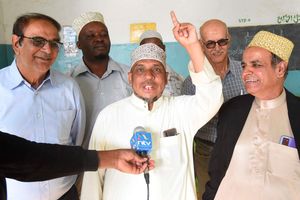
This follows a petition by Nyali MP Mohamed Ali presented to the House on February 21, 2024 “on behalf of the citizens of Kenya” representing the Christian and Muslim religious leaders and organisations, NGOs and individuals.
Nyali MP Mohammed Ali.
Photo credit: File | Nation Media Group
In arriving at its recommendations, the committee chaired by Runyenjes MP Muchangi Karemba cited Article 45 (2) of the Constitution and sections 162, 163 and 165 of the Penal Code that it wants the Ministry of Interior to use against same-sex relationships across Kenya.
Although the committee’s report is yet to be debated and adopted by the House, its directive nonetheless sets the stage for a high-stakes standoff between state enforcement agencies and human rights advocates fighting the reincarnation of a hostile legal landscape against the LGBTQ.
“The committee recommends that the Ministry of Interior and National Administration strictly enforces the law as is,” the committee recommends.
The committee made its recommendations following engagements with the petitioner, Ministry of Education, Ministry of Interior, Kenya Human Rights Commission, Pema Kenya, Human is My Identity Alliance, Glack+, Amnesty International Kenya, Kenya Law Reform Commission and Coalition for Grassroots and Human Right Defenders Kenya.
Section 162 of the Penal Code criminalises "carnal knowledge against the order of nature," including same-sex acts and bestiality.
Classified as a felony, a conviction carries a severe penalty of up to 14 years in prison.
Section 163 of the Penal code states that any person who attempts to commit “any of the offences specified in section 162,” is guilty of a felony and is liable to imprisonment for seven years.
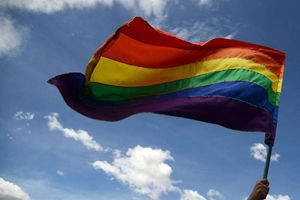
The LGBTQ flag.
Photo credit: Raul Arboleda | AFP
Section 165 of the Penal Code criminalises acts of "gross indecency" between males in public or private spaces and outlaws procuring or attempting to procure such acts.
Conviction carries a felony charge punishable by up to five years in prison. But the committee, in its report to the House, was of a different opinion.
The Nyali MP had asked the committee to ensure the Interior ministry strictly enforces the provisions of the Penal Code.
But even as the committee made its recommendations, a standoff with the Ministry of Interior is already emerging over whether sections 162, 163 and 165 of the Penal Code are constitutional following the February 2023 Supreme Court judgment.
“The Supreme Court declared these sections discriminatory and hence unconstitutional,” the Ministry of Interior stated in its memorandum to the Muchangi Karemba-led committee.
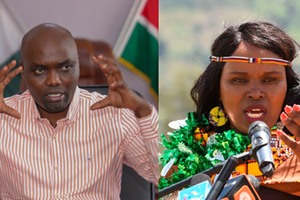
National Assembly Public Petitions Committee chairperson Karemba Muchangi.
Photo credit: Dennis Onsongo | Nation Media Group
“To date, the judgment has not been reviewed or set aside. It has the force of all and is binding upon the government. The Ministry of Interior and National Administration cannot therefore enforce the sections declared unconstitutional,” the Interior Ministry stated.
But the committee noted that its interpretation of the Supreme Court judgment is that sections 162, 163 and 165 of the Penal Code “were not rendered unconstitutional but rather, they could not be used to limit freedom of association.”
“The committee therefore observes that the court ruling allowing the registration of an association does not and cannot impeach either Article 45 (2) of the Constitution nor sections 162, 163 and 165 of the Penal Code, and does not in any way open the doors to legalize same sex unions.”
The committee based its findings on Article 45 (2) of the Constitution, which states that “every adult has the right to marry a person of the opposite sex.”
“Promotion of activities that are contrary to Article 45 (2) therefore ought to be disallowed,” reads the committee’s report.
The committee noted that any person seeking registration of any association “ought to clearly demonstrate that the association's activities do not intend to violate this provision of the Constitution.”
On February 24, 2023, the Supreme Court upheld the right of the National Gay and Lesbian Human Rights Commission (NGLHRC) to register under the Kenya NGOs Coordinating Board.
Supporters of the LGBTQ+ community at the High Court on Friday, May 24, 2019.
Photo credit: Dennis Onsongo | Nation Media Group
In a majority decision, the Supreme Court ruled that the NGO Coordination Board’s refusal to register the NGLHRC based on sexual orientation was unconstitutional.
The judges affirmed that the constitutional right to freedom of association and protection from discrimination applies to all Kenyans, regardless of their sexual orientation.
The Supreme Court later solidified this decision on September 12, 2023, when it dismissed a challenge by Homa Bay Town MP George Kaluma seeking to overturn the February 24, 2023 verdict.
Although the committee states that the petition before the committee was presented before the Supreme Court ruling, annexes to the report show that the petition was presented on February 21, 2024, way after the Supreme Court judgment.
The petitioner, in his pleadings before the committee, also goes on to recognise the fact that the Supreme Court “overstretched its mandate in holding that the right to equality before the law would not be advanced if people were denied the right not to be discriminated against based on their sexual orientation.”
Currently, no official data or statistics exist regarding the number of LGBTQ individuals in Kenya, as the practice is largely concealed and conducted in secrecy.
However, some LGBTQ members have publicly identified themselves on social media, even as the petitioner expressed concerns, claiming that the culture was foreign and aimed at enticing people to engage in what they considered unnatural practices.
The petitioner noted that the LGBTQ community is often associated with the use of rainbow colours and that certain mannerisms, including specific signs, dressing, body language and behaviour in public spaces, were indicators.
The Nyali MP had also wanted the committee to investigate the possibility of approved curriculum or content by the Ministry of Education, through the Kenya Institute of Curriculum Development, regarding LGBTQ.
“The committee found no such approved curricula and recommends that the Ministry of Education, through the Kenya Institute of Curriculum Development, ensures all educational curricula uphold Article 45 (2) of the Constitution,” the committee’s report reads.
The Nyali MP also requested the committee to recommend consideration and fast-tracking of the Family Protection Bill 2023 into law.
However, the committee noted that this was the preserve of the House Business Committee and the sponsor of the legislative proposal.
The committee observed that human sexuality education in schools “is structured not merely as sex education,” but as a broader developmental framework that supports learners in understanding, accepting and appreciating their sexual identity.
“It promotes values such as abstinence, self-respect and protection from risky behaviour, and not LGBTQ content.”
“From the foregoing, LGBTQ agenda in so far as the family unit is concerned, could therefore not be allowed to infiltrate the country's education curriculum as the family unit that learners ought to be taught is headed by parents, who could only be persons of the opposite sex.”
Over the past decade, the LGBTQ community members and representatives have consistently made efforts to challenge in various courts laws that prohibit homosexuality and other acts deemed unnatural.
According to the petitioner, these “meticulously planned and financially supported endeavours” are also prevalent in numerous African countries, such as Uganda, Botswana, Zimbabwe, Namibia and others.