Widows who refuse to surrender: Rural women reclaim their land rights
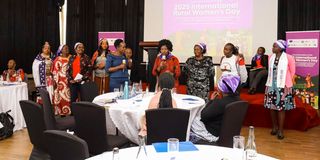
Rural women share their testimonies on October 9, 2025, at a Nairobi hotel during a gathering ahead of the International Day of Rural Women, observed annually on October 15.

What you need to know:
- Kenyan widows face brutal battles with in-laws trying to seize their land after their husbands die.
- Regina Mwaura lost 500kg of tea to intimidation but won her succession case and now helps other widows navigate the process.
When her husband died in 2013, Regina Mwaura was left with nothing but grief, small children, and a piece of land that would soon become the centre of a bitter battle.
"The in-laws wanted me out," said Regina, from Murang'a County, during a gathering of rural women at a pre-commemoration event for the International Day of Rural Women, held in Nairobi on October 8–9, 2025. The day is observed annually on October 15. It was convened by the Food and Agriculture Organisation in partnership with multiple state and non-state entities.
"But I told myself, I must remain a warrior for my children."


Her fight began in 2015 when she joined Grassroots Organisations Operating Together in Sisterhood (Groots) Kenya, a movement empowering women to claim their rights and participate in community land mapping. Murang'a County was then conducting a public land mapping exercise, and Regina volunteered to help create an inventory that was later handed over to the county government.
Also read: Siaya breaks silence on widow abuse
But even this act of community service invited hostility.
"One morning, I woke up early to go for the mapping, only to find the gate locked with a big padlock," she recalled. "My neighbours didn't want me to go. They said, 'Why is this woman leaving so early?' That day, I cried. I lost a full day's work."
The harassment didn't stop there. Tea pickers she employed on her small farm would suddenly quit after being intimidated by her in-laws. "I lost 500 kilos of tea in a month," she said. "They wanted me to give up."
But Regina refused to surrender. Encouraged by Groots' mentors, she sought help from the local chief to begin the succession process, a legal procedure for transferring property ownership. The first attempt was humiliating.
"The chief said my documents were shabby," she said. "He didn't even guide me. I almost gave up."
Her turning point came in 2019 during widows' training organised by Groots Kenya.
"There were about 40 widows," she recalled. "I couldn't even speak at first. I cried. But that was where I learned how to heal and how to fight."
Gazette notice
From the training, she learned how to compile her late husband's assets, submit them to the chief, and take the matter to court. "Three months later, my name was published in the Kenya Gazette," she said, smiling. "I finally got the confirmation of grant — the proof that the land was legally mine."
Today, Regina not only farms her land freely but also helps other widows in her village to do the same. One woman she assisted was told by a chief to bring Sh50,000 to start the succession process. "I told her no, you don't need to pay," Regina said proudly. "I took her through the process, and now she too has her Kenya Gazette notice."
In Kakamega County, Roselida Mukhwana, who sits on the Navakholo Sub-county Land Control Board, said men appearing before them for land transactions or succession cases often mention only their sons. In polygamous families, they tend to name only one wife.
"So I usually insist that they go back and list all the children and wives," she said. "Through that, I have helped 14 women become legally entitled landowners with title deeds."
She noted the desperation of some widows, saying many are tempted to give in to chiefs' sexual advances in the hope that doing so would help them secure their land and property.
"The helpless widows, most of them with little education, are made to believe that if they accept the chiefs' sexual advances, their succession problems will be solved. Do not give in," she cautioned. "Instead, reach out to the women in grassroots groups monitoring violations against widows, and you will be helped."
In Lari, Kiambu County, women, too, are ensuring that those disinheriting widows find no peace.
Gachambi Njuki, a member of a community-based, women-led "watchdog" group, said their mission is to intervene swiftly when a husband dies to protect the widow from losing everything.
"We go there, camp there, and make sure she cries with one eye while the other remains alert — otherwise you'll stop crying when everything has been taken," she said. "We have saved many widows from the misery of having their property documents taken away during mourning, and we are happy that several have now completed the succession process successfully."
However, Gachambi noted that the biggest challenge in helping women reclaim and protect their land is the lack of marriage registration.
"I urge all married women to register their marriages — even if it's customary, make sure it's recognised," she said. "Women are disowned when their husbands die, and when your marriage isn't registered, that battle for land will really make you cry."

Kabale Tache, CEO of the National Land Commission, speaks on October 8, 2025, at a Nairobi hotel ahead of the International Day of Rural Women, marked on October 15.
Kabale Tache, the Chief Executive Officer of the National Land Commission, noted that while constitutional provisions have advanced women's land rights, practical challenges persist.
"Even when the land belongs to the man, the woman is the host of the home," she said. "We've seen cases where the man wants compensation money paid into his account, but the woman resists because she built that home. Such disputes force us to intervene before proceeding."
The Commission, she added, continues to collaborate with the Judiciary and the Council of Governors to align customary land practices with the principles of equality and inclusion.
"Through Alternative Justice Systems, we have seen more women getting access to justice without the heavy cost of hiring lawyers," she said.
The women concluded the pre-commemoration with a call to President William Ruto to direct local administrators to support women in succession battles and to act as ambassadors for women's land justice.
They also appealed for the more than 50 laws and regulations governing land to be simplified and translated into local languages to help rural women understand their rights and procedures clearly.


