Hello

Your subscription is almost coming to an end. Don’t miss out on the great content on Nation.Africa

Ready to continue your informative journey with us?

Hello

Your premium access has ended, but the best of Nation.Africa is still within reach. Renew now to unlock exclusive stories and in-depth features.

Reclaim your full access. Click below to renew.

Milk
Caption for the landscape image:

Got milk? Not in Kenya, here's why

Scroll down to read the article

An attendant sorts various milk brands at Chieni Supermarkets in Nyeri town.

Photo credit: Joseph Kanyi | Nation Media Group

Kenyan consumers are feeling the pinch as popular milk brands disappear from supermarket shelves across the country due to the dry weather. 

As a result, the intermittent milk shortages have pushed up prices because processors are receiving less raw milk.
The shortages are being reported as formal-sector milk intake weakened in the first half of 2026, falling 0.6 per cent to 513.32 million litres down from 516.34 million litres, according to official data from the Kenya National Bureau of Statistics (KNBS).

The decline has tightened supplies available to processors at a time when dry conditions have reduced milk production in parts of Kenya, limiting an important source of supply.

The shortage is also occurring alongside wider food-price pressures, making milk more costly for households already adjusting to higher prices for basic food items. 

A spot check at the Naivas branch on Moi Avenue in Nairobi on Monday found only three lesser known brands on the shelves. Brookside, Mt Kenya, New KCC and Tuzo brands were missing.

Mr Willy Kimani, the founder of Jaza Retail, said reports from processors point to a shortage of fresh milk that is affecting deliveries to retailers and limiting the ability to maintain normal stocks.

“Our suppliers have informed us that the milk shortage is due to changes in the weather. They have told us that the situation will not improve until October at the earliest,” Mr Kimani said.

The shortage has hit consumers hard, with a shopper reporting that a Naivas outlet in Nairobi’s Donholm restricted purchases to five packets last Friday.

The shopper said that the cost of a packet of milk had climbed to Sh75 from Sh60, representing a 25 per cent increase.

Top New KCC executives were on Monday locked in a crisis meeting with major milk producers and suppliers from Eldoret as a worsening milk supply — triggered by drought and rising animal feed prices — raises concern among consumers in the North Rift region.

The closed-door talks came as milk production in the region continued to fall, with farmers struggling to sustain their herds amid a prolonged dry spell and a shortage of commercial feeds.

Milk

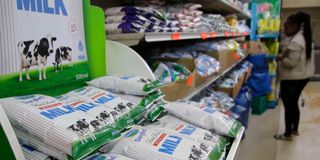
A shopper carries a basket with milk at Naivas Lifestyle in Nairobi.

Photo credit: Billy Ogada | Nation Media Group

“We are in a high-level strategy meeting with directors from Nairobi to address the falling production levels and the resulting supply disruptions to New KCC in this region,” a senior company official, who requested anonymity because he was not authorised to speak to the press, said.

A spot-check across major retail outlets in the North Rift region found New KCC-branded milk missing from some shelves, while competing brands such as Tuzo, Molo and Brookside were available but in limited quantity.

Mr Daniel Too, a director at a local dairy cooperative that supplies milk to New KCC, said that the region was experiencing a severe drop in production.

“Production of milk is very low. This has been caused by multiple factors, key among them the ongoing drought and the high cost of feeds, which many farmers can no longer afford,” he said.

Mr Too warned that the poor milk supply was already affecting major urban centres.

In Lodwar, Turkana County, consumers cannot find popular brands of milk in stores for days now.

At Kilimanjaro Supermarket and Batim Grocery — well-known retail outlets along Lorugum Road in Lodwar — the 200ml and 500ml packets of New KCC fresh milk were not available.

At Batim Grocery, Lato fresh milk and the 200ml Brookside fresh milk were also out of stock.

Lodwar resident, Ms Sharon Abei, was forced to switch brands because of her two children who take New KCC milk after school each evening.

“I had no option but to choose between the two available options of Zito and Fresha milk. A box with 21 milk packets of 200ml each retails at Sh650,” Ms Abei said.

A box of 500ml Brookside milk was retailing at Sh850, while Royal milk cost Sh730.

Retailers said that they are uncertain about when the popular brands of milk would be restocked.

At the same time, supermarkets and retail shops across the region have raised prices, with one supermarket manager saying the cost of a packet of milk had increased by between Sh5 and Sh10 because of higher wholesale prices and scarcity.

“We have been forced to increase the price of milk by between Sh5 and Sh10 per packet to match the higher wholesale costs and persistent market scarcity,” the manager said.

The development comes as the dairy industry enters a period when milk supply is dwindling as a result of insufficient pasture and water, particularly in livestock-dependent areas.

Famine Early Warning Systems Network (FEWS NET), a food-security monitoring and analysis network, has warned that seasonal dryness and above-average temperatures through September will reduce pasture and water, lowering livestock body condition and milk production.

The food security monitor had projected livestock migration to increase from August as households and animals move towards areas with better grazing fields and water supply. This is expected to further reduce milk availability and sales income.

“Pastoral areas are expected to remain in crisis through September. Conditions will improve to stressed between October and January, except in Mandera where crisis outcomes will persist due to slow recovery from the failed 2025 short rains,” FEWS NET said in the July warning.

“Livestock body conditions and milk production will decline, reducing household milk availability and sales income and driving consumption gaps and unsustainable coping.”

Milk shortage has historically exposed weaknesses in Kenya’s dairy supply chain, with processors alternating between inadequate milk during dry periods and excess production when rains improve pasture conditions.

Milk

An attendant sorts various milk brands at Chieni Supermarkets in Nyeri town.

Photo credit: Joseph Kanyi | Nation Media Group

The current supply squeeze is also emerging as the government seeks to strengthen dairy production and formalise more of the milk market.

The government has previously considered measures including strategic milk reserves to check seasonal fluctuations, but the industry has continued to experience recurring shortages during dry periods.

With an approximated 1.8 million smallholder farmers who make up around 80 per cent of the producers, it is estimated that about 80 per cent of Kenya’s milk is marketed informally.

The Kenya Dairy Board estimates production—including formally and informally marketed milk—is about 5.2 billion litres annually.

In its 2024-2027 strategic plan, the board aims to grow Kenya’s production to 11 billion litres annually within the next two years and, in the process, increase exports to one billion litres.

In Central Kenya, Milk processors said cows were producing lower volumes due to a lack of enough fodder. In Nyeri, Kirinyaga and Embu counties, a spot -check established that a packet of half a litre of milk was retailing at Sh48 up from Sh44.

“Farmers are not getting enough fodder. The drought affected mainly maize which did not mature properly this season, resulting to scarce feed for animals. Maize is normally used for making silage which we usually rely on for zero-grazing,” Mr Muhika Mutahi, founder and chairman of Wakukima Mukurwe-ini Dairy that processes Royal Fresh milk brand, said.

The processor, based in Nyeri County, has scaled down its daily production from 80,000 litres to 60,000. He said they expected the situation to continue for some time until the weather conditions improve.

Scramble for limited stock

In parts of the Coast region, the price of a 500ml packet of milk has risen to Sh75 from Sh60 as consumers scramble for limited stock in various supermarkets.

A spot-check at shops and supermarkets in Mombasa found reduced stocks of packaged milk, with some retailers reporting increased demand and difficulty maintaining supplies.

At A-One Supermarket, dozens of shoppers were seen purchasing milk in bulk, with some consumers expressing fears that the shortage could worsen.

Retailers said demand had increased as consumers responded to reports of reduced supplies, with some shoppers buying more than their usual quantities to stock up their pantries.

“We are receiving less milk than we normally do, yet customers are buying more. Some people are coming in and buying several packets at once because they fear it may run out,” Ms Jecinta Juma, a retailer in Mikindani, said.

At several Naivas supermarkets in the county, major milk brands were missing from the shelves, while some of the few brands available were only in 250ml packets.

Residents said that they started noticing changes in supply from late July, and the situation seems to be worsening.

A similar situation was witnessed in Nyanza and Western Kenya region, where vendors have raised concerns over the rising cost of milk, with the squeeze threatening to eat into their already narrow profit margins.

Ms Quinter Akoth, a trader at Homa Bay Municipal Market, said she used to buy a carton of milk for Sh620 before the crisis began. Each carton contains 12 packets of 500 millilitres.

Over time, however, the price rose to Sh750, leaving traders with little room to manoeuvre.

In the neighbouring Kisii Town, a similar experience has been reported. Some shoppers said they were being forced to switch to whatever brands were available, while others had to go without milk when stocks ran out.

Retailers said that there was reduced supply from processors and distributors, with deliveries becoming smaller and less frequent.

“We do not know what has caused this, but we suspect it is low production and the high cost of feeds. We have not been receiving full orders in the last one week, with deliveries coming in small quantities,” said an attendant at Unique Supermarket who did not want his name to be published.

Traders warned that the price of milk could rise beyond Sh72 if the shortage persists.

In Kisumu, however, there was no shortage of milk in major supermarkets across the city. 

Supermarkets including Naivas, Carrefour, Khetia’s and Quickmart had milk stocked on their shelves, with some 500ml packets retailing from as low as Sh55.

The situation was, however, different in many neighbourhood retail shops, where the same quantity was selling for about Sh80. Ms Dina Anyango, a shopkeeper, said limited supplies from wholesalers had forced small-scale traders to increase prices. 

Reporting by Kabui Mwangi, Titus Ominde, Sammy Lutta, Gitonga Marete, George Munene, Winnie Atieno, George Odiwuor, Wycliffe Nyaberi and Domnic Ombok


Follow our WhatsApp channel for breaking news updates and more stories like this.