Beneath the mist-covered hills of Kenya’s Rift Valley, where the red earth becomes slippery in the rain, and the grass is bitten by frost in the early morning, dairy farmers in Ainabkoi are quietly rewriting a story that once seemed destined for failure.
This revival is not fuelled by miracle funding or overnight success, but by practical reforms, technology and the steady rebuilding of trust between farmers and their cooperative.
Not long ago, the Ainabkoi Farmers’ Cooperative Society, one of Kenya’s oldest dairy Saccos, was on the brink of collapse.
Founded in 1963, it had served smallholder farmers across Uasin Gishu and neighbouring counties for decades.
But by 2020, its future looked bleak. Membership was shrinking, and milk volumes had fallen to just 1,300 litres a day from around 300 farmers. Many producers had lost faith in the effectiveness of collective farming.
"Farmers were leaving almost every month. The biggest challenge was marketing. Prices were poor, and farmers felt trapped because we were selling to only one buyer," recalls Stephen Tirop, the cooperative’s CEO.
At the time, Ainabkoi sold all its milk to New Kenya Cooperative Creameries (New KCC), which left farmers with little negotiating power.
Low volumes meant weak bargaining strength, and the low prices further discouraged production. It was a vicious cycle.
The cooperative boss also says that milk collection itself was another major problem. In many villages, farmers relied on ox-drawn carts or donkeys to transport milk to collection centres. Only a handful owned motorbikes.
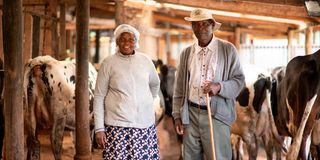
Magdalene Buigut and her husband, Kipkosgei Buigut, dairy farmers and members of Ainabkoi Dairy Cooperative Society, at their farm in Uasin Gishu County on May 29, 2025.
Photo credit: Pool
“We realised that not all the milk was being collected,” says Tirop. "The capacity of oxen and donkeys is limited, and transporting milk during the rainy season was nearly impossible."
Much of the milk had spoiled by the time it reached the cooperative. Even when it did arrive, Ainabkoi found it difficult to process.
Running milk coolers was expensive, and the Sacco lacked the trained personnel needed to manage the processing. Consequently, most milk was sold unpasteurised, which limited income opportunities.
Social and cultural dynamics also played a role. Although women did most of the day-to-day dairy work, such as feeding the cows, milking them and cleaning the sheds, they were largely excluded from earning money from milk sales.
“In our community, morning milk was considered men’s milk,” explains Tirop, adding, “That was the milk delivered to the cooperative. Milk produced in the afternoon and evening, which was mostly managed by women, rarely reached the market."
By 2020, morale among farmers was low, and the survival of the cooperative was uncertain.
When Mr Tirop was appointed CEO that year, he walked into a deeply troubled institution. Membership was dwindling, finances were weak, and trust between farmers and management had eroded.
"The odds were stacked against us," he says, "but we knew that if we addressed the root causes, the cooperative could be revived."
With strategic support from Heifer International, Tirop’s first move was to listen. The Sacco conducted a customer survey to understand why farmers were abandoning it.
“It became clear that low milk volumes were driving down prices. And low prices were pushing farmers away," he states.
The solution was straightforward yet challenging: increase milk volumes, improve quality, strengthen governance, and rebuild farmer confidence. Ultimately, this would encourage them.
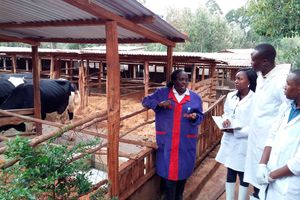
With Heifer’s backing, Ainabkoi set up an extension services department to organise farmers and provide training.
Extension officers began working directly with farmers on establishing and managing fodder, on animal health and producing clean milk.
In an interview with Seeds of Gold, Tirop noted that the cooperative had started helping farmers to improve productivity at the farm level. “That is the foundation of everything,” he emphasised.
Meanwhile, Ainabkoi partnered with neighbouring cooperatives to pool milk and negotiate better prices with buyers. As volumes increased, so did their bargaining power.
The impact was swift. Milk deliveries rose from 1,300 litres a day in 2020 to 4,400 litres in 2021.
By 2024, the CEO noted that the cooperative was collecting 15,000 litres daily.
Today, that figure stands at over 20,000 litres from around 2,500 active farmers.
For the first time since its incorporation over six decades ago, Ainabkoi is paying dividends to its members.
Using funds from Heifer's Catalytic Fund for Small and Medium Enterprises in the dairy value chain, Ainabkoi purchased 10 motorbikes for transporting milk. Some farmers also invested in tricycles, locally known as 'tuk-tuks'.
The effect was immediate and measurable. Transport costs dropped from Sh2 per litre to zero. Milk losses fell sharply and farmers’ net incomes increased.
Perhaps most importantly of all, afternoon and evening milk could finally reach collection centres. This change opened the door for women farmers.
“With better transport, women could now sell the milk they produce. Once their milk reached the cooperative, they could register as members,” says Tirop.
Today, Ainabkoi’s payroll reflects this shift. Men account for 53 per cent of suppliers, while women make up 47 per cent. Monthly payouts have grown from a peak of Sh4 million in 2021 to approximately Sh25 million today.
Much of the milk supplied by women is used to add value, particularly in the production of mursik, a traditional fermented milk drink.