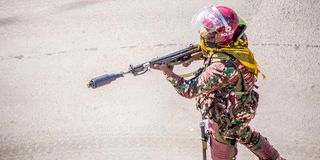
Two activists and a rights group have sued the government for allegedly shielding rogue law enforcement officers from being held accountable for their actions, such as violations of human rights, and perpetrating police brutality.
Mr John Wangai and Mr Peter Agoro, together with the Operation Linda Jamii group, allege that the government is aiding these vices through the delayed implementation of the National Coroners Service Act and the Prevention of Torture Act, which were enacted seven years ago.
In a petition filed at the High Court in Milimani, Nairobi, the petitioners claim that the delayed operationalisation of two statutes has contributed to the rising cases of police brutality and lack of accountability within the national security service.
They argue that the two laws, which were enacted in 2017, were intended to address the excesses of State security agencies and facilitate the investigation of violent deaths.
In addition that they were meant to ensure that perpetrators of torture, extrajudicial killings and enforced disappearances are held accountable.
Teacher Albert Ojwang who mysteriously died in a police cell.
Photo credit: Pool | Nation
According to the petitioners, the non-implementation of the laws requires judicial intervention since the delay has enabled police to escape accountability for their actions and has denied victims of police brutality justice.
They have named the Kenya National Commission on Human Rights (KNCHR), the Public Service Commission (PSC) and the Attorney General as respondents in the suit on behalf of the government.
“The failure of the respondents to operationalize the National Coroners Service Act, 2017, and the Prevention of Torture Act, 2017, has led to ongoing violations of the constitutional rights to life, human dignity, and freedom from torture, as guaranteed by the Constitution. This necessitates an urgent judicial intervention,” reads the petition backed by the civil society group Operation Linda Jamii.
The petition accuses the PSC and the Attorney General of failing to recommend and appoint the Chief Coroner, Coroners, and Deputy Coroners under the National Coroners Service Act, 2017. The failure has denied families of victims the right to truth and justice and perpetuated impunity.
“Kenyans have recently expressed concerns over their safety following the increased wave of mysterious disappearances and killings across the country. This points to a disturbing trend further exacerbated by a ballooning number of unresolved murder cases with calls to investigative agencies to take swift action and use all available forensic and investigative resources to apprehend perpetrators of these horrible crimes and bring them to justice,” reads the petition.
The petitioners believe that if the National Coroners Service Act were in force, a thorough and independent investigation would be happening within the State security agencies over the alleged violation of the rights of protesters.
This is because the Act establishes a legal framework for investigating deaths in the country, especially those involving suspicious, violent or unexplained circumstances.
“In the wake of the youth-led protests calling for accountability and transparency in government, it is worth noting that police officers were on the spot for using excessive force and wearing facemasks, making it difficult to identify them. Charges would have been preferred against them particularly in cases where they were alleged to have shot to death protesters,” argues the petitioners.
Face mask vendor Boniface Kariuki is rushed to hospital by protesters after he was shot by a police officer in Nairobi on June 17, 2025.
Photo credit: Billy Ogada | Nation
Lack of implementation of the Act, they say, has made it difficult to prosecute cases involving police killings, in turn denying justice for victims. This has also depressed public confidence and trust in the national criminal justice system.
The Act establishes a legal framework for investigating deaths in the country, especially those involving suspicious, violent or unexplained circumstances.
In addition, the Act establishes the National Coroners Council, for which the Coroner-General would serve as its secretary.
The service was supposed to streamline and coordinate its activities, with representatives from key government ministries, the Inspector-General of Police, the Director of Public Prosecution and at least two representatives nominated from the Kenya Medical Practitioners, Pharmacists and Dentists Union and the Clinical Officers’ Council.
“Whereas a total of 727 cases have been documented since 2007, only 26 of the total cases have resulted in prosecution of those believed responsible and fewer than 10 convictions obtained. Unfortunately, despite the legislation being in place, it remains non-operational because the responsible authority has not issued the necessary guidelines, rules, and regulations,” they claim.
In relation to the Prevention of Torture Act, they claim that the delayed implementation has enabled the abduction and torture of citizens by law enforcement officers in police custody.
“The Act now needs to be operationalized and implemented in practice in order to significantly prevent torture and other ill-treatment. Delays in addressing these violations exacerbate the emotional, psychological, and social suffering of victims and their families, erode public trust in the rule of law, and undermine constitutional principles,” says the petitioners.
The Act empowers victims to claim redress for all forms of inhumane treatment at the hands of the police and other state agents.
Josinter Anyango, holds a portrait of her 12-year-old son Kennedy Onyango, who was killed during anti-government protests in Rongai, during an interview at their home in Ongata Rongai on May 20, 2025.
Photo credit: Bonface Bogita | Nation Media Group
It also creates a Victims’ Trust Fund for compensation to enable families to rebuild and provide redress for the violations suffered.
In addition, it caters for victim and witness protection and support during criminal proceedings and also protects police and other law enforcement against illegal orders from their superiors.
The Act establishes offices such as the National Committee for the Prevention of Torture, which is responsible for overseeing the implementation of the Act, monitoring places of detention, and investigating allegations of torture.
The petition is pending hearing and determination by Justice Lawrence Mugambi and is scheduled for mention on September 25, 2025.