Hello

Your subscription is almost coming to an end. Don’t miss out on the great content on Nation.Africa

Ready to continue your informative journey with us?

Hello

Your premium access has ended, but the best of Nation.Africa is still within reach. Renew now to unlock exclusive stories and in-depth features.

Reclaim your full access. Click below to renew.

High Court halts construction of church at State House and State lodges

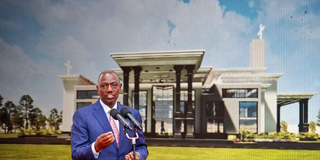
A third petition has been filed in court challenging President William Ruto's decision to build a church at State House.

Photo credit: Pool

The High Court has issued a temporary order stopping construction of a permanent church or any structure tied to a religious faith within the premises of State House, Nairobi.

The conservatory order also bars such construction in any of the country's State Lodges. 

 "A conservatory order is hereby issued restraining the government of Kenya, its officers and or anyone acting on its behalf from constructing a permanent church or building associated with any religious faith within the Grounds of State House, Nairobi or any other State House or State Lodges until November 18, 2025," said Justice Chacha Mwita.

The order followed an application by four civil society groups -Transparency International Kenya, Kenya Human Rights Commission, Inuka Kenya ni Sisi and The Institute of Social Accountability -who sued, challenging President William Ruto's decision to construct a Sh1.2 billion church at State House, Nairobi.

"Upon considering the pleadings and the grounds of urgency, I am satisfied that the application and petition raise fundamental constitutional and legal questions touching on State and religion which require urgent investigation and further consideration by the court," said Justice Mwita.

He directed the petitioners to furnish the Attorney General with the court papers so that she can file a response to their complaints regarding the church project.

While asking for the conservatory order, the petitioners told the court that they were apprehensive the project may be completed soon and defeat the substance of their case.

They argued that “the general public will continue to suffer irreparable harm and violation of constitutional rights and values”.

“The President of the Republic of Kenya has, through public statements and government action, confirmed his direct involvement in the construction of a church within State House Nairobi, a public institution and symbol of the Kenyan State,” said the groups lawyer Lempaa Suyuanka.

“The said project, even if allegedly funded through private contributions, involves the use of public land, facilities, and personnel and was undertaken without public participation or parliamentary oversight”.

The case came a month after two other petitions were filed by rights advocates Levi Munyeri and Dunstan Riziki, challenging legality of the said project.

Mr Munyeri and Mr Riziki had also applied for conservatory orders, which if granted would temporarily suspend the project until the court determines its constitutionality.

A common contention in the three petitions is that the construction of a Christian church within a public institution associated with the Office of the President directly contravenes Article 8 of the Constitution, which declares that there should be no State religion.

“By privileging Christianity through such state-linked infrastructure, the government risks entrenching religious favoritism, marginalizing other faiths or non-believers, and undermining the constitutional principle of religious neutrality,” contended the petitioners.

In the fresh case the four civil society groups have raised allegations of abuse of office, misuse of public resources, and erosion of public trust against the President as well as breach of various provisions of the Constitution and statutes.

Citing Article 10(2) of the Constitution, which mandates that the national values and principles of governance include participation of the people in the exercise of the powers of the State and in making decisions that affect them, the petitioners say the construction of the church at State House was not subjected to public participation.

“The Petitioners assert that the reported construction of a religious facility within State House, a public property held in trust by the President, was carried out without any form of public participation or consultation. This omission violates the constitutional principle of participatory governance,” maintained their lawyer Suyianka.

He also claimed breach of Article 27 of the Constitution, which guarantees every person equality and freedom from discrimination. Mr Lempaaa argues that the construction of a church within the State House violates this constitutional prohibition.

“Such discrimination threatens the rights of minority religious groups and individuals who do not adhere to any religion, thereby infringing their constitutional rights to freedom of conscience, belief, and equal treatment before the law,” he states.

Another claim is that the project breaches Article 32, which guarantees every person the right to freedom of conscience, religion, belief, and opinion.

It is his observation that the President’s decision infringes upon the rights of Kenyans who profess different religious beliefs or none at all, by signaling a form of state preference or alignment with a specific religion.