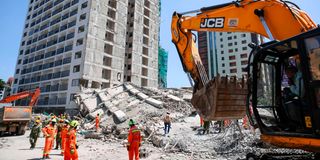
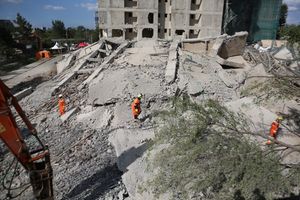
When a 14-storey building under construction collapsed in Nairobi’s South C on Friday morning, trapping at least two people, the disaster appeared sudden. But the warning signs had been visible for months, ignored by the agencies mandated to prevent such a catastrophe.
Multiple interviews, official records and past enforcement failures point to a deeper problem — a breakdown of construction oversight at Nairobi City County, compounded by inaction at the National Construction Authority (NCA), despite clear violations.
The collapse has reopened scrutiny of Nairobi’s deeply contested building approval process, which has been the subject of internal probes, assembly inquiries and whistle-blower claims.
Search and rescue operations by National Disaster Management Unit, Nairobi City County, the National Police Service and the Kenya Red Cross at the site of the collapsed building in South C, Nairobi.
Photo credit: Billy Ogada | Nation Media Group
Under Kenya’s construction oversight framework, responsibility for preventing such failures is split between county governments and NCA.
The county is the primary gatekeeper. Through its physical planning department, it is legally mandated to review and approve architectural and structural designs, ensure compliance with zoning rules and safety standards. Once approvals are granted, the county issues a building permit.
County governments are also required to conduct periodic inspections during construction to confirm that developments adhere to the approved designs. Where deviations occur—such as exceeding approved height limits—the law empowers county officers to issue enforcement notices, stop orders and, ultimately, to deny occupation certificates. The mandate rests solely on the chief officer for planning, currently Mr Patrick Analo.
Search and rescue operations by National Disaster Management Unit, Nairobi City County, the National Police Service and the Kenya Red Cross at the site of the collapsed building in South C, Nairobi.
Photo credit: Billy Ogada | Nation Media Group
When queried whether the county had acted against the contractor, Mr Analo said that the county unsuccessfully tried to stop the construction.
In February 2024, county enforcement officers attempting to halt an illegal construction on disputed land in South C were also attacked and injured.
No meaningful action followed. An assembly committee set up to investigate the matter and irregular approvals collapsed amid claims of intimidation and missing records.
Failed to stop construction
The inquiry had been prompted by mounting evidence that junior officers were approving building plans. Frederick Ochanda, the acting assistant director of development control, told the assembly’s planning committee that he had approved close to 600 applications without the knowledge of the county’s political or administrative leadership.
“The powers belong to the chief officer, but they were delegated to me through an appointment letter from the governor,” Mr Ochanda said.
But Mr Analo denied this, saying he neither held nor delegated access to the approval system.
The Architectural Association of Kenya (AAK) has on several occasions accused the county of deliberately undermining its own digital approval system, forcing a return to manual processes vulnerable to manipulation.
Bulldozers comb through the rubble of the collapsed multi-storey building in South C, Nairobi on January 3,2025.
Photo credit: Billy Ogada | Nation Media Group
The approval of construction is carried out by the Urban Planning Technical Committee made of representatives from AAK and the county government. Although the committee issues the approvals, Mr Ochanda was accused of giving a green-light to the construction of building despite the committee rejecting them.
NCA Director-General, Maurice Aketch, declined to explain why the authority failed to stop construction at the South C site despite non-compliance, instead directing us to a statement issued by Public Service Cabinet Secretary Geoffrey Ruku.
Mr Ruku said investigations were underway and that action would be taken against those involved in approving the building.
Cabinet Secretary for Public Service, Human Capital Development and Special Programmes Geoffrey Ruku addresses journalists at the site of the collapsed building in South C, Nairobi.
Photo credit: Billy Ogada | Nation Media Group
In a statement on Friday, Mr Aketch announced that the building was non-compliant, raising further questions on why then the construction was not stopped.
The South C Residents Association said the collapse was the outcome of sustained regulatory neglect. It noted that while workers and site agents are routinely arrested, developers, consultants, financiers and approving officials are rarely held accountable for such failures.
“This must be understood not as an isolated mishap, but as the culmination of enforcement failure,” the association said, citing ignored warnings over zoning, density and unsafe approvals.