In this final instalment of a three-part exclusive serialisation of Concert of Life: From the Lakeshore to the Boardroom, Francis Okomo Okello – a seasoned corporate leader and lawyer – revisits the exciting days of students’ activism and intellectual debates at Dar es Salaam University that forged the thinking of many prominent Kenyans.
University of Dar es Salaam (1971–1974): Growing up, I always dreamed of becoming a lawyer in the mould of my sister-in-law Nellie Akwiri Okello and Mr Zool Nimji. Zool was brother William’s advocate and friend. I first met Nimji in 1970 during a visit to his office at Shapley Barret & Co.
Advocates where he was a senior partner. Nimji had been retained by William to hold a watching brief on behalf of our family in criminal proceedings against Ondhoro Ogutu, who had killed our brother Samuel Ousa, during a scuffle arising from a land dispute in Masiwo village, adjacent to our ancestral home in Nyangera Daho. Ondhoro, the accused, got away with a manslaughter charge. I was quite impressed with Mr Nimji’s competence as an advocate, civility and immaculate attire. Later, Mr Nimji, as chairman of Diamond Trust of Kenya, would recruit me in 1975 as the bank’s Legal Executive and Company Secretary.
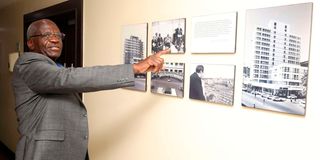
Francis Okomo Okello during a past interview
Photo credit: Bonface Bogita | Nation Media Group
I first learnt of my selection, to join the prestigious Faculty of Law at the University of Dar es Salaam (UoD), through an advertisement in the Daily Nation . We were 13 students from Kenya. The exciting news was re-confirmed by Prof Simeon Ominde, a friend to our brother William, who was at the time a member of the University Joint Admissions Board. As a Constituent College of the University of East Africa, University College Dar es Salaam, hosted the first Faculty of Law. Makerere University College hosted the School of Medicine and the University College of Nairobi hosted the School of Engineering.
I first travelled to Ubungo Hill, where UoD is situated, on an Overseas Trading Corporation (OTC) Bus in the evening hours of July 1, 1971. The bus terminus was along River Road, opposite Muthurwa Railway Staff Quarters. The students I met here for the first time were all en route to UoD to study law. Most of them would become lifetime friends and professional colleagues. The travelling party included Ambrose Rachier, Ndeto Mututo, Mutula Kilonzo, George Masese, Roch Odhiambo-Oburu, Ben Ciugu Mwagiru, Seth Chakava, Esther Ayany, Kiragu Ngibuini, Oyoo Orieyo, Mbuthi Gathenji and Absalom Onyango. There were also other non-law students such as Sally Kosgei, Lawrence Msaviru, Obumba Otongo, Odindo Akungu and Owiti Guya on the bus.
The OTC bus used to traverse East Africa, from Nairobi to Dar es Salaam and vice versa in two days – a gruelling journey that rendered our backsides numb and generated eye bags by the time the journey ended in Ubungo, Dar es Salaam or River Road, Nairobi. Even though Google Maps today shows the one-way distance at 817 kilometres, with the journey taking approximately 13 hours and 13 minutes, the condition of the road then made the journey longer and torturous.
On the way, we saw many towns we had only heard of, such as Sultan Hamud, Oloitokitok, Lushoto, Korogwe and Bagamoyo. We also started socialising as we got to know one another better. We were excited over what lay ahead of us and each individual’s professional ambitions. Our staple food during the road trip was roast maize, cassava, potato chips, rice and meat or chicken stew. During the journey, we quietly assessed one another in terms of possible academic ability and social compatibility for purposes of sharing hostels.
The University of Dar es Salaam is built on a beautiful campus on Ubungo Hill. It had what were at the time quite modern buildings and impressive learning facilities. Students enjoyed excellent meals, sporting facilities and comfortable residential halls. The Faculty of Law had highly qualified and dedicated teaching staff as well as overly competitive students. For instance, the 1974 Class to which I belonged, made history by breaking the psychological barrier when it produced the first ever student with First Class Honours in the Faculty of Law. That historical achievement was by Mutula Kilonzo. I grudgingly settled for a 2nd Class Honours, Upper Division. Even that 2nd Class Honours, Upper Division, was at the time a rare achievement only associated with such academic giants in the Faculty of Law as H W Okoth-Ogendo, Amos Wako, Wellington Perez Odero, Rautta Athiambo, Charles Mureithi, Richard Onyango-Ongeche and Farouk Muslim.
I failed to earn a First Class Honours because of not-so-impressive performance in the Laws of Contract, Administrative Laws and Laws of Tort, which incidentally were some of my favourite subjects. Mine was the price of over-confidence and complacency. We all acknowledged that Mutula Kilonzo had rightfully earned the distinction, which later, he never tired of reminding all and sundry about. He also unapologetically proclaimed this in his letterheads and business cards. It has to be said, though, that two years later, in the Class of 1976, Joseph Obado Adera (Kenya), R W Tenga (Tanzania) and David Wainaina Gachuhi (Kenya) also accomplished the same feat but with little or no fanfare or drama. Thereafter, achieving a First Class Honours at the Faculty of Law became normal.
Tenga and Gachuhi pursued careers in the academia as professors at the University of Dar es Salaam and University of Nairobi, respectively while Adera, after a stint as Chief Legal Officer & Company Secretary of Industrial Development Bank (IDB) (now IDB Capital) and Group Company Secretary of Barclays Bank of Kenya (now Absa Bank Kenya), went into private legal practice in Nairobi in the law firm of Adera & Company Advocates, which he co-owns with his wife, Advocate Grace Adera. In between his work in corporate Kenya, Adera successfully pursued an LLM degree in commercial law at the Harvard Law School between 1983 and 1984. Both Joe and his wonderful wife Grace Ruth Mayina Adera or Mama Biko, as we fondly refer to her, are godparents to our last born daughter, Catherine Genevieve Riako.
The University of Dar es Salaam was an intellectual cauldron and a hotbed of student politics. One of the most memorable experiences for me involved the battle for the soul of the Dar es Salaam University Students Organisation (DUSO) between Stanley Akivaga and Jenerali Ulimwengu.
Akivaga, a student from Kenya, was the DUSO president but had been expelled in 1970. As we arrived at UoD in July the next year, campus politics revolved around the expulsion of Akivaga, with the students staging riots demanding his unconditional return. Akivaga’s leadership had rubbed the University Administration, under Pius Msekwa, the Vice-Chancellor, the wrong way. During Akivaga’s absence from UoD, Jenerali Ulimwengu and his leadership wing tried unsuccessfully to fill the vacuum. Following incessant student riots, the university administration finally caved in and unconditionally re-admitted Akivaga, who resumed leadership of DUSO for a short time before completing his undergraduate studies in 1972/3.
As students, we used The University Echo, a monthly student publication, to exchange views on the topical public and international affairs of the day, and articulate issues affecting student life on campus. During my time (1972/73 and 1973/74), Rautta Athiambo was the Editor- in-Chief of Echo, while I was the Features Editor and Legal Advisor. Rita Riso, who later got married to Justice John Mwera, was the Production Editor. The National Union of Tanganyika Workers (NUTA) Press published our magazine using lithography technology. Typically, we would spend the night at the NUTA Press to ensure the magazine was put to bed. After printing, we would carry copies to campus for distribution the following morning.
An Autobiography by Francis Okomo Okello pictured on September 17, 2025.
Photo credit: Francis Nderitu | Nation Media Group
Meanwhile at the University of Nairobi, radical students under the leadership of Chelugat Mutai were publishing The Anvil, which had the same objectives as Echo. Equally popular at the time, was Cheche Magazine, produced by students and academics at UoD. Cheche leaned heavily on politics and was unapologetically Leftist. For instance, it radically critiqued such topical issues as ‘African Socialism’ as an ideology and practice of the then government in Tanzania.
In 1973, when Idi Amin’s Uganda was getting increasingly unhinged, I published a controversial article in The University Echo referencing the political developments within the East African region at the time as signalling the ‘death knell’ of the East African Cooperation (EAC). EAC was subsequently dissolved in 1977 due to irreconcilable personal and ideological differences among Presidents Jomo Kenyatta, Mwalimu Julius Nyerere and Idi Amin Dada. I was also a member of the Editorial Board Committee of Dar es Salaam University Law Journal between 1973 and 1974. With the benefit of hindsight, I can now say the seeds of my interest in media and communications, which would later lead to my engagement at the Nation Media Group, were planted, watered and sprouted at Kisii School, and bloomed at the University of Dar es Salaam.
If there is an attribute that marked out UoD at the time, it was the high profile public debates involving famous scholars as well as politicians and other public figures, some of them from outside Tanzania. One of my proudest moments came in 1973 when, after being nominated by the organisers, I moderated a public debate in the Dome (Nkrumah Hall) on Nationalism and Imperialism’ between Ali Mazrui and Walter Rodney. Why was this debate so important? In the context of the then prevailing Cold War politics, Prof Mazrui represented liberalism associated with the capitalist west while Dr Rodney, author of How Europe Underdeveloped Africa (1972) represented the radical wing associated with the Socialist East. Mazrui and Rodney were able and influential interlocutors from the two competing camps.
However, the contrast between the two intellectual giants went beyond ideological differences. While Mazrui spoke in a heavy baritone, Rodney had a shrill and sharp voice. In a tribute to Mazrui following his death on October 13, 2014, published in the Daily Nation of October 17, 2014, under the title, ‘A GREAT SON OF AFRICA: Mazrui’s story over the years has been one of impressive tenacity and stamina,’ the political scientist Mahmood Mamdani recalled the epic debate in the following words: Idi Amin’s expulsion of Asians pushed me out of Makerere and I took a job at the University of Dar es Salaam. There, I was a witness to non-barred debate between Mazrui, by now an icon of post-colonial liberalism, and Rodney, its most vociferous critic. No energy was spared. If words could produce fire, fires would have raged. What was an issue in the Mazrui – Rodney debate? The debate was about nationalism and imperialism. Immediately though, it was a debate over two issues: the role of imperialism and the relationship of intellectuals to nationalism (nationalists) in power. From today’s vantage point, we can say that in no way was the debate wasted energy.
Rodney emphasised dependency, and external constraints on nationalist power. Ali, in contrast highlighted the internal face of nationalism and its tendency to erode democracy. The debate had no clear winner or clear loser. And for precisely that reason, it did not end. It continued to rage inside Mazrui.
May I add here that while Rodney mesmerised the audience with cogent arguments and historical facts, Mazrui dazzled the audience with his eloquent, captivating, poetic and powerful oratory. It was quite an experience moderating the debate and watching at close range as the two academic giants tore into each other with razor-sharp intellect. Looking back, it seems ironical that as part of his illustrious career, in a twist of fate, Mazrui became the inaugural Walter Rodney Professor at the University of Guyana, Georgetown, Guyana in Rodney’s native land.
For those of us who believe in life hereafter, it may be reasonable to surmise that the two intellectual giants have continued their epic debate from where they left it on earth, albeit without human moderation. There could also have been an equally captivating debate in the Dome between Walter Rodney and Dr Mahmood Mamdani on a subject that I cannot clearly recall and could have been around ‘Re-positioning Africa in a Fast Changing Bipolar World’.
Such was the varied and enriching intellectual menu on which we were fed at the University of Dar es Salaam. However, my cohort did not benefit from the famous fireside conversations which Mwalimu Julius Nyerere, Tanzanian’s President and Chancellor of UoD, used to attend in the Dome. We heard stories, though, of how Mwalimu sneaked into campus to join the students’ debates as an ordinary participant. Another proud moment for me was the outcome of the 1973/74 Moot Court session. As part of our training, the faculty would organise highly competitive Moot Court Sessions each year. The sessions were aimed at honing our litigation skills in a court room environment. Participation in the sessions was compulsory for all law students. In our year, there were six competing law firms made up of four to six students. Students would be left to voluntarily team up depending on their abilities and willingness to work together. Our firm, 20th Century Advocates, included Manento, Sam Lemboko, Mlawa and yours truly.
Each member of a law firm was assigned specific tasks such as research, cross-examination of witnesses, preparation of pleadings, and making the submissions. The programme had retained Dr Kwesi Botchwey as the Moot Court’s Advisor. The panel of adjudicators comprised Mr Andrew Lyall (lecturer in Legal Methods & Systems), Mr Rembe and Mr Willy Mutunga (LLM student at the time). After fierce court battles, our firm, 20th Century Advocates, was declared the overall winner. The rankings were published in the Law Faculty announcement dated March 11, 1974. For our efforts I received, on behalf of the firm, a trophy award by the Dean of the Faculty of Law, Prof P L U Cross. In addition, we all received Certificates of Commendation at a ceremony held on or about March 17, 1974. Following these interactions, Mutunga and I became long-time friends. He later served as Kenya’s 13th Chief Justice and President of the Supreme Court of Kenya.
Nation Media Group Board Member Francis Okomo Okello during Nation Media Group’s Board dinner on September 19, 2024 at Serena Hotel in Nairobi.
Photo credit: Billy Ogada | Nation Media Group
Some of the outstanding students from the Class of 1974 include Peter Mzengo Pinda, who later became Prime Minister of Tanzania after a career in the civil service and Parliament; Mutula Kilonzo, lawyer and politician, who served as Kenya’s Minister for Justice and Constitutional Affairs; Chande Othman, who became the Chief Justice of Tanzania after working with the International Red Cross in Geneva and serving as a High Court judge in Tanzania; Madina Muro, a noted High Court judge in Tanzania; Ambrose Rachier, one of Kenya’s leading Conveyancing lawyers and a Sports Administrator; Roch Odhiambo Oburu, a successful lawyer; Costa Ricky Mahalu, who became the Vice-Chancellor of Saint Augustine University of Tanzania after a career in Tanzania’s diplomatic service and academia; Rita Sheikh, who was a High Court judge and a judge of the Court of Appeal in Tanzania; Esther Ayany, who served as Deputy Town Clerk in the Nairobi City Council; George Masese, a successful lawyer; Mbuthi Gathenji a successful lawyer; Josephine Kariuki, who became a successful corporate lawyer; Seth Chakava, Kiragu Ngibuini, Oyoo- Orieyo and Ndeto Mututo, all from Kenya and who became successful lawyers.
Other lecturers and students who impacted my life at UoD are: Dr Ondiek Okello, Dr Adhu Awiti, Dr Simon Odede, Rautta Athiambo, Arthur Eshiwani, Perez Wellington Odero, Farouk Muslim, Onyango Ongeche, John Mwera, Rossyln Omondo Otieno, Simon Mauncho, Tobias Muga Ongalo, Amanya Mushega, Charles Muriithi, John Ndungu, who has remained an all-weather friend to date, Okumu Wengi and Bagambire. Mr Rachier and I would later host Bagambire’s wife, Ruth, and help her move to Canada as the family escaped the tyrannical Amin Dada. Sometime in 1976 or 1977, my family had similarly hosted Kagata Namiti or Bob, as we fondly referred to him. He was Bagambire’s ‘blood brother’. Namiti was understood to have been smuggled out of Uganda as cargo through a railway line from Port Bell near Luzira on the shores of Lake Victoria. Our house in Nairobi at the time served as a sanctuary for many Ugandan friends and their families fleeing Amin’s reign of terror.
As students in Dar es Salaam, we had a confrontation with Chief Mangosuthu Buthelezi of South Africa’s the Inkatha Freedom Party when he visited our campus at the height of apartheid. We spoilt his party by asking him why he was ‘gallivanting’ across the globe while the true liberation stalwarts of South Africa, such as Nelson Mandela and Oliver Tambo, were either in jail or living in exile. One special evening, my bosom friends, William Otongo Obumba, Ndeto Mututo, Rachier, Roch Odhiambo Oburu and I, sneaked into a cocktail party at the Cuban Embassy in Oyster Bay, Dar es Salaam. That evening, we witnessed how a low flying aircraft changed the tone of conversations and generated security fright. This was the high noon of the Cold War, the rivalry between the West and the East was at its peak.
Mwalimu Julius Nyerere of Tanzania was actively promoting Ujamaa or Socialism, and so any such suspicious occurrence was easily perceived as possible Capitalist sabotage. I also recall the day Angela Davis,58, visited the campus and lit up the Dome through her fiery anti-imperialism and neo-colonialism speech.
There was also the day when Wole Soyinka failed to measure up to our expectations by losing his temper during a public debate with Walter Rodney on a subject I cannot recall. As students, we resolved that going forward we would interact with Wole Soyinka through his writings rather than speeches. By happenstance, I later met Soyinka, the Nobel Laureate, either in 2009 or 2010 at the Hilton Hotel in the Charles De Gaulle Airport, Paris, and struck a conversation with the greying professor and some members of his entourage, including two chiefs whose names now escape me. I took the opportunity to tactfully remind Soyinka of the Dar es Salaam incident. I was amazed at his ability to recall what happened.
In 2014, at the kind invitation of Muthoni Garland, I had the privilege of attending a memorial public lecture delivered by Soyinka during the Storymoja Festival at the National Museum, Nairobi. His brilliant delivery of a keynote speech restored my faith in him as a consummate public speaker. Aptly entitled ‘Parables from Wangari Maathai’s Trees,’ the lecture was in honour of the Kenyan environmentalist who had won the Nobel Prize for Peace in 2004 and Prof Kofi Awoonor, one of Africa’s greatest poets who had died in the 2013 Westgate Mall terrorist attack. Awoonor had been an invited guest at the Storymoja Festival in 2013.
Soyinka’s presentation was a powerful message on Wangari Maathai’s and Kofi Awoonor’s enduring contributions to Africa. Using metaphors of trees, forests and nature, he wove a skein of themes into a moving story.
The lecture covered many themes, including leadership in Africa before independence and after, the role of the intelligentsia in the continent’s transformation, environment and sustainable development, terrorism, culture, leadership, politics, justice, equitable distribution of resources, and freedom and humanistic values. As usual, Soyinka’s presentation was highly intellectual and at times abstract.
It was not just books, lectures and debates at UoD. Sometimes we would spend good times at the ‘White House’ dancing to music by Baba Gaston and his famous musical band, ‘Orchestre Baba Gaston Nationale.’
I remember Baba Gaston’s bewitching performance as the lead guitarist which, at its crescendo, saw him lie on his back while plucking the guitar strings with his teeth without missing a note or falling out of rhythm. The hall would erupt in cheers. We also danced to Morogoro Jazz Band in the Dome. We would be in our best attire and perfect behaviour, lest we get a thumbs down from the ladies. One evening, Rautta Athiambo, Perez Wellington Odero and Onyango Ongeche as our seniors gave us, William Obumba Otongo, Ambrose Rachier, Ndeto Mututo, Oyoo-Orieyo and yours truly, an induction tour of the Korocho Social and Night Club in Dar es Salaam. With roast beef and beer in plenty, Otongo could not help but raise his sonorous voice as the conversation warmed up. Rautta Athiambo had earlier warned us to remain sober and orderly. To which Otongo retorted tersely, “It is you people who brought us to this place and are buying beer and roasted beef for us. How can you, then, expect us not to acknowledge your generosity with this kind of reaction?” In shock, Rautta Athiambo backed off a little. He later returned to the subject, albeit in a more persuasive manner.
I renewed my interest in swimming and experienced first-hand the generosity of His Highness, the Aga Khan, who had donated funds for construction of the beautiful world class standard swimming pool at the university. Students from Kenya, Tabitha Omamo, Wanyama Kulundu Butonye, Mutula Kilonzo and myself were regular users of this facility.
UoD hosted the East African Universities Games in 1972, which brought together universities of Nairobi, Dar es Salaam and Makerere. It was through this that I first met James Orengo, Oki Ooko-Ombaka (née Ooko-Ombaka), Fred N. Ojiambo and Onyango Jamasai, among others. The interactions formed the basis of our subsequent negotiations with the university authorities, through Prof Josephat (Joe) Kanywanyi, during 1973/4 academic year, for UoD to admit Ooko-Ombaka into the Faculty of Law. He had been expelled from the UoN over student politics. The negotiations were initiated by Ambrose Rachier and myself following a luncheon that had been hosted by Prof Joe Kanywanyi and Mrs Kanywanyi in honour of James Orengo and Ooko-Ombaka during the East African Universities Games in 1972.