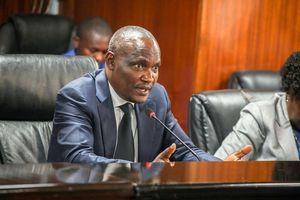
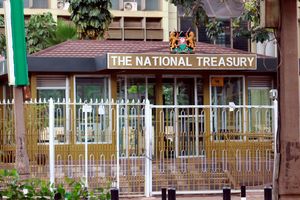
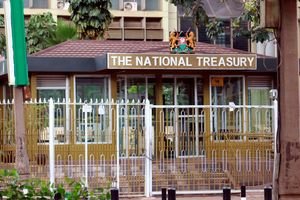
Latest details reveal that the government procured Sh32.4 million an hour within four months in four new loans, according to a government document, as its insatiable appetite to borrow continued with National Treasury Cabinet Secretary John Mbadi revealing that the public debt has hit Sh12 trillion.
The National Treasury document tabled in the National Assembly on October 7, 2025, during the afternoon sitting, shows that a cumulative Sh95.5 billion loans were procured during the period May 1, 2025 and August 31, 2025, from multilateral, bilateral and commercial lenders to finance various projects in the country.
A breakdown of the loan amounts translates to Sh23.9 billion a month, Sh776.6 million a day, Sh539,321 in a minute and Sh8,988 a second within the four-month period. The four loans are equally denominated in US dollars and Euros.
“One loan facility and one bond issuance from the previous period are reflected in the current report having been recorded in the commonwealth meridian system after a close of the reporting period,” the National Treasury document says of the new loans.
Section 31 (3) of the Public Finance Management (PFM) Act requires the Cabinet Secretary in charge of the National Treasury to update Parliament on the loans procured by the government.
“At the end of every four months, the Cabinet Secretary shall submit a report to parliament stating the loan balances brought forward, carried down, drawings and amortizations on new loans obtained from outside Kenya or denominated in foreign currency,” the law states.
The law also mandates the CS to include information as may be prescribed by regulations specifying the names of the parties to the loan and the amount of the loan, and the currency in which it is expressed and in which it is repayable.
The CS is further required to indicate terms and conditions of the loan- interest and other charges payable, terms of repayment, the amount of the loan advanced at the time the report is submitted and the purpose for which the loan was used and the perceived benefits of the loan.
Two of the four new loans will be repaid in US dollars and two others in Euros, attracting an interest rate of between 1.41 per cent and 8.25 per cent and a commitment fee of 0.25 percent.
The National Treasury document shows that Sh62 billion, an international sovereign bond, was issued on April 30, 2025, by CitiGroup Global Markets Europe AG to finance “liability management operations and budgetary support” for the 2025/26 financial year.
National Treasury Cabinet Secretary John Mbadi displays his briefcase before the reading of the National Budget on June 12, 2025.
Photo credit: Sila Kiplagat | Nation Media Group
The loan will be repaid in two equal instalments of USD250 million on April 30, 2030, the first amortisation date, and April 30, 2032, the maturity date.
“The loan attracts an interest rate of 8.25 percent per annum of the outstanding principal amount of the notes,” reads the government document.
The Sh16.4 billion procured from the International Fund for Agriculture Development is meant for the Integrated Natural Resources Management Programme.
This is meant to increase resilience to climate change and improve beneficiaries’ livelihoods, particularly for women, youth and other vulnerable groups.
Details show that the loan will be repaid in 40 equal semi-annual repayments of USD3,170,000 from June 15, 2030, through to December 15, 2049, attracting a 1.41 percent interest rate and a service charge of 1.39 percent, fixed for the life cycle of the loan and payable semi-annually.
The hunger for loans comes as concerns grow over the sustainability of the country’s public debt amid depressed revenue streams as well as the unstable forex regime against the Kenyan shilling.
According to the country’s annual borrowing plan for the financial year 2025/26, Kenya’s debt obligation is estimated at Sh1.098 trillion, comprising Sh646.4 billion in principal payments and Sh196.7 billion in interest payments.
In October 2023, parliament passed an amendment to the PFM Act, replacing the Sh10 trillion public debt numerical ceiling with a debt anchor set at 55 percent of the GDP in net present terms.
This is though projected to be achieved by 2029, with the current situation being about 62 percent of the GDP.
The economic inclusion and green recovery support program will be financed by the Sh9.17 billion borrowed from the Organization of Petroleum Exporting Countries (OPEC).
The program is meant to assist the government in implementing policy reforms “aimed at improving efficiency of public expenditure systems, enhancing budget and debt transparency.”
The purpose for which the loan was procured also includes fostering economic resilience through better efficiency, accountability and responsible use of public resources.
The loan will be repaid in 40 equal instalments of EUR 1.5 million from May 15, 2030, to November 15, 2049. The interest rate is 6 months Euribor plus a margin of 1.55 percent per annum on amounts withdrawn and outstanding.
The loan attracts a commitment fee of 0.25 percent per annum on the unwithdrawn amount of the loan and a front-end fee of 0.25 percent of the loan payable 90 days from the date of effectiveness.
The government has also borrowed Sh5.35 billion from the Federal Republic of Germany towards the financing of the 8.6MW Gogo hydropower power plant redevelopment project, a renewable energy enhancement facility (REEF) II.
The loan will be repaid in 20 equal installments of EUR 1,666,666.66 from May 15, 2030, to November 15, 2039 and the last 1 installment of EUR 1,666,666.66 on May 15, 2040.
The loan interest is at the rate of 2.98 percent per annum- fixed interest rate on disbursed loan amount, with a commitment fee at 0.25 percent per annum on undisbursed loan amounts.
“The loan attracts a non-refundable on-time lump sum management fee of 0.5 percent of the loan amount,” the loan document says.