Kenyans will head into the 2027 General Election using an electoral map drawn more than a decade ago, a decision that will shape political contests while locking communities into entrenched patterns of unequal representation and resource allocation.
The Independent Electoral and Boundaries Commission (IEBC) announced on Tuesday that it is deferring any substantive review of constituency and ward boundaries, a move with far-reaching consequences for the distribution of public resources, particularly through the National Government Constituencies Development Fund (NG-CDF).
This fund channels significant grassroots spending, with 75 percent divided equally among all 290 constituencies, and the remaining 25 percent allocated based on poverty levels and the number of wards.
When the boundaries were last reviewed in 2012, the formula largely reflected population distribution.
Since then, Kenya’s demographic landscape has shifted dramatically. Fast-growing urban and peri-urban constituencies now stretch the same baseline funding across far larger populations, resulting in fewer bursaries per student, overcrowded classrooms, congested health facilities, and thinner development budgets per resident.
Conversely, sparsely populated constituencies continue to receive the same equal share, translating into higher per-capita spending.
By freezing boundaries until after 2027, IEBC has effectively locked these imbalances in place for at least another electoral cycle.
The commission described its decision as a “phased approach,” prioritising technical preparations, including geospatial mapping, data validation, staff training and acquisition of technical tools while shelving actual boundary changes.
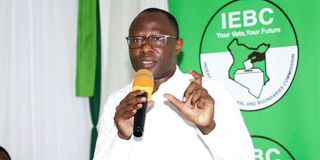
IEBC chairperson Erastus Ethekon said the move was necessitated by constitutional timelines, ongoing court cases over census data, and the risk of destabilising preparations for the elections.
“Given the legal constraints, active litigation, and the proximity of the 2027 General Election, the Commission has resolved that no constituency or ward boundaries will be reviewed before that election. Substantive boundary delimitation will be undertaken after the 2027 General Election using legally validated population data,” Mr Ethekon said.
Under the plan, all 290 constituencies and 1,450 wards will remain unchanged in 2027.
Boundary-related activities will also be wound down at least 12 months before the polls to allow full focus on voter registration, by-elections and election logistics.
In effect, the announcement locks in the current electoral map: all 290 constituencies and 1,450 wards will remain unchanged in 2027.
IEBC said a full boundary review takes at least two years, yet the Constitution requires any changes meant to apply to a General election to be completed at least 12 months before voting day - a deadline that falls in August 2026. Article 89 further requires reviews every eight to 12 years, with the last one completed in March 2012.
That deadline lapsed in 2024, largely due to the absence of commissioners and court disputes that invalidated the 2019 census data in parts of northern Kenya.
“With less than seven months left before the constitutional window closes, the process is no longer feasible,” Mr Ethekon said, noting that valid population data is a core ingredient in delimitation.
Even as public pressure grows for new constituencies and ward splits - often driven by population growth and claims of marginalisation, IEBC also ruled out any expansion.
Article 89(1) of the Constitution caps the number of constituencies at 290, a ceiling that can only be shifted through a constitutional amendment.
“Any review, in the absence of constitutional changes, will not increase or decrease the 290 constituencies but will only focus on reviewing their names and boundaries,” Mr Ethekon said.
The political sensitivity of boundary reform was further underscored during the now-defunct Building Bridges Initiative (BBI), which had proposed the creation of new constituencies as a structural fix to chronic representation gaps - including the failure to meet the constitutional gender quota in Parliament and the under-representation of youth and persons with disabilities.
Under the BBI model, counties where the population-to-MP ratio exceeded 132,138 people would have been awarded additional constituencies to ease voter congestion and broaden political inclusion. But the courts’ nullification of the initiative collapsed that pathway, leaving the rigid constitutional cap of 290 constituencies intact and reinforcing how legally and politically fraught any attempt to redraw electoral maps has become.
Mr Ethekon also flagged a legal contradiction around wards, with the County Governments Act fixing them at 1,450 despite the Constitution granting IEBC power to review electoral units, a conflict that would require parliamentary intervention. For communities that have long petitioned for boundary changes to reflect population pressures, the announcement effectively shuts the door until after the next election.
Boundary delimitation has consistently ranked among Kenya’s most contentious electoral exercises, reshaping political influence, access to state resources and the survival of political careers.
The last review in 2012 laid bare those tensions when 27 constituencies that failed to meet the minimum population threshold were “protected” from abolition after Parliament declined to approve their removal. They included constituencies in Mount Kenya such as Othaya, Ndaragwa, Tetu, Mukurweini, Kangema and Mathioya; coastal seats like Lamu East, Lamu West, Mvita, Voi, Wundanyi, Bura and Galole; and others across Rift Valley, Western and northern Kenya.
Since then, rapid population growth has steadily pushed up the national constituency quota - calculated by dividing the national population by the fixed 290 seats, meaning that a stricter application of the formula today would place even more constituencies below the threshold.
The phased approach also now confirms that the 2027 election will be fought on the same boundaries used in 2022.
IEBC has acknowledged the “enormous interest by politicians and citizens” pushing for boundary changes, but insists legal ceilings, court battles and time constraints leave it with little room to manoeuvre.
The commission is also juggling by-elections, continuous voter registration, electoral law reforms and mounting litigation - all while preparing for a national vote just over a year away.
IEBC says the comprehensive boundary review will resume after 2027, once census disputes are resolved and fresh population data is legally cleared.