As the National Assembly prepares to review its rules and guidelines, parliamentary committees with overlapping mandates are facing extinction.
The existence of the three public watchdog committees carved out of the giant Public Investment Committee (PIC) is also in the balance, as they will only be retained if they can demonstrate an impressive track record.
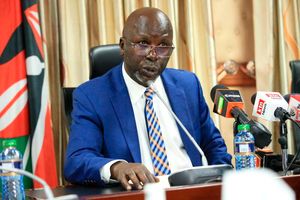
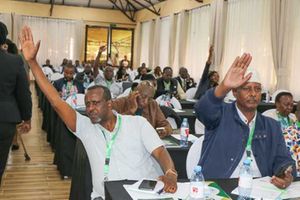
Public Investments Committee on Commercial Affairs and Energy during the session at the Parliament buildings Nairobi on Tuesday, March 12, 2024.
Photo credit: Dnnis Onsongo | Nation Media Group
These committees are the Public Investments Committee on Commercial Affairs and Energy, chaired by Pokot South MP David Pkosing; the Public Investments Committee on Governance and Education, chaired by Bumula MP Jack Wamboka; and the Public Investments Committee on Social Services, Administration and Agriculture, chaired by Navakholo MP Emmanuel Wangwe.
Speaking at the National Assembly retreat in Naivasha on Tuesday, Deputy Speaker Gladys Boss said that the House rules, known to members as Standing Orders, needed to be reviewed in order to address grey areas regarding the overlapping mandates of committees.
Ms Boss, who chairs the Liaison Committee responsible for coordinating the work of all National Assembly committees, said it was necessary to merge some committees with overlapping roles.
“Questions have arisen in the past on overlapping mandates of committees. More often than not, chairpersons of committees have sought the speaker’s direction to determine which committee should handle a certain matter. There is therefore a need to review our Rules of Procedure to address this grey area,” Ms Boss said.
“It may be necessary to merge some of the committees whose mandates are not distinct or may seem to overlap in order to resolve this question and any other.”
In 2022, a review of the Standing Orders increased the number of committees from 28 to 44, in a move that was intended to enhance the efficiency of MPs' oversight role.
Uasin Gishu Women Rep Gladys Boss Shollei taking oath of office after winning the Deputy Speaker race at the National Assembly on Thursday, September 8, 2022.
Photo credit: Dennis Onsongo | Nation Media Group
However, there is growing concern among the House's top leadership that the additional committees, especially the departmental ones, have not made the House more efficient in carrying out its duties.
There has also been concern in the past about the effectiveness of the Diaspora Affairs and Migrant Workers Committee, chaired by Taita Taveta MP Lydia Haika, and whether its responsibilities could be transferred to the Labour Committee.
Established under Standing Order 208, the committee is responsible for considering all matters directly related to policies and programmes for the protection of the rights and welfare of Kenyans in the diaspora, among other things.
In August last year, when Speaker Moses Wetang’ula raised concerns about the mounting number of petitions that had not been considered, some MPs suggested that the committee should be disbanded so that petitions could be dealt with by various committees instead of being assigned to one committee.
Clerk of the National Assembly Samuel Njoroge pointed out the split of the PIC into three committees in the 13th Parliament was meant to keep pace with the examination of audit reports regarding various parastatals.
The giant PIC, which had 250 State corporations to deal with in a financial year in the 12th Parliament, was split into three in order to bring up the examination of audit reports of parastatals.
The split was also a result of the complaints from the office of the auditor-general who had expressed disappointment over the number of heads of State corporations serving their terms and leaving without being made to answer to audit queries during their tenure by Parliament due to the workload in the committees.
In the review of the Standing Orders, Mr Njoroge said the scorecard of the three committees would now be scrutinised before the House decides on whether they should continue to exist.
The Clerk told the lawmakers that when the three committees were created, they had a sunset clause tied to the life of the 13th Parliament, set to expire in 560 days, hence it is now time to scrutinise their performance.
The National Assembly Clerk Mr. Samuel Njoroge.
Photo credit: Bonface Bogita | Nation Media Group
Records from Parliament indicate that during the period under review, departmental committees held 1,323 sittings, considered 65 Bills out of the 99 committed to them, processed 37 legislative proposals of which 16 were approved for publication, undertook approval hearings (vetting) on 95 State officers, and conducted several inquiries, amongst other critical business.
By the end of 2024, records in Parliament indicate that the three PIC committees had examined financial reports of over 85 State corporations since the inception of the 13th Parliament last year.
This is remarkable progress compared to the period when the committee was operating as one unit as in the entire life of 12th Parliament the committee only managed to examine records of 30 state corporations, citing factors such as huge backlog and enormous workload.
For instance, the Public Investments Committee on Social Services Administration and Agriculture (PICSSA) chaired by Mr Wangwe fingered 10 Cabinet secretaries for micromanaging State corporations under their respective ministries by failing to operationalise their functions in order to operate independently as envisioned under the law.
The committee accused the CSs of holding a tight grip on 23 corporations with a budgetary allocation of over Sh4 billion. These corporations have never been audited since inception yet each financial year they receive millions of taxpayers from the Exchequer.
This has raised questions over the prudent utilisation of the taxpayers’ money that the treasury has been channeling to these corporations as the report indicates that they have failed to submit their financial statements for auditing.
The committee pointed out that the parent ministries are deliberately micro-managing the State Corporations, hence denying them funding to provide the intended services to the public.
The committee noted that despite the State Corporations receiving money from the public through member registration and subscription fee, the money was not audited as they failed to prepare financial statements of account raising fears of possible mismanagement of the billions they received from the exchequer.
Mr Wamboka, who chairs the Public Investments Committee on Governance and Education that so far examined financial accounts of 57 State corporations, said specified action should be taken against officers who have acted contrary to the law.