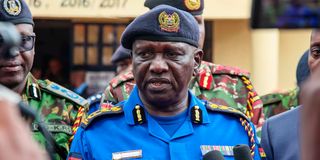
The National Police Service (NPS) has rolled out a nationwide intelligence-driven operation targeting criminal gangs and politically sponsored goons following a string of violent disruptions that have raised concerns over public safety ahead of the 2027 General Election.
Details of the strategy emerged after a high-level security summit at the National Police Leadership Academy in Ngong, convened by Inspector-General Douglas Kanja on Tuesday, where senior police commanders were tasked with developing region-specific interventions to curb the growing menace of gangs increasingly linked to political activities.
The new approach seeks to stop gang activities before they occur through intelligence gathering, surveillance of political mobilisation activities, coordinated arrests and prosecution of both gang members and their financiers.
The Inspector-General is also understood to have cautioned commanders against being drawn into political interests, stressing that the National Police Service must remain professional, impartial and focused solely on enforcing the law.
According to officials who attended the meeting, commanders were told to maintain operational independence and ensure that policing decisions are guided by intelligence and evidence rather than political pressure. Any officer found shielding criminal gangs or failing to act against politically sponsored violence would be held personally responsible.
“The issue of gangs is taking our country down a very bad path, and we must stop it now. We caution and urge the parents to take care of their children before they become guests of the state,” Mr Kanja said on Wednesday.
The strategy comes in the wake of last week's attack on worshippers and participants attending a public participation forum on the national budget at All Saints Cathedral in Nairobi, an incident that renewed scrutiny on the growing use of organised groups of rowdy youth to disrupt public gatherings.
Mr Kanja said that following the attack, five people have been arrested and four of them are being held as the police complete their investigations.
“We have arrested the five, and we are going for the rest. There are many more and they will face the rule of law on their own. There will be no sponsors,” Mr Kanja said.
Sources familiar with deliberations during the security meeting told the Nation that the Inspector-General directed all regional and county commanders to place intelligence collection at the centre of policing operations, particularly in areas witnessing heightened political activity.
Under the plan, the country's eight regional police commanders will work closely with county commanders and sub-county police chiefs to map political events taking place within their jurisdictions, identify individuals planning disruptions and intervene before violence erupts.
The intelligence-led approach is expected to focus on gathering information from communities, local administrators and security networks to detect early signs of mobilisation by criminal gangs often deployed to intimidate opponents, disrupt meetings or trigger chaos during political events.
Mr Kanja is also understood to have cautioned commanders against being drawn into political interests, stressing that the National Police Service must remain professional, impartial and focused solely on enforcing the law. The message, sources said, was that any officer found shielding criminal gangs or failing to act against politically sponsored violence would be held personally responsible.
Police commanders have also been instructed to closely monitor emerging criminal networks operating in urban centres and informal settlements where gangs have historically been recruited for political assignments. The operation will place greater emphasis on individual accountability, with security agencies keen to ensure suspects arrested during violent incidents face prosecution as individual offenders rather than relying on the protection of groups or political patrons.
The move marks a departure from previous approaches where arrests made after political disturbances often failed to result in convictions due to difficulties linking specific suspects to criminal acts committed within large crowds. Investigators have also been directed to aggressively pursue gang leaders and financiers believed to be funding and coordinating attacks.
Senior security officials are said to have resolved that dismantling criminal networks will require targeting the command structures behind the violence rather than merely arresting foot soldiers.
The Directorate of Criminal Investigations has consequently intensified analysis of CCTV footage, mobile phone records and other forensic evidence obtained from recent incidents, including the attack at All Saints Cathedral.
The operation will be supported through collaboration between the Kenya Police Service, Administration Police Service, DCI and regional security structures in what officials describe as a coordinated effort to neutralise criminal gangs before the country enters the peak electioneering period.
During the unveiling of a new Administration Police block at Kiamumbi Police Station, Mr Kanja also stressed that the regional commanders should deploy officers to monitor political activities.
"I had a conference with all the county commanders on Tuesday. I wanted them to get it from me. I told them that they must deal with the issue of goons once and for all," said the Inspector-General.
He said the suspects would face individual responsibility for their actions regardless of whether they acted as part of a larger group.
"I want to caution those who are involved in goonism. You will be arrested alone and face the court alone. You will not show up as a group. Once you arrive in court you will be alone and we will deal with you squarely," he said.
The Inspector-General said police would pursue both gang leaders and sponsors behind acts of violence.
"We do not care where or what you are or where you come from. We will deal with you firmly. We have already arrested five people. You are going to see more arrests, the leaders of the gangs and the arrest of the sponsors of these goons," he said.
Mr Kanja revealed that he had personally briefed commanders from the eight police regions on what he expects in the coming months.