Court proceedings on police killings during recent protests are exposing attempts to conceal incriminating evidence in a pattern that has played out in past trials, prompting a judge to rebuke “the blue code of silence.”
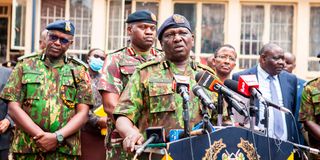
Rex Masai, who was shot during the anti-tax demonstrations.
Photo credit: Pool
First, the official position of the National Police Service (NPS) was that Ojwang committed suicide inside a Central police station cell.
As that lie was falling apart, the technician who installed the police station’s surveillance system was clandestinely hired to go and tamper with footage that would have offered more insights into what happened to the 31-year-old teacher.
An Independent Policing Oversight Authority (IPOA) investigation has also revealed that Albert was initially booked in as sick, before the record was altered to show that he was healthy when being taken into the cell.
That technician is now a prosecution witness in the Albert Ojwang murder trial, where former Officer Commanding Station (OCS) Samson Taalam and two of his juniors – James Mukhwana and Peter Kimani – are the suspects.
General Service Unit deserter John Ngige Gitau, Ginn Ammitou and Brian Mwaniki are the other charged suspects.
In an inquest into the murder of 29-year-old Rex Masai, Taalam’s predecessor Tiberious Ekisa has testified that the NPS CCTV command centre was not operational on the afternoon of June 20, 2024, when the protester was shot dead.
Last week, another officer attached to Central police station, Martin Githinji, was at pains to explain multiple discrepancies in an arms movement register filed before the court, and which would have aided in establishing whether Rex was felled by a police gun, and who the weapon had been assigned to.
Among the discrepancies were the use of different service numbers against Githinji’s name in the sections where he claims to have signed out two guns.
The court heard that another officer’s name was whitewashed from the arms movement register and replaced with a Sammy Waweru.
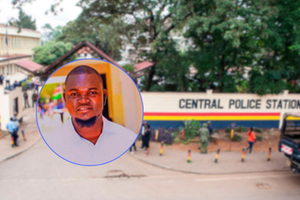
Teacher Albert Ojwang who mysteriously died in a police cell.
Photo credit: Pool | Nation
The two incidents have revived fears of a secret, unwritten rule amongst police officers that the courts have previously frowned upon when convicting rogue officers – the blue code of silence.
Under the blue code, police officers are not to report or expose the wrongdoings of their colleagues, no matter how grave the action.
Despite the term being coined in the US, the vow of silence has been in existence even outside the police service. In the criminal world, for instance, the popular phrase snitches get stitches applies the same principles as the blue code of silence.
The catchy term, used globally, is a fancy synonym for cover-up, which has deeper legal implications if one is found guilty of the action.
All through the Rex Masai and Albert Ojwang cases, several concerns have been raised about alleged cover-up attempts, which are now playing out before judges.
Much like Albert Ojwang, British aristocrat Alexander John Runan Monson was taken into a police cell healthy early morning on May 19, 2012, but unclear events led to his death as a result of the custody under even more unclear circumstances.
He was 28-years-old at the time, and was arrested at around 1.30am for allegedly smoking marijuana outside Tanduri Bar in Diani. At 5.30pm the same day, he was dead.
Police officers insisted that he died of a drug overdose, even though toxicology tests showed that there were barely any drugs in Alexander’s body at the time of death.
“However, due to what is referred to as “blue code of silence” in the police force, the accused persons are bound to protect their own. However, while this may help them escape the hangman, it does not stop their responsibility to take care of the deceased the moment they became aware that the deceased was unwell. The deceased came into their hands a healthy man. He left without his life. The authority of policemen the world over is to protect life, and not to take it away. A cell must be a safe place regardless of why the suspect is in it,” Justice Eric Ogola sitting in Mombasa said on November 15, 2021 as he convicted four police officers of manslaughter.
Naftali Chege, Charles Wang'ombe Munyiri (Rtd), Ishmael Bulima and John Pamba at the High Court in Mombasa on July 19, 2018, when they were charged with Alexander Monson's murder. PHOTO | PHILIP MUYANGA | NATION MEDIA GROUP
Naftali Chege (15 years), Charles Munyiri (12 years), John Pamba (12 years) and Ishmael Baraka Bulima (9 years) were sentenced to prison in what was the first-ever IPOA investigation after its 2012 creation.
The International Justice Mission (IJM) has consistently raised concern over the persistent issue of the ‘blue code of silence’ within police ranks, which undermines investigations and often leads to cover-ups.
A striking example is the case involving former Ruaraka OCS Nahashon Mutua, who tortured a man in custody and attempted to frame a cellmate.
He later enlisted fellow officers in a coordinated effort to conceal the murder by falsely attributing it to a detainee already facing murder charges, until IJM intervened.
“In instances where police officers investigate their colleagues, even if the same would be done scrupulously, it is of fundamental importance and not just merely of some importance, that the integrity of the process should manifestly and undoubtedly be seen to have been maintained. In such cases, what is important is not just what was done but what may appear to have been done. Justice would not appear to have been done,” said Vincent Chahale, Country Director, IJM Kenya.
Additionally, the complexity of forensic analysis and tracking firearm movements within police operations presents significant challenges. In some cases, firearms are switched or misattributed, making it difficult to hold any officer accountable.
Chahale further said that without transparent systems and external oversight, critical evidence can be obscured or mishandled.
Strengthening the role of independent forensic experts and ensuring full cooperation with IPOA is essential to uphold accountability and restore public confidence in the justice system, the IJM Kenya Country Director added.
On Monday, Justice Reuben Nyakundi, sitting in Eldoret, will sentence police officers Emmanuel Wafula and Godwine Wekesa, who murdered 21-year-old Dennis Lusava in a Kakamega police station in October, 2022.
The two officers initially attempted to arrest Dennis on October 4, 2022 in Likuyani, Kakamega County, but members of the public saw this as harassment and blocked the move.
Three days later, the two officers arrested Dennis, booking him in for the same offence, but with a deeper motive – to get vengeance for the humiliation they felt he had taken them through.
They tortured Dennis to death, and then dumped his body in River Nzoia before falsifying the Occurrence Book to show that the 21-year-old had been released from custody.
Key officials from Kenya Ferry Services (KFS) and senior police have been summoned to court on July 24 to explain the missing and incomplete CCTV footage related to the 2019 Likoni ferry tragedy that killed Mariam Kigenda and her daughter.
Photo credit: File, Pool | Nation
In an ongoing inquest into the death of 35-year-old Mariam Kigenda and her four-year-old daughter Amanda, Mombasa Chief Magistrate Alex Ithuku last Thursday issued a warrant of arrest for a police officer who allegedly mishandled CCTV footage of the 2019 incident.
The CCTV footage was expected to determine whether the Kenya Ferry Services could be to blame for the incident in which Mariam’s vehicle reversed off the MV Harambee and plunged into the Indian Ocean, on account of the vessel’s condition.