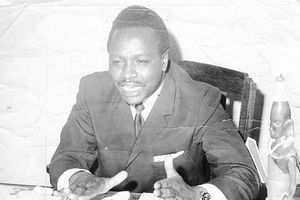
In October of 1962, in Nairobi's Embassy Hotel, Jomo Kenyatta's private secretary, J.M. Kariuki, arrived for a covert undertaking.
His mission was of national import—but clandestine. JM, together with lawyer Henry Wariithi, were to meet Israeli secret agent Mr. E. Peled in a crucial meeting with the ex-Mau Mau General, Waruhiu Itote, better known as General China.
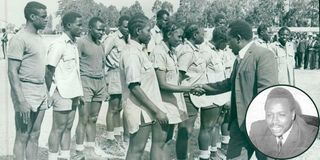
JM Kariuki (left) handing over a gift from the National Youth Service girls to Mrs Ward.
Photo credit: File | Nation Media Group
After Kenyatta was released from prison, Israeli diplomats rushed to Nairobi to forge ties with him. In October 1961, a junior diplomat Asher Naim was asked by Ehud Avriel, then special adviser to the Israeli foreign minister, to go to Kenya and find Kenyatta.
By then, Britain had turned down the appointment of Uzi Nedivi, a high-ranking official, as consul general in Nairobi. It was said that given Naim’s junior status at the time, “nobody would notice” when he visited Kenyatta while under restriction in Gatundu.
During their first meeting, Naim sold the idea of a National Youth Service to Kenyatta, similar to the one they had in Israel. The talks were fruitful. “At the end of the encounter, Kenyatta asked if Israel could supply him with an incubator for his chicken coop; one was delivered two weeks later,” Naim later wrote. “Back in the hotel in Nairobi, there were four messages from MacDonald, assistant to the British governor, asking to return the call urgently. The voice of the messages was sober and unfriendly: Kenyatta is under house arrest and a visit to him requires advance permission.”
With that, contact with JM as Kenyatta’s private secretary became important.
Kariuki, ever the mastermind, procured scholarships to train Kenya's future intelligence officers and pilots in Israel—an initiative so sensitive that had Britain caught wind of it, they would have swiftly curtailed it. Kenya was still a British colony. Kariuki developed a network of Jewish friends – and if he became instantly rich, it was thanks to these networks rather than any tangible business.
Jomo Kenyatta (centre) during a visit to Lake Bogoria. Behind him is his then secretary, JM Kariuki.
Photo credit: File | Nation Media Group
On November 12, 1962, a year to independence, Itote, aided by his Israeli handlers, slipped unnoticed out of Kenya, without a passport, and accompanied by thirty compatriots. Their destination: the remote Kibbutz Kfar Hannassi in Upper Galilee. There, in the heart of Israel, Itote found himself enrolled in the Military Officers Training School in Tel Aviv. Initially, he thought he was being trained to take up the military leadership in Kenya. He had said as much.
Kariuki’s role, too, became clear in the years that followed. Introduced to Israeli Foreign Minister Golda Meir by Kenyatta himself, Kariuki harboured a singular ambition: to forge an elite security force for the newly independent Kenya, one that would stand apart from the British-trained intelligence apparatus.
General China outside his home in Njabini, in Nyandarua.
Photo credit: File | Nation Media Group
A vision that, in its stealthy inception, had woven together the destinies of Kenya and Israel—both bound by the shared pursuit of sovereignty and self-determination.
Together with Tom Mboya [who was assassinated in 1969 ], JM became one of the contacts in Nairobi. NYS was JM’s signature project. The initial aim was to retrain the Mau Mau war orphans and youth who had left the forest war – and if possible – absorb them into the military.
By September 1963, just three months before independence, JM moved to solidify this vision within Kenya’s political framework. In partnership with Jesse Gachago—the Makuyu MP who would later be jailed for coffee theft—he introduced a private member’s motion in Parliament advocating for the creation of the National Programme for Kenyan Youth. This was a groundbreaking move—the first freelance motion ever presented in Parliament, reflecting JM’s willingness to push boundaries. The proposal aimed to replicate Israel’s Nahal experiment, integrating military discipline with national development. Interestingly, there was no mention of the Israeli hand.
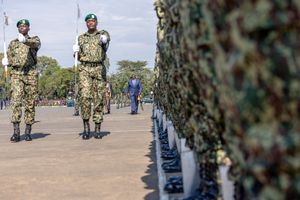
National Youth Service recruits conduct a drill during the graduation ceremony at Gilgil training camp on December 8, 2023.
Photo credit: File | Nation Media Group
Prime Minister Kenyatta, though privately supportive, maintained a deliberate silence. As Prime Minister, he could not afford to openly endorse a motion that would expose his behind-the-scenes collaboration with Israel. JM, ever the political gambler, carried the weight of the initiative on his shoulders, navigating a tightrope between international diplomacy and Kenya’s fragile post-colonial politics. He had Kenyatta’s trust and always thought he would be independent Kenya’s minister for Agriculture.
To take control of NYS, Kariuki’s earliest manoeuvres were the creation of a National Youth Leader position in the Act of Parliament that created the National Youth Service. If JM had future ambitions, this was part of his scheme. He also made sure that the National Youth Leader position did not fall under the classification of a “public office” as stipulated in Section 41(f) of the then Constitution, which barred public officers from contesting parliamentary seats. His role, ostensibly, was to serve as an advisor to the minister, with a crucial clause inserted to affirm that the National Youth Leader would also be a sitting Member of Parliament.
As fate would have it, on the very day KADU formally dissolved itself, the National Youth Service (NYS) Bill was tabled in Parliament, igniting a heated debate—one in which JM Kariuki’s role took centre stage. Some legislators proposed that the Youth Leader should hold a rank subordinate to the Director, while others argued that youth training should extend beyond handling rudimentary weapons. A particularly striking suggestion came from Mr Gichoya, who opined that the NYS should be integrated into KANU should the nation continue with a one-party system.
Intriguingly, the National Youth Service commenced operations even before the bill had secured parliamentary approval. As deliberations unfolded, Henry Wariithi – who was with JM at the Embassy House meeting - advanced a provocative stance: the youth, he contended, should be systematically indoctrinated in the nation’s political philosophy, with training extending to military weaponry. He scoffed at the idea of mere drills with spades and shovels, insisting that if these young men were to be called upon in times of crisis, they ought to be adept in the use of machine guns.
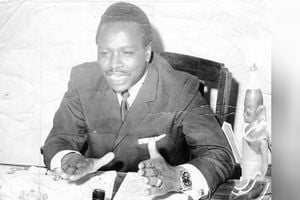
National Youth Service (NYS) Deputy Director Waruhiu Itote, better known as General China, congratulates female recruits after beating their male counterparts in a tug-of-war competition at the NYS headquarters in Ruaraka Nairobi.
Photo credit: File | Nation Media Group
Had that happened, JM would have been in charge of a machine that was lethal and which owed allegiance to him. To contain any mutiny, a clause was inserted by Parliament. The rationale behind this, as the minister candidly explained, was alarmingly straightforward: "We may wake up one day and find everything is completely in the hands of the youth. What would we do next? This is why we bring these provisions—so that they know, from the moment they step into this organisation, they are bound to discipline, bound to obedience, bound to silence."
What Parliament did not know was that Israel had a hand in shaping the NYS and that JM was part of it.
The first NYS intake took place in August 1964, and the first group graduated in August 1965.
The responsibility of spearheading this ambitious, multi-million-shilling initiative in Kenya fell on JM, a man whose credentials as both a former detainee and a rising political star made him a natural choice. His memoir, Mau Mau Detainee , had just been published by Oxford University Press, cementing his status as a key voice in the Mau Mau narrative.
More crucially, JM was no ordinary politician, having served as Kenyatta’s private secretary and a trusted insider within the new power structure. Personally recommended by Kenyatta to Israeli Prime Minister Levi Eshkol and Foreign Minister Golda Meir, JM became the linchpin of this covert operation. The Israelis, eager to cultivate strong ties with the emerging Kenyan state, saw in him a willing and capable partner, one who could navigate the complex interplay between former Mau Mau combatants and the newly forming government.
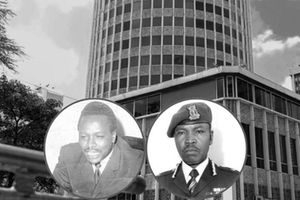
JM Kariuki (left) and President Jomo Kenyatta.
Photo credit: Nation Media Group
Beyond NYS, it was JM who secured the first 45 scholarships from Israel to train intelligence officers. Early in 1962, the head of the Mossad arrived in Kenya and wanted to meet Kenyatta. A breakfast was organised at the home of a junior Israeli diplomat, Asher Naim. Kenyatta was accompanied by JM. It was in this meeting that the discussion on cooperation in the field of intelligence and security started.
Initially, Kenyatta wanted JM to have the best. He authorised his acquisition of a colonial farmhouse and 100 acres. He also received an extra 800 acres.
If JM was so close to the intelligence, it was due to his early dalliance with Mossad. Then, he stepped on everybody’s toes as hubris and ego took a toll on him. The mafia in politics and business decided to kill him.
In 1975, in the aftermath of J.M. Kariuki’s death, British journalist and historian Martin Meredith arrived in Nairobi to chronicle the funeral for the Sunday Times . As an outsider, he cast JM as a “playboy” - and as “not a particularly admirable character.” However, he also said that JM was gifted with “an unerring popular touch” and a rare ability to connect with the masses, to ignite their hopes and grievances with effortless charm.
Flamboyant, wealthy, and a gifted orator, JM was a walking provocation to his fellow elites. He ran with the hares and hunted with the hounds, boldly positioning himself as the voice of the downtrodden. With every speech, every confrontation, and every challenge to the establishment, he courted danger.
Friends, like G. G. Kariuki, had warned JM to tread carefully in the treacherous Kenyatta succession battlegrounds—but JM, ever defiant, pressed on, needling the regime with relentless audacity. At just 46, he was dead .