Happening Now: NTV KENYA LIVE | Senate Proceedings
Premium
Justice Lenaola elected president of Hague-based Sierra Leone court
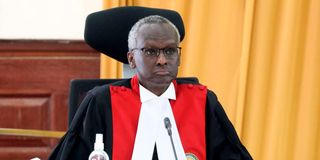
Supreme Court Judge Isaac Lenaola.
What you need to know:
- Supreme Court judge Isaac Lenaola will head the court for the next two years, with a possible extension to four years.
- UK-born judge Andrew Hatton, appointed to Residual Special Court for Sierra Leone in 2013, will serve as the vice president.
Supreme Court judge Isaac Lenaola was on Friday elected the president of a Hague-based court created as a result of a civil war in Sierra Leone that raged on from 1991 to 2002, leaving more than 50,000 people dead.
After the war, the Special Court for Sierra Leone was formed by the Sierra Leonean government and the United Nations. Its headquarters were at the Hague, and it was given the mandate to prosecute those who bore the greatest responsibility violating international humanitarian law and Sierra Leonean law.
That court was operational from 2002 to 2013. At the end of its tenure, the Residual Special Court for Sierra Leone (RSCSL) took over, to handle matters such as supervising prison sentences, witness protection, management of the archive, assisting national prosecution authorities, among others.
It is this court that Justice Lenaola will head for the next two years, which may be extended to four. Previously, he was the vice president.
Two-year renewable terms
“Officers are elected to two-year renewable terms,” said a statement from the RSCSL on Friday, adding that Justice Lenaola has been a judge of the court since 2013.
Justice Lenaola’s profile on the RSCSL website says: “Until his appointment as judge of the Supreme Court, Judge Lenaola was the presiding judge of the Constitutional and Human Rights Division at the High Court in Milimani, Nairobi where he rendered illuminating and ground-breaking decisions on human rights, devolution, separation of powers among other areas of jurisprudence.”
UK-born judge Andrew Hatton, also appointed to the RSCSL in 2013, will serve as the vice president. His background includes decades of legal practice in the UK, and part-time judicial service.
Review from convicted persons
The statement added that ahead of the election, the judges held a two-day plenary where they “considered and deliberated on a number of important issues, including on proposed Rule amendments, the draft Stocktaking Report, and funding of the court”.
The court’s website says that some matters are active until 2055.
“To guarantee the rights of those convicted, the RSCSL will have the authority to manage requests for review from convicted persons and this function may extend until 2055,” it says.
“The RSCSL shall carry out its functions at an interim seat in the Netherlands, with a branch or sub-office in Sierra Leone for witness protection and support, until such time as the UN and Government of Sierra Leone agree otherwise,” the website adds.


