Kenya joins human rights list of shame after protest killings

Rex Masai, Erickson Mutisya, Kennedy Onyango, Caroline Shiramba and Benson Mbithi who were killed during the 2024 anti-Finance Bill protests.

Kenya has been added to the list of 51 countries worldwide with worsening conditions for civic freedoms and human rights. It’s among six others who have recently been included in the list of shame.
The others are El Salvador, Indonesia, Turkey, Serbia, and the United States of America.
The development comes weeks after the June 25 and July 7 protests, in which more than 60 people were killed and hundreds left nursing injuries.


Civicus Monitor, a global human rights and civic freedoms watchdog that tracks the state of civic freedoms—expression, association, and peaceful assembly—across 198 countries, has added Kenya to its watch-list following what it describes as “a disturbing escalation in State-led suppression of civic freedoms.”
In a statement on Wednesday, Civicus Monitor said that, more than a year after the June 25, 2024 protests against the Finance Bill, the Kenyan government continues to employ brutal tactics to silence dissent, including lethal force, arbitrary arrests, and digital surveillance.
"Civicus Monitor rates Kenya as 'repressed,' the second-worst rating a country can receive, indicating severe restrictions on the freedoms of expression, peaceful assembly, and association," said Civicus Civic Space Research Lead Ine Van Severen,.
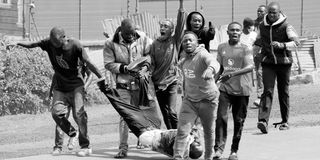
Youths carrying a fatally shot person in Kangemi, Nairobi, during Saba Saba protests on July 7, 2025.
Civicus Monitor is a global alliance of civil society organisations and activists, with over 15,000 members in 175 countries.
Its civil society members include Amnesty International, Oxfam, Greenpeace, Plan International, and Save the Children.
It draws data from over 20 partner organisations, using a rating system that classifies countries from 'open' to 'closed.' Kenya is rated as 'closed,' the worst rating a country can receive.
According to the watchdog, on June 25, 2025, thousands of Kenyans poured into the streets. However, instead of engaging with citizens’ concerns, the government responded with brutal force.
The events were documented in a recent Civicus Monitor report titled “Police bullets, digital chains: State-sanctioned brutality in Kenya’s peaceful youth-led uprising.”
"At least 65 protesters were killed, hundreds injured, and over 1,500 arrested. There were reports of rape and gang rape, allegedly perpetrated by state-sponsored goons deployed to infiltrate protests, attack demonstrators, and loot businesses," the statement read.
"State-sponsored goons operated alongside masked, plain-clothes security officers in unmarked vehicles—a practice explicitly barred by court order but still widely used," the statement further noted.
Civicus Monitor faulted the State for its use of "terrorism charges" to criminalise dissent.
"The use of terrorism charges against peaceful protesters raises serious concerns about the weaponisation of the legal system to criminalise dissent. Allegations that much of the violence was instigated by state-backed actors further underscore the systematic nature of repression. The Kenyan government has turned its back on the rights of the people,” stated Van Severen.
Civicus Monitor also cited the recent murder of teacher and activist Albert Ojwang at the Nairobi Central Police Station, saying Kenya has begun imposing restrictions on the use of digital space, further suppressing freedom of expression.
The human rights watchdog further urged lawmakers to reject a push by the State to introduce a law that threatens to entrench mass surveillance.
It said civil society groups fear a January 2025 directive requiring social media companies to establish physical offices in Kenya—issued amid rising online criticism of President William Ruto—could be a veiled attempt to undermine digital rights under the guise of national security.


