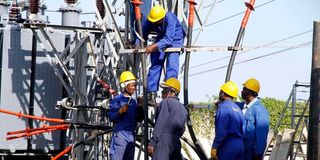
Kenya Power is retrofitting sections of its electricity network to prevent birds of prey and other wildlife from dying on live wires. The company launched the initiative on Thursday at Soysambu Conservancy, in a five-year partnership with US-based Kaddas Enterprises.
"Wildlife electrocution causes roughly 30 per cent of Kenya's power outages, which themselves account for about 50 per cent of all blackouts nationwide," Kenya Power said in a statement. "That means roughly 15 percent of the country's total power supply disruptions stem directly from animals contacting live power lines," the utility added.
Bird-friendly power lines to reduce outages
Soysambu Conservancy hosts some of Kenya's most vulnerable raptor species. The martial eagle and augur buzzard, both large birds of prey, perch on power poles and lines while hunting. When they land on uninsulated conductors carrying high voltage, they die instantly. Each death triggers a power cut that can cascade through regional electricity distribution.
The Lanet-Naivasha Interconnector, which runs through Soysambu Conservancy, has experienced repeated power failures linked to electrocuted wildlife. In one notable incident, a giraffe was electrocuted on the line, causing an extended outage across a significant portion of Nakuru County.
"Wildlife is part of our national heritage, which heavily drives our tourism sector. Equally, Kenya Power's role in energy distribution is a key component of our country's economic growth. Our aspiration is to ensure peaceful co-existence between nature and the energy infrastructure," said Eng .Henry Pwani, the Head of Research at Kenya Power's Institute of Energy Studies and Research (IESR).
The technical solution involves installing specially designed covers on power line sections identified as electrocution hotspots. These covers allow electricity to flow while preventing animals from making direct contact with live conductors. Kenya Power is using this pilot site to test the covers before rolling them out to other high-risk areas.
"By safeguarding wildlife, we are also improving power supply reliability to give a better experience for our customers. This is a win-win situation to the environment and our business," Eng. Pwani said.
Kenya's raptor populations face multiple threats such as habitat loss from agricultural expansion and urban development, pesticide poisoning from agricultural chemicals, and direct persecution by farmers who view raptors as threats to livestock all contribute to population pressures. Power line electrocution adds another source of mortality that wildlife managers have struggled to address.
Human-wildlife conflict has intensified as human settlements and agricultural land encroach on wildlife habitat. Power lines, roads, and railways now cut through migration corridors and habitat that wildlife has used for centuries. Rather than remove the infrastructure, this project attempts to make it safer for wildlife to coexist with it.