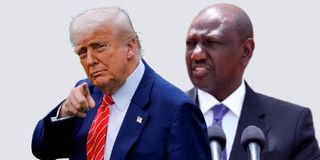
US President Donald Trump has stunned allies by saying it is not America’s job to guard countries like Kenya and Somalia — remarks that cast doubt on decades of military cooperation, even as the UN approved a new mission Nairobi hopes to join in the conflict-torn Haiti.
The UN Security Council approved a US-backed Gang Suppression Force (GSF) to combat armed gangs in Haiti, a new team which Nairobi has expressed interest in joining to replace the expiring Kenya-led Multinational Security Support Mission (MSS).
In an address to the US military’s top brass on Tuesday, Mr Trump said that after decades of military campaigns abroad, it was time to turn the armed forces inward against what he described as an unspecified “enemy from within.”
“Only in recent decades did politicians somehow come to believe that our job is to police the far reaches of Kenya and Somalia, while America is under invasion from within,” he said.
He spoke at a forum where more than 800 generals attended at the Marine Corps Base Quantico in Virginia.
It remains unclear how the remarks will affect Kenya’s relationship with Washington, given that only last year the Joe Biden administration designated Kenya as a major non-NATO ally. Significantly, Kenya also hosts a key US military base in Manda Bay, Lamu County.
President Trump said his administration’s resources would now be directed more at home than abroad.
He also suggested he would deploy the military to cities such as San Francisco, Chicago and New York.
“We are under invasion from within. No different than a foreign enemy, but more difficult in many ways because they don’t wear uniforms. At least when they’re wearing a uniform, you can take them out. It’s war from within,” he added.
Meanwhile, the UN Security Council has approved the creation of the Gang Suppression Force to replace the MSS, which Kenya has led since last year.
The UN Security Council adopted a US-proposed resolution on the new, larger force on Tuesday.
The resolution comes amid a worsening security situation in Haiti, where powerful gangs have tightened their grip on large swathes of the country. MSS has fewer than 1,000 officers and has struggled to contain the well-armed Haitian gangs.
US Ambassador to the UN Mike Waltz Mike Waltz welcomed the vote, noting that the MSS lacked the scale, scope and resources to confront the gangs.
The "Gang Suppression Force" (GSF) will have up to 5,550 police and soldiers with the power to detain suspected gang members.
The GSF will boost the Kenyan-led Multinational Security Support mission (MSS) - a force which was meant to have up to 2,500 members, but fell far short of that and has been unable to curb the violence since its deployment in 2023.
“Today’s vote sets that right. With this transformation, the new Gang Suppression Force will be five times the size of its predecessor, with a strengthened mandate to go after the gangs,” he said.
He added: “The international community is sharing the burden and living up to its promise to help Haiti turn the tide. It offers Haiti the chance to assume responsibility for its own security.”
The GSF is expected to launch targeted operations to dismantle criminal networks, restore order, and secure humanitarian access. While the Kenya-led MSS had made some gains, the UN said it faced mounting challenges, hence the need for a broader multinational approach.
The new mission will coordinate international efforts to stabilise the Caribbean nation while supporting Haitian authorities in rebuilding state institutions. However, questions remain about its funding, rules of engagement, and long-term exit strategy.