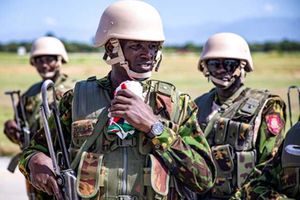
A debate on whether the Kenya-led Multinational Security Support (MSS) mission in Haiti should be taken up by the United Nations has persisted even after the global body’s chiefs swatted away the idea.
The new peg arose last week after some leaders of the Caribbean region argued such a transition could leverage the mission that now seems overwhelmed by gang violence in Haiti.
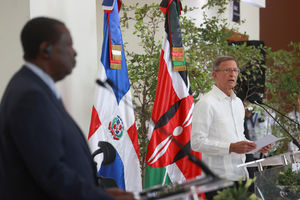
Dominican President Luis Abinader and his predecessors; Hipólito Mejía, Leonel Fernández, and Danilo Medina issued a joint statement calling for the MSS to be turned into a UN-led hybrid mission.
Homero Figueroa, the Dominican Presidential spokesperson told the media that the move by the team from his home country was driven “by the urgent need to prevent the total collapse of Haiti’s state institutions.”
“All communications were routed through the permanent UN representations,” said Figueroa.
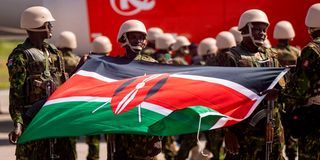
The debate has endured for most of the life of the MSS, which was created in October 2023 but Kenya only deployed the first policing troops in June last year. Jamaica, Guatemala, Bahamas, El Salvador and Belize have since also sent smaller contingents but the Mission is led by Kenya.
Although it is endorsed by the UN Security Council, it is not a UN Peacekeeping mission which means it cannot draw its financial support from the UN kitty. Instead, it relies on donors who have not been forthcoming.
When the idea was first proposed by Haitian leaders, Kenyan President William Ruto supported it.
President William Ruto shakes hands with Kenyan police officers when he arrived in Port-au-Prince, Haiti.
Photo credit: PCS
“On the suggestion to transit this into a fully UN Peacekeeping mission, we have absolutely no problem with it, if that is the direction the UN security council wants to take,” Ruto said in September when he visited Port-au-Prince to meet with Kenyan troops.
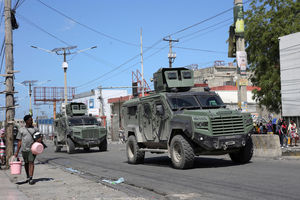
In spite of initially vowing preparedness to take down Haitian gangs, funding gaps and equipment shortages have ensured little progress for the mission. And critics have seized the moment to call for the UN to smell the coffee. Some 700,000 people have been internally displaced in Haiti since the MSS started, reflecting the continual activity of gangs and violence.
Louis Charbonneau, UN director for Human Rights Watch argued that transforming the MSS into a full-fledged UN mission that has adequate resources and is guided by human rights would be a constructive step.
“Restoring stability to Haiti is something past UN missions have succeeded in doing, though neither successive Haitian governments nor the UN were able to sustain that stability.
“The UN has the skills and know-how to do it again while avoiding the mistakes of past UN operations in Haiti – provided it has the resources,” Charbonneau wrote in a blog.
However, the UN Secretary-General António Guterres earlier this year proposed something different: That the MSS continues as it is as UN takes up the bill for certain programmes related to Haitian restoration.
“A realistic option is based on a dual-track strategy, with the United Nations assuming new roles to enable the MSS, the national police and Haitian authorities, to substantially reduce gang territorial control through peace enforcement,” the UN boss said in February.
“This would require a robust mandate for the use of force and the capacities to conduct targeted operations against gangs.”
Still, the debate has, sort of, been stuck at the UN Security Council where members can’t agree. China and Russia were earliest opponents to transforming MSS into a peacekeeping mission.
The US, the United Kingdom (UK) and France are the other veto-holding countries that supported a transformation but with strict rules of operations.
In its argument, the Dominican government states that the current MSS lacks the resources to stabilise the gang-infested nation.
Kenyan police offices stand at the airport after disembarking, in Port-au-Prince, Haiti June 25, 2024.
Photo credit: File | Reuters
They argued that a UN-managed mission would ensure that the officers are well financed and more equipment of war availed.
The MSS mandate will come up for review in the coming months as its year-long extension will expire in September, making it two years old in Haiti.
Whether MSS term is extended at all will still remain on the Security Council, meaning that the next three months will be crucial on the future of the Mission. Some countries under the Organisation of American States (OAS) had mooted an arrangement for a new kind of mission. Kenya says the more the merrier.
“Yes, we are aware. That is a greater involvement of Caribbean countries and it will serve to make the Haitian stabilisation effort a collective international effort enhancing its likely success,” said Dr Korir Sing’oei who is the Principal Secretary Foreign Affairs.
Kenya is an observer state at the OAS whose members include the US, Brazil, Uruguay, Costa Rica, Argentina, Bolivia, Paraguay, Colombia, Chile and Venezuela.
Other countries are; Anguilla, Antigua and Barbuda, Aruba, the Bahamas, Barbados, Belize, Bermuda, British Virgin Islands, Cayman Islands, Cuba, Dominica, Dominican Republic, Grenada, Guyana, Jamaica, Haiti, Montserrat, Netherlands Antilles and Puerto Rico.
Before Kenya agreed to lead the MSS Mission and deploy 1,000 police officers to Haiti, former US President Joe Biden had sought support from regional partners. None were willing to deploy.
And the US private military Blackwater was in discussions with Haitian government to deploy and protect security installations.
Recently, Alvin Holsey, the head of US Southern Command that oversees military operations in the Caribbean Admiral Alvin held a meeting with Colombia defence Minister Pedro Sanchez as part of the plan to deploy officers from the region.
Later the Colombian government said, “the US expressed interest in advancing with Colombia on a multinational strategy to support Haiti.”
Commander Alvin also recently met with Jamaica’s top defence leadership where they discussed a similar partnership.
“Together America and Jamaica are building a safer, stronger Caribbean- united by shared values, mutual respect, and a commitment to regional security,” the US Embassy in Jamaica said following the May 9, meeting.