It is Kenya’s most protected address—its walls patrolled by elite Recce Company commandos, its perimeter lined with CCTV cameras and guarded round-the-clock. Yet, time and again, trespassers have breached these defences, slipping through the layers of security and protocol.
From audacious acts to tragic encounters, the history of State House and State lodges' intrusions reveals not just security lapses, but also the undercurrents of desperation, mental illness and defiance that run through the nation.
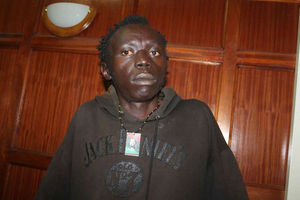
Kithuka Kimunyi, a man suspected of killing a GSU officer, is help on October 13, 2025 at Kilimani Police Station.
Photo credit: Billy Ogada | Nation Media Group
Months earlier, in March, 12 people were arrested while attempting a coordinated entry into the same compound. The suspects reportedly planned the breach in advance, forcing the State to quietly review security protocols.
The June 2024 Finance Bill protests saw demonstrators in Nakuru and Nairobi test the State’s resolve. In Nakuru, rioters vandalised a guardhouse before being dispersed by police—one of the closest attempts to storm a State House since independence.
In March 2023, opposition-led protests in Kisumu saw crowds make repeated attempts to access the State lodge. The compound became a symbol of resistance, its walls bearing witness to a generation’s anger against power and inequality.
In June 2020, a 15-year-old boy slipped past guards into State House Nairobi, saying he wanted to “seek assistance”. The court later released him, but the incident reignited debate about how far citizens will go to be heard.
Brian Kibet Bera, a university student, was shot by State House security guards after reportedly scaling a gate there armed with a knife. PHOTO | COURTESY
A year earlier, in June 2019, Brian Kibet Bera, an engineering student at Jomo Kenyatta University of Agriculture and Technology, jumped the fence armed with a knife after posting online that he was on a divine mission. He was shot and subdued by guards, his story quickly becoming a national conversation on mental health and the thin line between faith and delusion.
In March 2017, guards opened fire on another intruder, killing him instantly. It was a grim reminder that trespassing into the heart of power could turn deadly.
Mr William Ngene Njuguna when he appeared in court on March 9, 2016 charged with offence of entering a protected area without permission. Mr Njuguna admitted that his curiosity got the best of him and he just had to see State House with his own eyes. PHOTO | PAUL WAWERU | NATION MEDIA GROUP
In October 2015, Kadhik Juma Walter was arrested after sneaking into the State House, Nairobi compound. Calmly, he told police he was “a friend of the president”. His claim amused the public but embarrassed the authorities charged with protecting the president.
The earliest recorded intrusion dates back to January 2 2003, when a man managed to “bluff” his way into the compound just as President Mwai Kibaki’s government took power. It was dismissed as an isolated case—but the years that followed showed a recurring pattern.
From bluffers to protesters, dreamers to the disturbed, Kenya’s most guarded gates have never ceased to draw those desperate enough to try. Each breach, however small, has peeled back the illusion of invulnerability that surrounds the presidency.
Behind those walls lies not just the heart of power—but a mirror reflecting the country’s own anxieties, frustrations and unending struggle to be heard.