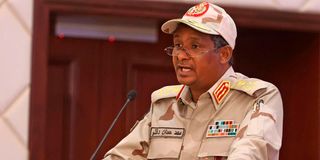
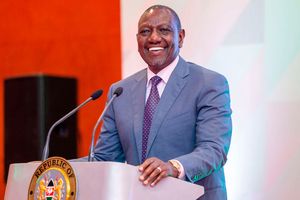
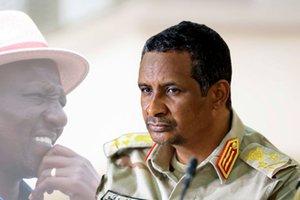
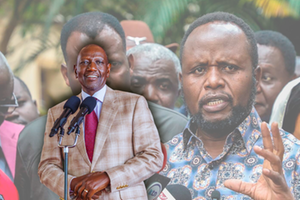
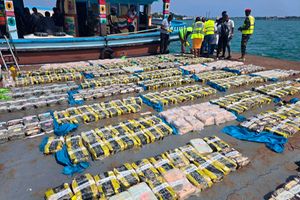
Kenya hosted Sudan rebel leader Mohamed Dagalo, alias Hemedti—who is sanctioned by the international community on accusations of war crimes—for a meeting in Nairobi earlier this month.
An April 10 press briefing by United Nations (UN) Secretary-General Antonio Guterres’s spokesman, Stephane Dujarric, revealed the Rapid Support Forces (RSF) leader's presence in Nairobi, raising questions on whether Hemedti lives in Kenya or he had only visited for the meeting.
Mr Hemedti is facing UN sanctions for the conflict in its fourth year, which has seen thousands killed and displaced millions of Sudanese people, triggering one of the world’s worst humanitarian crises.
The United States Treasury Department on February 19 posted a new sanction list that included Alguney Dagalo Hamdan Musa , the younger brother to Hemedti and a commander within RSF.
The sanction list indicated that the Kenyan government had issued Hemedti’s brother with a passport AK 1586127, allowing him easy access to the country.
But it’s not only the US that has sanctioned RSF senior leaders. On January 29, the Council of the European Union also listed Mr Musa alongside six other RSF and SAF senior figures for war crimes. The council also linked him to two companies said to be fronts for RSF’s war material supplies.
Despite past criticism for hosting the RSF warlords in the country, the Kenyan government is still on the radar for the activities of Hemedti and his allies.
Apparently, Hemedti is not the only Sudanese armed leader in Kenya. Mr Dujarric’s press briefing posted on the UN website shows that on April 6 or thereabouts, UN envoy Pekka Haavisto visited Kenya to meet Hemedti and leaders of other armed groups in Sudan in a bid to find a long-lasting solution.
“Mr Haavisto, I think, has really hit the ground running. He was in Khartoum, where he met with the President,” Mr Dujarric says in the press briefing. “As you know, he (Haavisto) met Mr Mohammed Dagalo Hemedti in Nairobi, the head of the RSF, and met a number of other leaders of armed groups and civilian political actors as well as civil society representatives.”
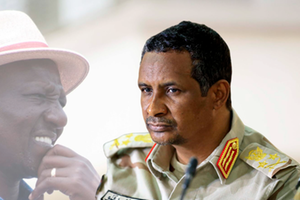
President William Ruto (right) and RSF Leader General Mohamed Hamdan Dagalo at State House, Nairobi.
Photo credit: PCS
The meeting, also attended by members of the diplomatic community and the Kenyan authorities, shows the UN appearing to have accepted Mr Hemedti’s presence in Kenya as a fait accompli.
Foreign Affairs Cabinet Secretary Musalia Mudavadi and Principal Secretary Korir Sing’oei did not respond to Nation’s enquiries yesterday on whether Hemedti lives in the country or had only come in for the meeting, and Nairobi’s continued dalliance with the sanctioned leader.
Mr Haavisto’s Nairobi meeting with the RSF leader and other armed groups in the Sudan conflict came ahead of the April 15 Berlin ministerial-level meeting of the International Sudan Conference, where he was scheduled to give more updates on his shuttle diplomacy efforts to end the conflict.
RSF has had quite a number of activities in Nairobi, including press conferences, which have not gone down well with the Sudan government. For instance, on February 22, 2025, the RSF convened a meeting in Nairobi that was covered by local and international media, with another meeting planned for mid-April 2025.
Last year, the Sudanese government, for the first time, directly linked Kenya’s government to the turmoil in Sudan, specifically for aiding RSF to carry out atrocities, in an open letter to Kenyan MPs.
The letter dated March 14, 2025, by the Vice-President of the Transitional Sovereign Council of Sudan, Commander Malik Agar, challenged MPs to put pressure on President William Ruto to expel RSF leaders from Kenya and not to allow the president to interfere in Sudan’s internal affairs.
Khartoum accused Nairobi of helping to foment the violence in the North African country, which has since seen Sudan ban imports from Kenya, largely tea and coffee.
“I trust that your esteemed Parliament will uphold the legacy of Pan-Africanism and will not permit Kenyan territory to be used to legitimise or host entities intent on undermining a neighbouring African state,” said Mr Agar.
The appeal to Parliament followed a similar one to President Ruto on Kenya’s continued hosting of the RSF leaders.
“Pursuant to my previous open letter to President William Kipchirchir Samoei Arap Ruto , I wish to highlight the importance of our long-standing and brotherly relationship with the Republic of Kenya – one that is founded on mutual respect, shared struggles, and a collective vision for a peaceful and prosperous Africa,” said Mr Agar.
According to Mr Agar, RSF meetings in Nairobi are aimed at establishing a “parallel government”, which directly undermines Sudan’s sovereignty and poses a threat to regional peace and stability.”
In the press briefing, Mr Dujarric stated that “in his meetings”, Mr Haavisto stressed the urgent need to pursue practical measures to de-escalate the conflict and ensure the protection of civilians.”
“Mr Haavisto reiterated that the conflict cannot be resolved through military means and highlighted the importance of achieving swift, tangible progress towards peace, given the devastating impact the ongoing violence is continuing to have on Sudan and its people.”
Last week, the UN envoy echoed statements by the UN Secretary-General and the UN Security Council, reaffirming the need to safeguard the sovereignty, unity and territorial integrity of Sudan. He rejected the establishment of any parallel authorities and underscored the commitment of the UN to engaging with all relevant stakeholders to advance peace.
According to the Council of the European Union, Mr Musa, born August 9, 1990, is associated with Tradive General Trading Company and GSK Advance Company Ltd.
He possesses passport number B00017334 (Sudan) and alternative passport number B00024943 (Sudan). While sanctioning him, the council noted that he is “subject to restrictive measures by the Council of the European Union for being involved in the RSF’s procurement processes”.
“Therefore, he is associated with entities responsible for supporting actions of the RSF that threaten the peace, stability or security of Sudan,” the council said.
President William Ruto (right) and RSF Leader General Mohamed Hamdan Dagalo at State House, Nairobi.
Photo credit: PCS
“Alguney Hamdan Dagalo Musa is therefore responsible for planning acts in Sudan that constitute serious human rights violations or abuses or violations of international humanitarian law, and he is also responsible for actions that threaten the peace, stability or security of Sudan,” it added.
On November 27, 2023, the High Representative of the European Union for Foreign Affairs and Security Policy issued a statement on behalf of the union, reiterating strong condemnation of the continuous fighting between SAF and RSF.
The statement also deplored “the dramatic escalation of violence and the irreparable cost to human life” in Darfur and throughout the country, as well as violations of international human rights and humanitarian law.
On October 28, 2025, the High Representative issued a joint statement with Commissioner Hadja Lahbib on the seizure of El Fasher, Darfur’s capital. The statement underlined that the seizure “marks a dangerous turning point in the war and threatens to further worsen the already dire humanitarian situation”.
The statement added that “civilians being targeted on the basis of their ethnicity, which underscores the brutality of the RSF.”
The deadly fighting that erupted on April 15, 2023, between the Sudanese Armed Forces (SAF) and RSF has left at least 34 million people, a staggering 65 per cent of the country’s population, in urgent need of humanitarian support, according to the UN.
On April 14, the UN emergency relief coordinator, Mr Tom Fletcher, in a statement posted on the UN website, said “this grim and chastening anniversary marks another year when the world has failed to meet the test of Sudan”.