For years, diplomats have joked — uneasily — that no Sudanese war ever starts or stops without something stirring in Nairobi.
So, when US Secretary of State Marco Rubio warned that Washington would act against countries supplying Sudan’s combatants, it was little surprise that attention drifted toward Kenya, a nation whose past entanglements and recent gestures have raised uncomfortable questions.
US Secretary of State Marco Rubio.
Photo credit: Reuters
For decades, the Kenyan capital has played a subtle, ambiguous, and at times controversial role in the conflicts that have torn Sudan apart. From the quiet safe houses of Lavington to the hushed corners of church compounds and hotel lobbies, Nairobi has served as the backstage of Sudanese wars. It has sheltered liberation heroes and hunted men, hosted spies and defectors, witnessed arms deals and ceasefire drafts, and seen betrayals disguised as peace offers. It was the city where Sudanese combatants came to breathe, to regroup, to negotiate—and sometimes, to conspire and kidnap opponents.
It is within this peculiar tradition that one particular house in Lavington stands out. Nestled deep inside the exclusive suburb, where villas recede behind clipped hedges and every gate seems to guard a secret, the house looks unremarkable to the casual passer-by.
An elegant residence perched on a slope, its stern stone facade framed by manicured lawns, a winding path of trimmed grass, and wrought-iron grills. The sort of place one imagines belonging to a retired diplomat, or to a discreetly wealthy CEO who prefers to entertain behind high walls.
But to those who know the complex, blood-stained history of Sudan’s liberation struggle, the house carries a different energy. This was once the Nairobi refuge of Dr John Garang de Mabior —the soldier-scholar who embodied both the fury and the dream of a divided Sudan. His years spent here were years of strategy and survival, marked by night consultations, unfolding maps, whispered arguments, and, perhaps, the shrill ring of satellite phones connecting him to commanders in the bush.
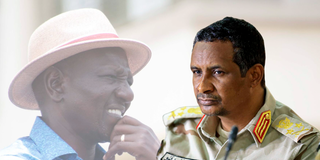
President William Ruto (right) and RSF Leader General Mohamed Hamdan Dagalo at State House, Nairobi.
Photo credit: PCS
Garang found in this Lavington compound what he rarely encountered elsewhere: sanctuary. Privacy. A place where a man at the centre of a liberation war could think and recover, could plan and persuade.
Here, in a six-bedroom home on a lush one-acre garden, he received his most trusted commanders, South Sudanese politicians, humanitarian emissaries, and foreign envoys. Kenyan intelligence officers slipped in and out quietly, taking the temperature of a conflict whose flames were visible across the border. Deals were brokered. Alliances tested. The transformation of the SPLA — from a guerrilla force to a political power — was choreographed behind these walls. In many ways, Nairobi was not just a neighbour. It was a stage where Sudan’s wars rehearsed their next act.
When the war between the Sudanese Armed Forces (SAF) and the Rapid Support Forces (RSF) erupted in 2023, Kenya once again found itself drawn into the vortex. But this time, the alliances seemed less clear, the intentions more disputed, the consequences more volatile.
South Sudan's Dr John Garang who never lived to see the fruits of his struggle.
Photo credit: File | Nation Media Group
The turning point came in early 2024, when President William Ruto hosted RSF leader Mohamed Hamdan Dagalo — better known as Hemedti — at State House, Nairobi. The optics were striking, even jarring. Hemedti, commander of a paramilitary force internationally accused of mass atrocities, strolled through the corridors of Kenya’s highest office, smiling for photographs and shaking hands with officials. For many Sudanese watching from afar, the event was nothing short of diplomatic legitimisation.
The timing made it even more explosive. The RSF had just unveiled a governing structure in the territories under their control; a move widely seen as an attempt to establish a rival administration and carve out a parallel state. By meeting Hemedti so soon after this announcement, critics argued, Kenya appeared to be blessing this embryonic breakaway government.
So, when US Secretary of State Marco Rubio warned last week that Washington “knows who’s involved” in supplying weapons to the RSF, his words reverberated sharply in Nairobi’s diplomatic circles. “They’re clearly receiving assistance from outside,” Rubio said, adding that pressure was being applied to “relevant parties.” He did not name the countries he had in mind.
For months, suspicions had been swirling. Earlier in the year, video footage surfaced from an alleged RSF depot near Khartoum showing crates of ammunition bearing Kenyan markings. Nairobi immediately dismissed the images as manipulated or misinterpreted. But for many observers, the footage reopened old wounds, especially given Kenya’s complicated historical role in Sudan’s earlier conflicts.
President William Ruto (right) and RSF Leader General Mohamed Hamdan Dagalo at State House, Nairobi.
Photo credit: PCS
It also raised new questions about Kenya’s posture toward Hemedti — questions that intensified after the RSF declared their “transitional government” shortly after the Nairobi visit. Whether coincidence or choreography, the optics were damaging. Sudan’s internationally recognised government in Port Sudan accused Kenya of conferring legitimacy on a militia implicated in ethnic cleansing. Governments from Turkey to Saudi Arabia expressed disquiet. Sudanese citizens marched in anger, accusing Kenya of siding with their tormentors.
Kenya denied all accusations. But perception, once seeded, is notoriously difficult to uproot.
To be fair, Kenya is hardly the only country under scrutiny. The United Arab Emirates has long been the primary alleged supplier of weapons, drones, and logistical support to the RSF. The SAF accuses the UAE of funnelling arms into Sudan through Chad, the Central African Republic, and a constellation of African intermediaries. Both the UAE and the RSF deny everything. Yet satellite images, battlefield debris, and captured equipment have increasingly pointed in that direction.
In this geopolitical labyrinth, Kenya risks becoming entangled in ways far more consequential than in past Sudanese conflicts. The United States has classified RSF atrocities in Darfur as genocide — an indictment that carries weight beyond rhetoric. If Kenya is perceived as offering political legitimacy, logistical channels, or diplomatic cover to an RSF allegedly backed by the UAE, it risks placing itself at odds with Washington, its principal security and economic partner.
This is not the first time Kenya has been accused of entanglement in Sudan’s wars. In 2008, the world watched aghast as Somali pirates hijacked the MV Faina, a Ukrainian vessel loaded with T-72 tanks and heavy weaponry. Kenya initially insisted the shipment was for its own military.
Delegates affiliated to Sudan's Rapid Support Forces during a meeting at Kenyatta International Convention Center in Nairobi on February 18, 2025.
Photo credit: Reuters
Documents later suggested the cargo was destined for the SPLA, then transitioning into what would eventually become South Sudan’s national army. A 2020 Swiss research report concluded that tanks photographed in a South Sudanese military base were identical to those unloaded in Mombasa —implying Kenya had covertly facilitated SPLA armament in violation of peace agreements.
Nairobi’s involvement in Sudanese politics has never been ideological. It has been strategic, regional, historical and at times for selfish gains by leaders. Garang’s commanders lived here. They trained, fundraised, negotiated, and recovered here. Kenya midwifed the Comprehensive Peace Agreement of 2005. When South Sudan was born, Nairobi was among the first to cradle it. These ties did not evaporate with independence; they merely shifted shape.
Thus, when President Ruto met Hemedti, the gesture was not viewed in isolation. It was interpreted through decades of accumulated memory — of Kenya picking sides, of quiet deals and quiet betrayals, of Nairobi’s perennial role as a discreet political furnace where Sudan’s conflicts were melted down and reforged.
The SAF government responded with unprecedented bluntness. After the RSF returned to Nairobi to sign a “transitional constitution,” the Sudanese Armed Forces released a blistering statement accusing Kenya of embracing a “genocidal militia” and labelling Kenya a “rogue state.” Such language, rarely heard in East African diplomacy, reveals the region’s growing fragility.
Delegates from Sudan's West Darfur State at the KICC in Nairobi on 18 February 18, 2025, ahead of the planned signing of the Government of Peace and Unity Charter.
Photo credit: Evans Habil | Nation Media Group
The RSF’s signing of what they called the “Sudan Founding Charter” effectively laid the foundation for a parallel administration, threatening further disintegration of a country already cascading into humanitarian catastrophe. Their recent capture of El-Fasher, after an 18-month siege, left behind scenes too painful for delicate description: mass graves, charred neighbourhoods, and communities targeted with chilling precision. Satellite images show bodies strewn in open fields. Human rights groups have long warned that what is unfolding in Darfur bears the unmistakable hallmarks of genocide.
Speaking at talks near Niagara Falls, Secretary Rubio did not mince his words. “Women and children have been targeted in acts of the most horrific kind,” he said. “This is not collateral damage. This is deliberate.” His frustration was palpable, his warning unmistakable.
Whether such remarks will shift the behaviour of regional actors—some of whom have cultivated Sudanese alliances for decades—remains to be seen.
What is certain is this: the ghosts of old wars still roam Nairobi’s diplomatic corridors. The legacy of safe houses, exiled politicians, clandestine arms shipments, and midnight negotiations has never left the city’s bloodstream. It lingers in its embassies, in its intelligence briefings, in its carefully choreographed silences.
And that house in Lavington stands as a reminder of a time when a war was once directed from its rooms. In East Africa, history never truly passes. It merely changes its actors, its uniforms, and its excuses.
John Kamau is a PhD candidate in History, University of Toronto. Email:[email protected] ; X: @johnkamau1