A Kenyan who has been fighting to stop his extradition from Morocco after being linked to an illegal Sh7.5 billion global arms trade is currently held at a prison in the United States.
Elisha Odhiambo Asumo was extradited to the US on March 11 from Morocco following a covert international operation that had been quietly unfolding across continents.
To investigators, his arrest in April 2025 was part of efforts to dismantle a global network that allegedly sought to funnel military-grade weapons to one of the world’s most feared drug cartels—Cartel de Jalisco Nueva Generación (CJNG).
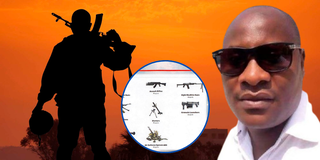
A screenshot of the Arms Brochure, which included advertisements for various types of military-grade weaponry, including drones, surface-to-air missiles and rocket-propelled weapons.
US prosecutors say Asumo was helping to connect African documentation channels with European arms dealers in the scheme valued at $58 million (Sh7.5 billion). The US Attorney’s office in the Eastern District of Virginia said Asumo appeared in a federal court on March 12, accompanied by Federal Bureau of Investigation (FBI) officers.
“The defendants allegedly believed that the CJNG intended to use these weapons in furtherance of the illegal trafficking of large shipments of cocaine into the United States. On Feb. 20, 2025, the CJNG was designated a Foreign Terrorist Organization under the Immigration and Nationality Act and as a Specially Designated Global Terrorist under Executive Order 13224. Arms sales to transnational criminal organisations like the CJNG are prohibited by virtually every country,” the US Attorney’s office said in a statement.
Elisha Asumo who has been linked to the Jalisco New Generation Cartel (CJNG).
Photo credit: Pool
Asumo’s group was led by Bulgarian arms dealer Peter Mirchev. Prosecutors allege that the Kenyan’s role centred on securing end-user certificates, which are used to certify the final destination of weapons. Instead of serving as safeguards, these papers were allegedly falsified to conceal the cartel as the true recipient. Through contacts in Africa, investigators say, Asumo helped to obtain documentation that gave the appearance of legitimate transactions while masking illicit intent.
The network had advanced to what investigators describe as a “test phase”. A shipment of 50 AK-47 rifles, complete with magazines and ammunition, was allegedly arranged from Bulgaria using forged Tanzanian documentation. The purpose, prosecutors say, was to validate the supply chain to prove that the network could deliver weapons successfully before scaling up to far larger deals.
Rocket-propelled grenade launchers
Court documents reveal discussions of a vast weapons catalogue worth billions. The list included rocket-propelled grenade launchers, sniper rifles, anti-aircraft systems, surface-to-air missiles and even weaponised drones. Prosecutors say the suspects were aware that these weapons were destined for cartel use, which strengthens their case.
The US has linked Kenyan Elisha Odhiambo Asumo to involvement in transnational arms and drug trafficking Mexican grouping called Cartel Jalisco Nueva Generación.
Photo credit: Shutterstock
Authorities allowed the plot to continue developing. By doing so, they were able to capture not just isolated acts, but a pattern of behaviour, meetings, agreements, document preparation and logistics coordination. In one instance, prosecutors note that the conspirators “agreed to again provide arms control documents designed to obscure” the cartel as the end-user, underscoring the calculated nature of the scheme.
The operation spanned multiple countries. While Asumo was arrested in Casablanca, Morocco, Mirchev was detained in Madrid, Spain. Another suspect, identified as Subiro Osmund Mwapinga, was apprehended in Ghana and later extradited to the US, while Ugandan national Michael Katungi Mpweire remains at large.
Mirchev, was on April 20, 2026, arraigned in a US court following his extradition from Spain, the attorney’s office said. The court was informed that in a series of meetings with individuals claiming to represent the CJNG, Mirchev agreed to arrange, coordinate and participate in illegal arms transactions.
Investigations suggest that African documentation channels were central to the scheme, raising questions about how easily official paperwork can be manipulated. While there is no indication of State involvement, the case places a Kenyan national at the centre of a sophisticated criminal enterprise with far-reaching implications.
Background reports indicate that Asumo had established connections that allowed him to navigate multiple jurisdictions, making him a valuable asset in the network. His ability to secure or influence documentation processes in Africa gave the operation a veneer of legitimacy, enabling weapons to move across borders without immediately raising red flags. It is this intersection of local access and global ambition that investigators say made the network particularly dangerous. The US government has framed the case as part of a broader effort to combat transnational organised crime.
Each of the accused faces serious federal charges, including conspiracy to provide material support to a criminal organisation. If convicted, they face a mandatory minimum sentence of 10 years, with the possibility of life imprisonment. Authorities are expected to rely heavily on undercover recordings, documentary evidence and witness testimony.
The undercover sting that brought down the network underscores both the sophistication of law enforcement and the scale of the threat. By infiltrating the operation and posing as cartel buyers, investigators were able to expose not just a single transaction, but an entire supply chain.
It is a method that has been used in other high-profile cases, but rarely with such a broad international footprint. Asumo now sits in US custody, awaiting trial in a case that could take years to conclude. Yet even as legal proceedings begin, questions linger. How many similar networks operate undetected?
How vulnerable are international systems meant to regulate the flow of weapons? And to what extent are individuals in countries like Kenya being drawn into global criminal enterprises? But one thing is clear: what began as a covert operation has evolved into a stark illustration of how deeply interconnected the world of organised crime has become.