Families of Kenyans killed during the June 2024 anti-Finance Bill protests marked the second anniversary of the demonstrations on Thursday with renewed calls for justice, saying compensation cannot replace accountability for the deaths of their children.
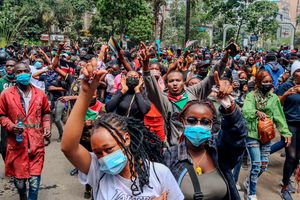
In Nairobi and elsewhere, grieving parents gathered to honour those killed during protests that began over tax measures before evolving into a broader movement demanding accountability and better governance.
June 25 anniversary: Family lay flowers on barbed wire after Parliament snub
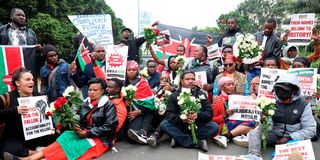
Outside Parliament Buildings, families laid wreaths and held portraits of their loved ones. Many said returning to the sites where their children died reopened wounds that remain unhealed two years later.
Standing near Parliament Road, Edith Wanjiku Kamau recalled her son, Ibrahim Kamau, who was killed during the demonstrations.
Edith Wanjiku Kamau, the mother to the late Ibrahim Kamau, outside Parliament Building on June 25, 2026 during demonstrations marking the second anniversary of the Gen Z anti-Finance Bill protests.
Photo credit: Bonface Bogita | Nation Media Group
“My request to President William Ruto is simple. The police officers who killed our children are known. Arrest them, remove them from service and just give us justice,” she said.
Caroline Mutisya, the mother of the late Erickson Mutisya, speaks outside Parliament building on June 25, 2026 during demonstrations marking the second anniversary of the Gen Z anti-Finance Bill protests.
Photo credit: Bonface Bogita | Nation Media Group
“My child cannot be equated to compensation. Compensation should go hand in hand with justice. Until those responsible are held accountable, our wounds remain open,” said Carolyne Mutisya, whose son Erickson Mutisya was killed during the protests.
For Jacinta Anyango, the anniversary revived painful memories of her 12-year-old son, Kennedy Onyango, who was shot dead in Rongai, Kajiado County.
Jacinta Anyango, the mother of the late 12-year-old Kennedy Onyango, who was killed in Rongai during protests, weeps during the demonstrations marking the second anniversary of the Gen Z anti-Finance Bill protests outside Parliament Buildings on June 25, 2026.
Photo credit: Bonface Bogita | Nation Media Group
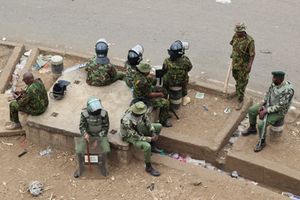
“My son was killed and no one has been arrested. Let us mourn our children peacefully. We do not want teargas. We do not want violence. We only want justice,” she said.
Rex Masai’s mother, Gillian Munyao, echoed the call.
“Justice first. The officers who killed our children must be arrested because no amount of money can replace a life,” she said.
Gillian Munyao, the mother of the late Rex Masai, speaks to the media in Nairobi on June 25, 2026 after laying wreaths at Parliament Buildings in honour of her late son.
Photo credit: Francis Nderitu | Nation Media Group
In Nakuru, Maria Shiewe said the pain of losing her son, Austin Makhoha, remains raw two years later.
Makhoha, who lived with autism, left their Kabachia home during the protests to help his younger siblings get to safety. Hours later, his body was found at Nakuru Teaching and Referral Hospital mortuary with six gunshot wounds.
“He was not a protester. He was protecting his younger brothers and I only want to know who shot my child and maybe then I can find peace,” Ms Shiewe said.
She described her son as gentle, protective and devoted to his family. “He hated quarrels and loved his family. He looked after his younger brothers and no mother should ever have to bury a child,” she said.
Ms Shiewe said compensation would not ease her grief, describing such payments as “blood money”.
“Even if they bring it, it will not enter my compound. No amount of money can replace my son,” she said.
Elsewhere in Nakuru County, Violet Gwazina remembered her last-born son, Kelvin Madaga, whose dream of becoming a teacher was cut short by a police bullet.
Violet Gwazina during an interview at her home in Ngata estate, Nakuru estate on June 24,2026. Her son Kelvin Madaga was shot dead during the 2024 anti-finance bill demonstrations in Nakuru town.
Photo credit: Mercy Koskei | Nation Media Group
Madaga, a first-year student at Migori Teachers College, died three days after being shot during the demonstrations.
“Every time I think about my son, I cry. I do not know if I will ever forget him. The pain is still fresh,” Ms Gwazina said.
“Even if someone gives me millions of shillings, I cannot go to the market and buy another child. Money cannot replace my son.”
In Narok, the family of 19-year-old Brian Kasaine reflected on the life of a teenager they say had a promising future. Kasaine, who scored a B+ in the KCSE examination, had been preparing to join university when he was shot dead near Narok Police Station.
His father, Justus Nyayo, said the family still struggles to come to terms with the loss. “We have lived in agony. Every day we ask the same question: Who killed our son and why?” he said.
His mother, Mary Nyanchoka, recalled the last conversation they shared before he left home.
“We laughed together that morning. We spoke normally and then he left for town and never came back. His only mistake was joining a peaceful protest,” she said, maintaining that her son was unarmed.
Separately, survivors of alleged state violence criticised what they described as the exclusion of victims of abductions and enforced disappearances from a proposed compensation programme.
The Coalition of Victims and Survivors Against State Violence (CVSSV) issued a 24-hour ultimatum demanding publication of the names of affected victims, failing which it said it would move to court.
The coalition accused the compensation committee chaired by Prof Makau Mutua of selectively implementing recommendations contained in a report by the Kenya National Commission on Human Rights (KNCHR).
“Abductions and enforced disappearances are among the gravest categories of state-sponsored human rights violations witnessed in Kenya’s recent history. None of the 35 cases of enforced disappearances and 135 cases of torture have been listed in the purported phase one payouts,” said Jamil Longton.
The coalition argued that excluding such victims undermined the credibility of the compensation process and weakened efforts to secure justice for all affected families.
Lawyer Abna Mango said the committee lacked the legal authority to alter the KNCHR recommendations and announced plans to challenge the process in court under Article 47 of the Constitution, which guarantees fair administrative action.
“Their move to omit victims of enforced disappearances is not only overreaching but also unlawful,” Mr Mango said.
Reporting by Kevin Cheruiyot, Eric Matara, Jurgen Nambeka and Mercy Koskei