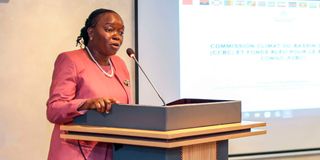
Kenya is hosting a high-level meeting of the Congo Basin Climate Commission, where regional leaders and experts called for accelerated financing and stronger coordination to protect the world’s second-largest tropical rainforest amid growing climate pressures.
Speaking at the opening of the Focal Points Meeting of the Congo Basin Climate Commission in Nairobi on Tuesday, the Cabinet Secretary for the Environment, Climate Change and Forestry, Deborah Barasa, said that the gathering comes at a “decisive moment” for Africa’s climate agenda, as countries seek to align regional priorities with the new global commitments made at last year's UN climate summit in Brazil.
“We gather here at a decisive moment in our collective journey to safeguard Africa’s ecosystems, strengthen climate resilience, and advance sustainable development for our people,” Ms Barasa said in welcoming remarks delivered on behalf of the government and people of Kenya.
Republic of Congo’s Minister of Environment and Sustainable Development and Executive Secretary of the Congo Basin Climate Commission, Arlette Soudan-Nonault (left), alongside Kenya’s Cabinet Secretary for Environment, Climate Change and Forestry Dr. Deborah Barasa(center) and the Special Envoy of the President of the Republic of Kenya on Climate Change, Ali Mohamed (right), during a high-level meeting at Four Points by Sheraton, Hurlingham, Nairobi, on January 27, 2026.
Photo credit: Wilfred Nyangaresi | Nation Media Group
The Congo Basin Climate Commission, established following the 2015 Paris Agreement and endorsed by the African Union in 2017, brings together countries from the Economic Community of Central African States and the East African Community to pursue low-carbon, climate-resilient development. Its members include Angola, Cameroon, the Democratic Republic of Congo, Kenya, Uganda and Tanzania, among others, with Morocco as a founding partner.
At the heart of the commission’s work lies the Blue Fund for the Congo Basin: a regional financing instrument designed to support projects in forestry, agriculture, water, energy, transport, and infrastructure. Officials described the fund as a practical and symbolic tool for promoting nature-based solutions.
“This fund is not merely a financing mechanism; it is a symbol of Africa’s determination to invest in nature-based solutions and ecosystem-driven adaptation,” she added.
Participants said the Nairobi meeting is part of a sequence leading to a donors’ round table scheduled for May 2026 in Brazzaville, Republic of Congo. 43 flagship projects have already been selected following portfolio harmonisation last October and were presented to partners at the UN climate conference, known as COP30, in Belém, Brazil.
“Now, here in Nairobi, our task is to integrate that feedback, finalise technical and budgetary files, and approve the resource mobilisation strategy and communication plan,” added CS Barasa.
COP30 marked a turning point for forests, placing them at the centre of global climate discussions for the first time. Delegates welcomed the adoption of the Belém Pact, which formally links the conservation of tropical forests to climate finance, as well as the launch of the Tropical Forests Forever Facility, a new blended-finance mechanism which has received initial pledges totalling almost $7 billion.
However, speakers acknowledged shortcomings, including the absence of a binding global roadmap to end deforestation and persistent gaps in forest finance.
“While new mechanisms were launched, overall finance for forest protection and sustainable management remains insufficient, especially compared to the scale of the crisis,” noted Mr Ali Mohamed, the Special Envoy of the President of the Republic of Kenya for Climate.
Jean Paterne Megne Ekoga, Vice-President of the Development Bank of Central African States (BDEAC), addresses delegates at a high-level meeting at the Four Points by Sheraton, Hurlingham, Nairobi, on January 27, 2026.
Photo credit: Wilfred Nyangaresi | Nation Media Group
The Congo Basin, which stores vast amounts of carbon and supports millions of livelihoods, has historically received less international funding than other major tropical forests, such as the Amazon. According to officials, the outcomes from Belém offer an opportunity to address this imbalance, provided that regional coordination is strengthened.
“The Congo Basin is a global climate asset,” he said. “Its protection is not only a regional priority but a global imperative.” He added.
Kenya, as host, reaffirmed its commitment to the Paris Agreement, the U.N. 2030 Agenda and the African Union’s Agenda 2063, pledging to work with partners to ensure the Blue Fund delivers tangible results, including jobs, improved livelihoods and stronger ecosystem resilience.
“As immense as the task before us is, so too is our collective resolve,” the official said. “Let us ensure that the Congo Basin Climate Commission becomes a beacon of hope, innovation and solidarity for generations to come.”
Speaking at the same event, the Minister of the Environment, Sustainable Development and the Congo Basin, Arlette Soudan-Nonault, said that its financial instrument, the Blue Fund for the Congo Basin (F2BC), the Climate Commission of the Congo Basin (CCBC) serves as a politico-diplomatic mechanism designed, among other objectives, to ensure coordination of initiatives, programmes and projects aimed at reconciling the fight against climate change with socio-economic development in our Member States.
“I welcome the presence of all CCBC–F2BC Focal Points and all finance experts from our Member States, sub-regional organisations and the Central African States Development Bank,” she said.
She also thanked the Central African States Development Bank (BDEAC) for its technical support alongside the Executive Secretariat of the CCBC, as well as all our technical and financial partners, including ECCAS, the EAC, 4C Morocco and all our partners. “I am thinking in particular of UNDP and AFD for their multifaceted support.”
Republic of Congo’s Minister of Environment and Sustainable Development, and Executive Secretary of the Congo Basin Climate Commission, Arlette Soudan-Nonault, during a high-level meeting at Four Points by Sheraton, Hurlingham, Nairobi, on January 27, 2026.
Photo credit: Wilfred Nyangaresi | Nation Media Group
The Congo Basin is becoming increasingly important in discussions about the global climate, nature-positive growth and the carbon market, since it contains one of the world's most significant carbon sinks and biodiversity regions.
It also focused on laying the political and technical groundwork for large-scale capital mobilisation through the Blue Fund mechanism, while promoting Africa-led climate solutions ahead of key global financing events in 2026.
As a leading figure in African climate action and the chair of the Committee of African Heads of State and Government on Climate Change (CAHOSCC), President William Ruto has received reports on these and other strategic documents, including a draft decision presented to the committee in February 2025.
The final coordinated strategy aims to secure funding for projects in forestry, agriculture, fisheries and infrastructure within the 17 member countries by aligning climate mitigation, adaptation and resilient growth.