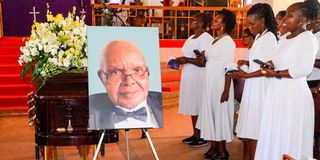
Three different forms of practices are expected to take part in the burial of distinguished historian Prof Bethwell Allan Ogot at his home in Umiru village, Gem Yala, Siaya County.
Prof Ogot will be buried on Saturday February 22 in a ceremony expected to be attended by many dignitaries from across the country and continent.
On Friday, a requiem mass for the fallen historian was held at St Paul’s Anglican Church of Kenya in Yala after the body arrived at around noon.
Later, members of the public had an opportunity to view the body at Yala Township Primary School before a night vigil at his home.
Anyone wishing to pay tribute to the fallen doyen has been asked to do so during the night vigil, as there is likely to be limited time during the funeral service due to the presence of dignitaries.
Meanwhile, at Maseno University’s Odera Akang’o campus, the venue for the funeral service, preparations were in top gear, with event organizers erecting a massive dome tent ahead of the funeral.
A few kilometres away, at his home in Gem Yala, his grave has already been dug, and he will be laid to rest next to his late wife Grace Ogot’s mausoleum.
When asked how the three groups would work together during the final send-off of the departed scholar, burial committee chairman Eng. Sam Opot said a final meeting between the burial committees in Yala and Nairobi would be held to finalize the program.
“We shall have a final consultative meeting between the home burial committee and the one in Nairobi after the requiem mass. After that, we shall be able to outline how the program will run and who will be in charge,” said Eng Opot.
According to Mr Willis Onyango Masime, an elder and member of the funeral organizing committee, the elders will be part of the night vigil and will also play a prominent role during the funeral.
Prof Ogot was a renowned scholar, a staunch Christian, and a strict adherent of Luo traditions.
There were concerns that these three aspects might clash or that one might take precedence over the others.
However, Mr Onyango assured that all three would feature prominently in the final send-off.
“We will bury him in accordance with Luo traditions, as we always do for elders. Scholars will also be there to pay their last respects. They will serve as pallbearers, just as they did in Nairobi during the requiem mass,” said Mr Onyango.
Prof Ogot was well known for his deep knowledge of Luo traditions, which he often shared in various forums.
In what the community refers to as Luo Kitgi Gi Timbegi—which translates to Luo customs and beliefs—expectations are high that, just as soldiers receive a gun salute, the esteemed professor’s burial will adhere to all Luo cultural rites.
In the Luo community, there are specific rites guiding the burial of an elder.
A funeral for a prominent figure or elderly person is not complete without Tero Buru—a ritual performed to celebrate the departed and drive away spirits before burial.
During this ceremony, elders and selected youths drive a herd of cattle around the home of the deceased before leading them to the nearest water body—usually a river or lake—where evil spirits are believed to be destined.
Participants in this ritual typically dress in animal hides and sisal hats, wear the famous akala (tyre sandals), carry twigs, and chant war songs to ward off spirits.
Azimio leader Raila Odinga and Siaya Governor James Orengo participated in this ritual during the burial of former Education Cabinet Secretary Prof George Magoha.
After the dust settles, the entire village gathers around the gravesite, drinking traditional brew while singing and dancing around the casket.
Ker Odungi Randa, Chairman of the Luo Council of Elders, told Nation.Africa that while Prof Ogot was an elder, he was also a distinguished academician, meaning scholars would likely play a critical role alongside the elders.
However, he emphasized that the professor deserved a befitting send-off in accordance with Luo traditions.
“While academia will take the lead in the funeral since he was known in those circles, his educational background does not prevent us from observing our traditions. Tero Buru should be performed so that he is laid to rest as a Luo elder. Unfortunately, we do not have herds of cattle nowadays, but five bulls would suffice for this important cultural rite,” said Mr Randa.
He added that Sigweya or Gweyo—chants where individuals invoke the name of the deceased and recall fond memories—would be performed.
Additionally, as an elder, Prof Ogot must be buried between 4 and 5 p.m.—neither earlier nor later.
Mr Randa eulogized the fallen historian as a hero who put Luo traditions on the map, with one of his last public engagements being his presentation at the Piny Luo festival in January in Siaya.
As a professor emeritus of both Maseno University and Masinde Muliro University of Science and Technology, these institutions are expected to play prominent roles in the ceremony, according to Dr Charles Nyambunga of Maseno University.
“After Masinde Muliro and Maseno universities take their prominent roles, the late Prof Ogot’s membership in the historians’ community of East Africa means they too will play a significant role in the ceremony,” said Dr Nyambunga.
According to academic tradition, pallbearers are supposed to be PhD holders dressed in robes, as a sign of respect to the departed scholar.
“Prof Ogot can only be compared to Prof Gideon S. Were, who also made immense contributions to history. Based on his great achievements, he deserves a proper send-off with scholars taking a leading role,” added Dr Nyambunga, a widely published media scholar.
The Anglican Church of Kenya is also expected to play a significant role in the ceremony, as the late scholar was a Christian and a member of the denomination.
Evangelist Daniel Okuku, however, emphasized the need for a clear distinction between the church, academic, and cultural components of the ceremony.
“Even though the late scholar was not a member of the clergy, the Anglican Church of Kenya will play a major role in the final ceremony. However, there should be no mix-up during the ceremony. For instance, the church service should not be interrupted by elders running with bulls—that would be unfortunate,” said Evangelist Okuku.
He continued: “Let the church perform its part, the scholars handle their portion, and, if necessary, the elders also have their time to eulogize the departed scholar.”
Prof Ogot was a towering figure in Kenyan and East African history. His publications remain major resources in Kenya’s education curriculum, particularly on the migration and settlement of communities in the country.