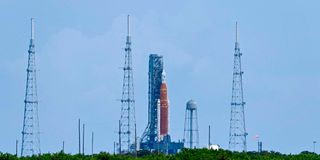
The Artemis I unmanned lunar rocket sits on launch pad 39B after its launch was postponed, at NASA's Kennedy Space Center in Cape Canaveral, Florida, on September 3, 2022.

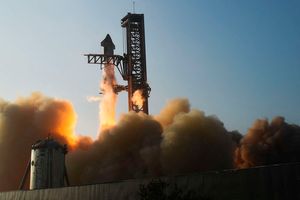
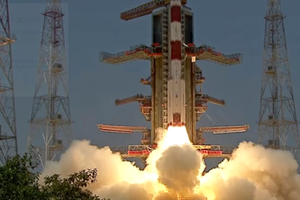
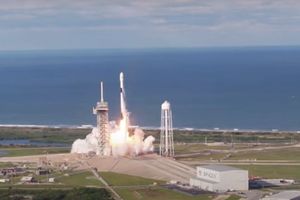
At 1.24am Wednesday, April, 1 (East African time), a rocket is expected to fire off the coastal state of Florida in the United States with enough force to hurl four humans outside the Earth and towards the moon.
It will be history in the making because among the four will be a woman, a black man and a non-US citizen set to be the first of their kind to fly beyond low earth orbit (at least 2,000 kilometres above the Earth’s surface).
The four will be in a cylindrical “house”, with a diameter of five metres, called the Orion spacecraft. The spacecraft will be their home for at least 10 days as they go around the moon and back to Earth.
They will not be landing on the moon, but their mission – termed a test flight – is a crucial step towards plans by the US to have a man back on the moon by 2028. At their closest to the moon, they will be about 9,600 kilometres away from its surface.
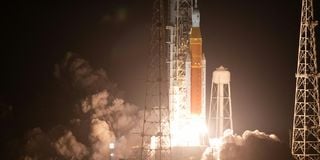
In this handout photo provided by NASA on November 16, 2022, the Artemis I unmanned lunar rocket lifts off from launch pad 39B at NASA's Kennedy Space Center in Cape Canaveral, Florida. NASA's Artemis 1 mission is a 25-and-a-half day.
The launch, scheduled for 6.24pm Florida time from the Kennedy Space Centre, is part of a mission codenamed Artemis II. There was Apollo, and now there is Artemis.
For starters, Apollo is the nickname of the mission that saw numerous flights targeting the moon in the 1960s to the 1970s. Apollo 1 (1967) ended in tragedy, leaving three astronauts dead; Apollo II (1969) put the first man on the moon, while Apollo 17 (1972) marked the last time astronauts set foot on the moon.
Since Apollo 17, humans haven’t flown beyond low Earth orbit (which is 160 to 2,000 kilometres above the surface). Artemis II will take humans beyond low Earth orbit; Artemis III will be in low Earth orbit for various tests, while Artemis IV is expected to land humans on the moon.
“Artemis II builds on the success of the uncrewed Artemis I in 2022, and will demonstrate a broad range of capabilities needed on deep space missions,” America’s National Aeronautics and Space Administration (NASA) says on its website.
In Greek religion, Artemis is the twin sister of Apollo. She is the goddess of wild animals, the hunt, and vegetation, chastity and childbirth.
NASA started a countdown to the launch on Monday. However, as it happened with Artemis I in 2022, the take-off might be postponed if the weather isn’t ideal or if faults are identified. As from the scheduled take-off time, NASA says there will be a two-hour window for the launch.
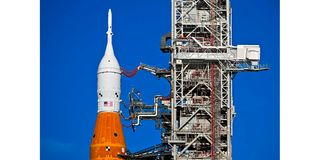
The Artemis I unmanned lunar rocket sits on its launch pad 39B at NASA's Kennedy Space Centre in Cape Canaveral, Florida.
“The weather forecast shows an 80 per cent chance of favourable weather conditions, with cloud coverage and potential for high winds on the ground as primary weather concerns,” NASA said on its website.
The four-person crew that will be in the Orion spacecraft comprises Nasa’s Reid Wiseman, Victor Glover and Christina Koch.
Jeremy Hansen (mission specialist) from the Canadian Space Agency will be the first non-US citizen to go beyond low Earth orbit.
Christina, another mission specialist, will be the first woman to go beyond that barrier, while Glover (pilot) will be the first black man to reach the milestone. Wiseman is the mission’s commander.
Their spacecraft will literally be falling for the most part of its mission post-launch. That means that it will be given a special boost, then be subjected to the moon’s and Earth’s gravity as it travels to the far side of the moon then re-enters the earth.
The Artemis I unmanned lunar rocket sits on launch pad 39B after its launch was postponed, at NASA's Kennedy Space Center in Cape Canaveral, Florida, on September 3, 2022.
Think of it as a free-wheeling vehicle moving without burning fuel.
A Kenyan-born engineer, Mr Samuel Ndaro, played a part in creating the rocket that lifted the Orion spacecraft to space in Artemis I.
Speaking with the Nation in 2022, he said he was part of the team at Boeing that was looking out for any shortcomings in a component of the launch setup called the intertank that literally connects two different tanks of the launcher.
As a certified material board engineer, Mr Ndaro led a team of four that inspected the parts that manufacturers sent to Boeing to be included in the intertank. If there were any discrepancies in the specifications, it was his job to ensure that modifications were good enough “in terms of engineering, quality and safety to be put on the rocket”.
Follow our WhatsApp channel for breaking news updates and more stories like this.