A legal battle over the authenticity of former Attorney General James Boro Karugu’s will has intensified, with conflicting forensic reports deepening the dispute.
The development comes even as lawyer Peter Gachuhi, named as an executor of the disputed will and one of the petitioners challenging intended criminal charges over forgery, denied drafting the contested document. In an affidavit filed in court, he states that while Karugu had asked him in 2013 to serve as an executor and trustee for a planned foundation, he neither drafted the will nor the trust deed.
The contested documents, a Will and trust deed dated April 2, 2014, were presented to Karugu’s family weeks after his death in November 2022, sparking objections from his daughter, Victoria Nyambura, and prompting a criminal probe.
State investigators, relying on a forensic examiner’s findings, argue that signatures and initials on the documents match Karugu’s known handwriting samples. They noted page-number anomalies and pagination breaks suggesting a “cut-and-paste” assembly.
The DCI report asserts that “the signatures were made by the same author” and notes consistency in certain initials.
However, irregularities such as inconsistent pagination, unprofessional property schedules, disputed signatures on critical pages, and a smudged page number raised suspicions of tampering.
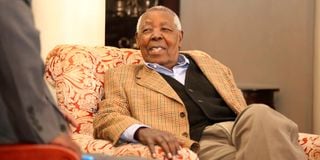
Kenya’s second post-independence Attorney-General James Boro Karugu.
Photo credit: File | Nation Media Group
“The impugned Will and Trust Deed as presented, bear several drafting concerns that do not resonate with professional standards of a man of the stature of Karugu; an impeccable lawyer and second Attorney General of the Republic of Kenya. The initials appearing in all pages of the two questioned documents, as of the deceased, are a forgery,” the DCI replying affidavit reads.
In contrast, a privately commissioned forensic expert, Anthony Ngige, disputes the DCI’s conclusions.
The expert states that the questioned signatures and writings do consistently match known samples, indicating they are genuine, of the same author and they have neuromuscular consistency.
“The findings of this forensic document examination support the genuineness, authenticity, and integrity of the Last Will and Testament and the Settlement Trust Deed of James Boro Karugu. Scientific examination did not identify evidence of page insertion, document assembly, or material alteration. The allegations of forgery are not supported by forensic evidence,” says the expert, dismissing forgery claims.
Former Attorney-General James Boro Karugu.
Photo credit: File | Nation Media Group
According to him, any minor differences observed were assessed to be natural variations, which are expected in genuine handwriting, “as no individual can reproduce a signature in an identical manner on every occasion.”
He also criticised the DCI for not employing advanced forensic techniques like infrared photography.
“The DCI’s allegations of forgery, by page insertion, cut-and-paste manipulation, alteration, simulation, or document assembly, are not supported by scientific examination. Independent analysis, including paper grain and fibre assessment, demonstrates uniform structural characteristics across all pages consistent with a single, unified document," says Mr Ngige, the CEO of Stealth Africa Consulting LLP.
He adds: The DCI report provides no comparable spectral analysis, nor any scientific basis to substantiate these claims.
This divergence has set the stage for a technical and legal contest over the reliability of forensic evidence.
While the State relies on its examiner’s findings to support criminal charges, the petitioners argue that the contradictions expose weaknesses in the prosecution’s case.
The Director of Public Prosecutions (DPP) and the DCI maintain that their findings justify criminal charges, citing alleged falsification and manipulation of documents affecting Karugu’s vast estate.
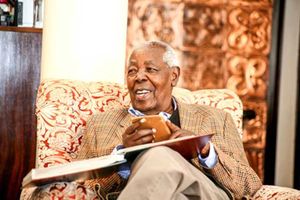
Former Attorney-General James Karugu recounts his life in office, during an interview at his Kiambu home on May 9, 2017 PHOTO | DIANA NGILA | NATION MEDIA GROUP
Meanwhile, lawyer Gachuhi and four other petitioners are seeking to halt the prosecution, arguing it could prejudice an ongoing succession case.
Gachuhi, in his witness statement, maintains he only agreed to act as an executor of the Will after being approached by Karugu and was not involved in drafting either the will or the trust deed. He also states he is not a beneficiary under the will and had no role in preparing the documents.
Victoria Nyambura has applied to join the proceedings as an interested party, claiming to be a victim of fraud. The petitioners oppose her inclusion, contending that the State adequately represents her interests. The Attorney-General has taken no position on her application, leaving the matter to the court’s discretion.
The case now hinges on two key issues: the reliability of forensic evidence and whether additional parties should be allowed into the proceedings.
The outcome could determine the fate of Karugu’s estate, valued at hundreds of millions of shillings, including prime properties, Treasury bonds, vehicles, and shares in NSE-listed companies.
Karugu, who served as Attorney General from 1980 to 1981, was buried at his Kiamara farm in November 2022.