Hello

Your subscription is almost coming to an end. Don’t miss out on the great content on Nation.Africa

Ready to continue your informative journey with us?

Hello

Your premium access has ended, but the best of Nation.Africa is still within reach. Renew now to unlock exclusive stories and in-depth features.

Reclaim your full access. Click below to renew.

Matter of life and death: Seme’s snake bite nightmare and anti-venom shortage

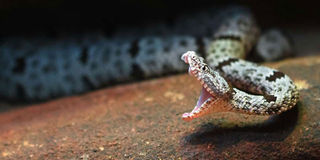
Seme sub-County reports at least 400 cases of snake bites in a year.

Photo credit: Shutterstock

What you need to know:

  • Records at the Kombewa Sub County Hospital in Seme show that 426 snake bite patients were admitted at the facility in 2023.

Residents of Seme sub-County in Kisumu are a worried lot following rising cases of snake bites, some ending in fatalities.

The sub-county reports at least 400 cases of snake bites in a year.

Health experts say several villages within Seme sub-County are prone to snake bites with the impacts being paralysis or death in case of late intervention.

Records at the Kombewa Sub County Hospital in Seme show that 426 snake bite patients were admitted at the facility in 2023 as admissions increased to 512 in 2024.

This year alone, 246 people were admitted after encountering snake bites. Up to 68 patients were given anti-venom over the past two years.

In December last year, Ms Nereya Ochieng’ felt a sharp pain in her left thumb as she was inspecting her chicken coop at her home in Kaila North Village, Seme Kisumu County.

The farmer initially heard her chicks squawking, a sign that they were in distress.

She went to inspect the cage without knowing the looming danger she was to encounter.

As she was putting the birds aside, she was bitten by a snake.

At first, she felt a slight pain on the finger since the serpent’s fangs did not go deep but a few minutes later, she started feeling dizzy while her heart was also pumping fast.

“I used a piece of cloth to tie around the bitten parts as my husband left home in a hurry to find out how I could be rushed to the hospital,” she recalls.

Swollen hand

The venom had begun spreading to other parts of the body and was affecting tissues on the hand.

“My hand was swollen and blood was also oozing from the bitten areas,” says Ms Ochieng’.

Unfortunately, when they arrived at Kombewa Sub County Hospital, the couple was informed that the facility had run out of anti-venom.

They were referred to the Jaramogi Oginga Odinga Teaching and Referral Hospital (JOOTRH) almost 35 kilometres from home.

When they arrived, they were informed again that the regional facility had also run out of anti-venom.

“I panicked and for a moment, I thought I was going to die,” she recalled.

The snake bite survivor was injected with the anti-venom from a private facility and later referred to JOOTRH where she was admitted for the next three days.

According to Ms Ochieng, the description of the snake aided the doctors in finding the right anti-venom to treat her.

A few kilometres away in Nyamisri village in the same sub-county, Ms Benter Osodo shared her experience after she suffered the same fate.

It was in October 2022 when she saw a snake hunting a rat under her bed.

As she tried to drive out the reptile and the rat, she was bitten on the hand and immediately rushed to Rodi Dispensary for treatment.

Ms Osodo had however been referred to Kombewa Sub County Hospital where she was admitted for three days.

“I am still unable to use the affected hand. I have to rely on help from those around,” Ms Osodo says.

Ms Osodo says this year, already one of her community members has been bitten by a snake.

She further notes that cases of snake bites among poultry and other domestic animals are also common.

Dr Isanda Martin, a veterinary surgeon in Kisumu says that just like humans, snake bites are equally dangerous to animals.

According to the veterinarian, animals that succumb to snake bites are not fit for human consumption.

“Locals often consume the carcass of the dead animals and only dispose of the affected area, there is however no scientific proof that disposing of the bitten area makes the animal fit for consumption,” says Dr Martin.

According to the expert, animals react differently to cases of venomous snake bite attacks.

Just like humans, he says, snake venom can kill an animal within two hours of attack.

“Consuming such an animal is extremely dangerous because the venom is likely to remain active in their system. The consumer is also likely to die from direct envenomation,” says Dr Martin.

Dr Vincent Otieno, a Medical Superintendent at Kombewa Sub County Hospital says the health facility, unlike others in other regions, receives multiple cases of snake bite patients each year.

He attributes the high number of snake bite survivors to favourable climatic conditions that make snakes thrive. Seme has a tropical climate.

It also has a forested area where snakes multiply fast.

“Up to 400 snake bite cases are admitted at the hospital every year. Luckily, most of them involve snakes that are non-venomous,” Dr Otieno says.

He also notes that a number of the survivors always show up at the hospital with cloth pieces tied around the bitten area.

Dr Otieno says the practice is dangerous since it affects the tissues around the tightly tied areas.

He also reveals that tying part of the affected body parts prevents proper blood circulation.

“We have had deaths especially whenever the survivors are unable to find medical attention on time,” she says.

Coupled with the scarcity or unavailability of anti-venom to treat the casualties, the residents are concerned that the numerous cases reported in hospitals can lead to more deaths or permanent injuries.

But in an effort to manage the growing cases of snake bites, Dr Otieno says the county recently embarked on delivering snake anti-venom using drone technology.

“In case of specialised care, we are always forced to refer the patients to JOOTRH,” Dr Otieno says.

Meanwhile, Dr Martin says there is need for public awareness of the impacts of snake bites on both humans and animals to limit cases of harm.

According to animal experts, cases of snakebites on animals remain unreported due to lack of information while posing as a threat to humans.

“In order to tackle the impacts of snakebites on both humans and animals, we need to adopt the one health concept. With this we can be able to protect our loved ones and animals all at the same time,” he says.

Snakebites 

According to Dr Otieno, the areas prone to snakebites are Rodi Ward and Asat Ward in Seme Sub-County Kisumu County.

Snake bites, a neglected tropical disease recognized by the World Health Organization (WHO), claim at least 100,000 lives globally.

In Kenya, snakebites kill at least 4,000 people each year leaving thousands with life-threatening paralysis.

According to the statistics by the Local Institute of Primate Research, survivors end up with lifetime complications or die as a result of delayed intervention.

While efforts are underway to produce a region-specific anti-venom, significant gaps remain in public awareness and healthcare infrastructure.

Earlier this year, Kenya achieved a significant milestone when it joined other countries during the 78th World Health Assembly in Geneva to become a global member of the Strike Out Snakebite (SOS) Initiative.

The initiative is aimed at bringing an end to snakebite.

Both the two women, now community health promoters (CHPs), admit they were clueless when asked about the type of snakes that bit them.

It is usually advisable for a survivor to know the physical details of a snake that bit them including the colour and physical appearance.

Nevertheless, they began taking precautions to prevent snake attacks and are using their experience to create awareness of snake bites.

Some of the measures they are using include clearing bushes around their houses.

The CHPs conduct outreaches to educate the community on the importance of keeping their environment clean to evade snake bites.

“Whenever we visit, we lay emphasis on the need to clear the bushes in the surrounding and keep the house neat,” says Ms Osodo.

The residents have equally encountered pythons which hunt livestock.