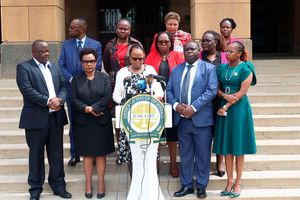
Mbadi and AG Oduor found in contempt, to appear in court for sentencing

Treasury Cabinet Secretary John Mbadi and Attorney-General Dorcas Oduor have been ordered to appear before the High Court next week for contempt.

Treasury Cabinet Secretary John Mbadi and Attorney-General Dorcas Oduor have been ordered to appear before the High Court next week for mitigation and sentencing after they were found guilty of disobeying court orders compelling the government to disclose details of sovereign bonds and how the borrowed funds were spent.
Justice Patricia Nyaundi directed the two senior government officials to appear before her on November 27, 2026, after finding them in contempt of court.
“Having found the 1st and 2nd respondent in contempt, what follows next is a determination of the appropriate sanction. I therefore direct that Hon CPA John Mbadi Ngong’o EGH and Hon Dorcas Odour SC, EBS, OGW, attend court on November 27, 2026 at 12 pm for mitigation and sentencing,” said the judge.


The contempt proceedings arise from a December 2024 judgment in which the High Court found that the government had violated the constitutional right of access to information by refusing to disclose details of sovereign bonds issued over a nine-year period.
In the judgment, Justice Lawrence Mugambi ruled that withholding the information sought by the Kenya Human Rights Commission and Wanjiru Gikonyo violated Article 35(1) of the Constitution and the principles of openness and accountability in public finance.
He ordered the government to provide the documents and information requested in a letter dated February 7, 2022, within 45 days.
The request covered sovereign bond agreements and contracts entered into by the government, including terms and conditions governing defaults, the identity and beneficial ownership of bondholders, how the proceeds were utilised and treaties relating to external borrowing.
In Thursday's ruling, Justice Nyaundi said evidence that the judgment and decree had been served on the government and acknowledged remained unchallenged.
She noted that although the officials had been given an opportunity to respond to the contempt application, they had failed to file any response.
“Their silence is telling. In the absence of any contrary explanation, the Court can only conclude that the Respondents do not oppose the application and have chosen to submit to the authority of the Court than contest the reliefs sought,” said the judge.
“Having been afforded an opportunity to be heard and having declined to take it, they cannot now be heard to complain of the consequences that flow from their inaction,” she added.
The judge emphasised that court orders are binding and must be obeyed unless set aside through the due process of law.
She warned that allowing deliberate disobedience of court orders to go unpunished would undermine public confidence in the administration of justice and weaken the rule of law.
The government had previously defended its handling of the information request through an affidavit sworn by then Treasury Principal Secretary Julius Muia on July 26, 2022.
Mr Muia acknowledged receiving the February 7, 2022, letter and said the Treasury had responded on May 6, 2022, providing records in accordance with the Public Finance Management Act.
He argued that details of sovereign bonds were available in the prospectuses published when the securities were issued, while information on beneficial owners was constantly changing because the bonds traded on the London Stock Exchange.
He also said individual bondholders' information was protected by data protection laws in their respective jurisdictions.
On the use of borrowed funds, Mr Muia pointed to the Annual Budget Policy Statement and information submitted to Parliament, arguing that details of government borrowing were already available to the public. He added that information on treaties and agreements with foreign governments and international financial institutions was held by the Ministry of Foreign Affairs.
However, the applicants maintained that the government had not supplied the specific contracts and agreements they sought, leaving Kenyans unable to scrutinise the terms under which the country was borrowing.
The request was made against the backdrop of increased external borrowing during the Jubilee administration, which issued several sovereign bonds, beginning with a debut $2 billion Eurobond in 2014.
At the time, the bond was the largest sovereign issuance in Sub-Saharan Africa. About $600 million of the proceeds were used to repay a syndicated loan contracted in 2012, while the remainder was intended to support energy and infrastructure projects and substitute domestic borrowing.
The applicants also raised concerns over the handling of the proceeds. A report by the Auditor-General dated June 24, 2014, indicated that the Sh176 billion raised from the first international bond had been deposited in an offshore account, contrary to constitutional requirements.
They argued that Kenyans needed access to the agreements to establish how the borrowed money was spent and whether the government complied with constitutional requirements governing public borrowing.
Follow our WhatsApp channel for breaking news updates and more stories like this.