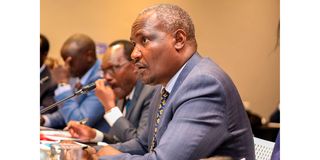
Treasury Cabinet Secretary John Mbadi has sought to assure the public that the National Infrastructure Fund (NIF) will benefit all parts of the country.
Mr Mbadi dismissed claims by a section of MPs during debate of the Bill that some parts of the country will be disenfranchised during the identification of the commercially viable projects that the fund is meant to finance.
“All parts of this country have at least a viable project that can add value to our economy. They will be identified without any political consideration and fully funded from the proceeds of this kitty,” Mr Mbadi said.
The CS said the fund will be used to fund ‘politically correct’ projects saying such a move would not attract investors.
“If I say that a road in my village should be tarmacked just because I am a CS, that will not be logical and will not attract investors. We will be looking for projects that can attract private investors,” Mr Mbadi said.
He pointed out that areas such North Eastern regions have been neglected for a long time yet the area has potential of producing wind energy which is among the viable projects that the fund seeks to finance.
“There is a notion that nothing good can come from the Northern region. Areas like Turkana have the potential of producing wind power for Energy generation. Those are the kind of projects that we will map out,” Mr Mbadi said.
During debate of the Bill, Kitui Central MP Makali Mulu pointed out that the fund is silent on how the commercially viable projects will be shared equitably, a factor he said will lead to marginalization of some parts of the country.
Similar concerns were also echoed by Funyula MP Wilberforce Oundo who said there is lack of clarity on who will choose the commercially viable projects risks disenfranchising other parts of the country.
Mr Mbadi however urged politicians not to politicize the fund saying such a move risks discouraging private investors from coming on board.
“Equity and inclusivity will be key considerations while determining the commercially viable projects to be funded, not politics. Because the moment we politicise the projects, there will be delay in the execution of the projects,” Mr Mbadi said.
The fund is expected to mobilise Sh5 trillion over the next 10 years, transforming the country’s infrastructure financing model, which is heavily dependent on borrowing, into a more sustainable, investment-based model.
Through the fund, the government also seeks to mobilise private capital and non-traditional sources of infrastructure finance including domestic pension funds and collective investment schemes, sovereign wealth funds, climate finance in order to reduce the reliance of public debt for the financing of commercially viable and infrastructure projects.
The fund will be used to fund strategic projects in the most important sectors such as transport, energy, water, irrigation and digital connectivity. Some of the projects that are likely to lose include the construction and improvement of highways, railways, airports, seaports and agribusiness.
The Fund will be run by a council which will comprise the Cabinet Secretary of the National Treasury, the Governor of the Central Bank of Kenya, the Attorney General, and six professionals appointed by the President for a three-year term.
The council will manage the investment policy of the fund and recruit the board of directors, but the daily operations will not be managed in a way that will jeopardise the independence of the board.
Mr Mbadi said the President is expected to name the six members of the board anytime from next week.
“There are amendments that MPs made to clause 2, this means that the appointment of the council members by the President had to be delayed for two weeks when the fund Act will now become law, otherwise the President is ready to put the council in place so that we hit the ground running,” Mr Mbadi said.
Tough legal action will be taken to those found culpable of misappropriating the fund. Among the penalties include the repayment of the amount misappropriated twice, a fine of at least Sh10 million or serving at least five years in prison.