Members of Parliament are inching closer to passing a Bill to give the National Transport and Safety Authority (NTSA) powers to regulate fares by public transport vehicles.
The NTSA (Amendment) Bill, 2023 seeks to amend the NTSA Act No.33 of 2012 to provide for the development of policy guidelines to regulate charges payable by passengers in Public Service Vehicles (PSVs) in the country.
The Bill sponsored by Kimilili MP Didmus Barasa seeks to bring an end to the absolute powers that public transport owners have enjoyed over the years in deciding the amount of money to charge their customers.
Kimilili Member of Parliament Didmus Wekesa Barasa before the Departmental Committee on Labour at Parliament buildings Nairobi on Tuesday, November 21, 2023.
Photo credit: File | Nation
Currently, the charges are subject to market forces.
However, if the Bill is passed, NTSA will have powers to validate and approve fares charged by Public Vehicles and grant commuters a formal avenue to report operators who overcharge.
Kenya is seeking to join countries like Ghana, Ivory Coast, Rwanda, Tanzania, Cameroon, Fiji and Germany where the government regulates and sets the minimum fare to be charged on public transport.
During the debate of the Bill, majority of lawmakers supported the proposal, saying it was time to bring sanity in the public transport sector and rein in public transport owners who exploit the public with unpredictable fare charges.
“We cannot continue encouraging a banana republic in Kenya where transport from point A to B is not predictable. We cannot have a country where fare is dictated by the weather and the number of people in a stage,” Mr Barasa said .
“We cannot operate in a country where a board of fare Sh300 is displayed, but when the weather changes, another board of 500 is displayed. We cannot leave Kenyans in the hands of cartels. This must be controlled,” he added.
Mr Barasa argued that just like the government controls the price of cane, fuel and other crucial commodities, Kenyans must also be protected from the public transport cartels that swindle Kenyans.
“A Kenyan who left his house with Sh100 as fare does not know what he will pay in the evening. This Bill will bring equity, order and Kenyans can effectively budget with their salaries,” Mr Barasa said
“Every sector must be controlled; while we appreciate that the matatu sector is like any other sector that needs to make profit, they must be controlled; they cannot make profit any other time that they want,” he added.
Kesses MP Julius Ruto said regulation of the public transport sector is a matter of public interest that Parliament must undertake.
“We are saying, we can have an organized entity. This is a matter of public interest; we are looking at that common man who must survive, eat and live,” Mr Ruto said.
Tigania West MP John Mutunga said matatus cannot be allowed to operate the way they want without any form of regulations.
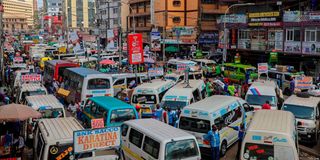
Matatus wait for passengers at a matatu stage.
Photo credit: File | Nation
We have seen cases where fuel prices increase and fare goes up but when fuel decreases, fare does not come down. Matatus can’t be allowed to change fares where they want,” Dr Mutunga said.
“Where circumstances have changed, we must have a mechanism of reviewing the changes. In Europe and America, the fares are cheaper because they are regulated,” Dr Mutunga said.
Dagoretti North MP Beatrice Elachi said Parliament owes the future generation an organized public transport system where there is no exploitation and there is order.
“Let us organize the public transport system not for us but for the generation to come. I know it’s a live wire to touch because of politics, but we have to do it for the future,” Ms Elachi said.
“Something must be done; we must have regulations to guide the sector. Even though they are our voters, they are our sons and daughters and we must guide them,” She added
The lawmaker said the regulations should also be extended to the public transport crew such as conductors who do not treat customers with dignity.
“The crew on matatu must also be disciplined;this idea of throwing people out when they don’t have fare must be stopped,” she said.
Nominated MP Sabina Chege said there is need for Parliament to protect consumers from exploitation by the public transport sector, especially on the fares charged.
“In countries where there are these regulations, there is decency. Public dignity is a must, we must have a system where customers are treated with dignity and not exploited,” Ms Chege said.
Barasa’s Bill was, however, been rejected by the House transport committee and also by Kipchumba Murkomen when he served as the Cabinet Secretary for transport.
In submissions to the National Assembly’s Departmental Committee on Transport and Infrastructure, in November 2023, Mr Murkomen said a comprehensive study and stakeholder engagement must be undertaken if price controls are to be introduced in the PSV sector.
“We advise that a comprehensive study and stakeholder engagement should be undertaken on the Bill’s proposals to determine their practicability and ensure the same do not violate any conventions or treaties applicable,” Mr Murkomen said.
In 2018 Parliament rejected a similar push by the transport ministry to amend the Traffic Act to give the Cabinet Secretary in charge powers to regulate fares in the Public Service Vehicle industries.