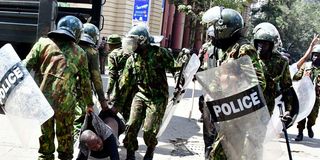
The Inspector-General of Police and other senior officers could soon be held personally responsible for excesses committed by police officers after a parliamentary committee backed reform proposals by the Independent Policing Oversight Authority (IPOA) aimed at restoring accountability within the National Police Service (NPS).
The move comes amid rising cases of police brutality against unarmed civilians during peaceful protests and routine police operations, with concerns growing over weak accountability mechanisms and operational gaps in the management of public order situations.
Appearing before the National Assembly Administration and Internal Security Committee, IPOA said incidents leading to deaths, serious injuries, sexual violence and destruction of property “have to stop.”
The proposals would place greater responsibility on police commanders, who have often blamed organisers of peaceful protests for incidents linked to police conduct.
Police beat a demonstrator at a previous protest.
Photo credit: Nation Media Group
IPOA Commissioner Kenwilliam Nyakomitah told the committee, chaired by Narok West MP Gabriel Tongoyo, that the current legal framework does not adequately hold senior officers accountable for acts of omission or commission by officers under their command.
“There is currently no criminal sanction for a superior officer who fails to prevent misconduct by their juniors,” said Mr Nyakomitah. “The law only requires them to report misconduct after it occurs, leaving a critical gap in prevention.”
IPOA, which is mandated to provide civilian oversight over the police service, argued that the reforms are necessary to enforce Article 244 of the Constitution, which requires police officers to maintain the highest standards of professionalism, transparency and accountability.
Previously, individual officers accused of committing abuses against civilians have faced charges alone, while their commanders escaped scrutiny despite allegations that operational orders may have contributed to the violations.
Under the proposed changes, commanders ranging from the Inspector-General and Deputy Inspectors-General to regional commanders, county police commanders, OCPDs and OCSs could face sanctions for failing to prevent or stop misconduct by officers under their supervision.
IPOA noted that commanders make critical operational decisions, including deployment of officers, tactics used during operations, rules of engagement and supervision of police activities.
According to the authority, careless or poorly made decisions significantly increase the risk of harm to civilians and therefore require stronger accountability measures at the leadership level.
“A superior officer may know what is being planned and what is likely to happen, but the law does not compel them to act to stop it. That is the gap we must address,” Mr Nyakomitah said.
He added that the law should impose clear duties on commanders to prevent, repress and report misconduct.
“If a superior officer fails to act despite having knowledge, then there should be consequences. That would ensure these incidents do not occur in the first place,” he said.
Members of the parliamentary committee supported the push for clearer lines of responsibility within the police command structure.
Mr Tongoyo said existing provisions under the National Police Service Act assign responsibility to officers commanding stations, but stressed the need to identify legal and operational gaps.
“What we need now is a clear mapping of what exists, where the gaps are and what exactly needs to be fixed,” he said.
IPOA also raised concerns over the Internal Affairs Unit (IAU), describing it as largely dysfunctional and lacking public trust.
IPOA Director of Complaints Dr Ruth Kaguta told the committee that more than 70 percent of complaints received by the authority relate to police conduct and could be resolved internally if the unit was fully functional.
“Unfortunately, the unit is almost dysfunctional,” said Dr Kaguta, citing frequent leadership changes, lack of independence and public distrust as major challenges.
She said repeated restructuring within the unit had undermined collaboration with IPOA and delayed justice for complainants.
“There have been constant leadership changes, and in some instances we are told meetings cannot even take place due to reorganisations,” she said.
Dr Kaguta further argued that placing the unit under the Inspector-General compromises its independence and erodes public confidence.
“Complainants come back to us saying they do not trust how their cases are handled. The unit is not independent, and that affects its credibility,” she said.