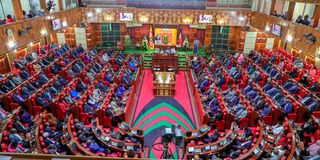
A parliamentary committee has given all public institutions one year to remove asbestos roofing from their buildings, a process that will be overseen by the National Environment Management Authority (Nema).
In its report tabled in the House, the National Assembly Committee on Public Petitions has also directed the Ministry of Health to conduct a medical survey within six months to ascertain the extent and impact of exposure to asbestos, which is reported to cause cancer.
According to government records, 188 schools and other educational institutions have been found to contain asbestos in various quantities, totalling 3,180.5 tonnes.
Documents tabled in Parliament last year indicate that buildings belonging to the National Treasury, the Ministry of Lands, Urban Planning, Housing and Public Works, the Ministry of Interior, the Ministry of Education and the Ministry of Health are among those with the highest levels of asbestos roofing.
The private sector is also to blame, as it has a total of 8,467 tonnes of asbestos.
Research shows that exposure to asbestos is hazardous to human health and can result in mesothelioma, an aggressive cancer that affects the membrane lining the lungs and abdomen, presenting symptoms similar to respiratory illness.
Furthermore, the World Health Organization states that all forms of asbestos are carcinogenic, as the material has been linked to cancers of the lungs, larynx, and ovaries.
Globally, over 200,000 deaths are attributed to occupational asbestos exposure each year, representing over 70 percent of all work-related cancer fatalities.
Asbestos is a group of six naturally occurring fibrous minerals found in metamorphic deposits around the world. It is chemically inert, fire-resistant, and does not conduct heat or electricity, making it a commonly used insulator.
It is also highly resistant to tensile stress, and is insoluble and odourless.
“The committee recommends that all stakeholders remove asbestos roofing from public institutions within one year of tabling of this report,” reads the committee report.
The carcinogenic properties of asbestos pose a risk through bio-accumulation and persistent exposure, potentially entering water systems, aquifers and the food chain.
The committee said in its report that although there is increased removal and disposal of asbestos roofing materials due to global awareness and its negative effects, the process in the country is very slow despite its risk and frequent communication made by government agencies.
The committee also noted in its report that the deteriorating asbestos sheets continue to release fibres into the air, contaminating soil, water and endangering the communities.
Appearing before the committee last year, then Environment and climate change Cabinet Secretary Aden Duale supported calls to ban the use of asbestos as roofing materials in the country.
“We can’t compromise on the health of our citizens. It’s currently raining everywhere, and our people are drinking water from those roofs. I apologise on behalf of previous regimes, but this government must tackle this issue for the sake of people’s health,” he said.
The committee, during its consideration of the petition, was informed that Nema had already developed an inventory of buildings and facilities with asbestos materials in 19 counties. The survey included schools, houses and hospitals.
The 19 counties where Nema did the inventory include Bungoma, Busia, Embu, Homa Bay, Isiolo, Kisii, Kakamega, Kisumu, Kitui, Machakos, Makueni, Marsabit, Meru, Migori, Nairobi, Nyamira, Siaya, Tharaka Nithi and Vihiga.
The committee now wants the Ministry of Environment, through Nema, to within six months conduct a survey and identify public buildings with asbestos roofs in the remaining counties.
“The committee recommends that Nema continue sensitising public institutions to replace the asbestos roofing materials with environmentally-friendly materials,” reads the report.
Despite the recommendations, many institutions still grapple with how to safely remove and dispose of asbestos roofing. For instance, in Kisumu County alone, over 150 institutions still have buildings roofed with tonnes of asbestos-laden material.
The petition was presented in the House by Wajir North MP Ibrahim Abdi, who argued that residents of his constituency have suffered.
According to the lawmaker, Article 42 of the constitution recognises the right of every Kenyan to a clean and healthy environment, and protection of the environment for the benefit of future generations.
The lawmaker told Parliament that all public buildings with asbestos roofing, including primary schools in Wajir and other ASAL regions of northern Kenya, should be identified with a view to replacing the asbestos with galvanised iron sheets to mitigate the risk of cancer.
He proposed that funds from the National Government Constituency Development Fund (NG-CDF) and development partners should be used to replace asbestos roofs with safer materials.
Kenya’s construction industry extensively used asbestos in the 1960s as the materials were considered to be strong, heat resistant and affordable.