Nearly nine months after the national government imposed a ban on asbestos roofing materials, a growing number of institutions are still faced with the daunting task of removing and disposing of the hazardous waste safely.
Health experts have issued stark warnings about the public health risks associated with asbestos roofing sheets, particularly when they are not handled or disposed of correctly.
Once hailed in the 1970s for its durability and properties in soundproofing and fire resistance, asbestos became a favoured construction material. It was widely used in ceiling boards, floor tiles, shingles and fire doors. But most importantly, it was the roofing choice for schools, hospitals, churches, military barracks, universities and government housing.
However, during the 1980s, scientific research revealed the grave dangers of asbestos exposure. Inhalation of its microscopic fibres was linked to debilitating and often fatal respiratory diseases, including lung cancer, asbestosis and mesothelioma - an aggressive cancer affecting the lining of the chest and abdomen.
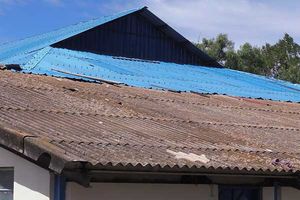
The urgency of the crisis was starkly highlighted in August 2025, when hailstones severely damaged the asbestos roofing of Ober Kamoth Sub-County Hospital in Kisumu County leaving fractured shards scattered across the facility. The incident exposed patients, healthcare workers, and the wider community to potential airborne asbestos fibres - a critical health hazard.
“The broken roofing material had splintered into fine particles, creating a significant risk. Asbestos dust from these aged and weathered sheets can easily become airborne and infiltrate hospital wards, contaminate equipment and leach into surrounding soil and drainage systems during rainfall,” explained Leonard Ofula, the National Environmental Management Authority (NEMA) Director for Kisumu County. “
Mr Ofula underscored the danger posed to various vulnerable groups such as children, the elderly, individuals with pre-existing respiratory conditions, healthcare staff, maintenance workers and the surrounding community.
In Buoye, near Rabuor in Nyando Sub-County, tensions flared when residents opposed the dumping of asbestos debris near a river. The roofing sheets, originally removed from a church in Kericho, had inexplicably ended up in Kisumu. Following public outcry and prolonged negotiations, the hazardous material was finally removed and transported to a designated hazardous waste landfill in Mombasa.
According to the World Health Organisation, all forms of asbestos are carcinogenic. The material is linked to cancers of the lungs, larynx and ovaries, in addition to mesothelioma. Globally, over 200,000 deaths annually are attributed to occupational asbestos exposure - representing more than 70 percent of all work-related cancer fatalities.
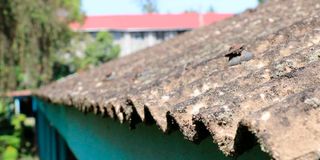
Asbestos roofing at a primary school.
Photo credit: File| Nation Media Group
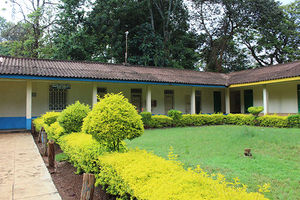
Despite the health threats, many institutions remain uncertain about how to safely remove and dispose of asbestos roofing. In Kisumu County alone, over 150 institutions still have buildings roofed with tonnes of asbestos-laden material.
“Maseno University wanted to dispose of its asbestos roofing but discovered that the cost to transport it to a landfill in Mombasa would amount to Sh13 million,” noted Mr Ofula.
He added that Muhoroni Sugar Company is also currently seeking an appropriate disposal site for its asbestos roofing.
“As long as the roofing remains intact, the risk is minimal. The real danger arises when it is broken, releasing fine fibres into the air,” Mr Ofula explained.
He also warned against the use of rainwater harvested from asbestos roofs, highlighting the risk of contamination.
“Such water is unsafe for drinking or irrigation and could potentially pollute underground water sources,” he said.
Disposal of asbestos is a meticulous process that must begin with an environmental assessment conducted by certified experts. The handling and removal must only be carried out by licensed asbestos abatement professionals trained in stringent safety procedures.
During removal, the roofing sheets are wetted to suppress dust, then carefully dismantled and sealed in containment. All waste must be securely packaged, clearly labelled as hazardous and transported in compliance with the Waste Management Regulations (2024) to a NEMA-approved hazardous waste disposal site.
Given the absence of a suitable landfill within Kisumu, NEMA advises institutions to consider onsite burial of asbestos waste, subject to environmental approval.
“In the hospital’s case, we identified and cordoned off contaminated areas to minimise exposure risks. We recently received a letter from the Environmental PS authorising onsite disposal. No commercial activity will be permitted near the site,” Mr Ofula said.
The designated burial area must be located well away from any water sources. A pit, at least four metres deep, is dug and lined with a damp-proof membrane.
Only asbestos-containing materials are placed within, after which the pit is filled with soil. The area must be clearly marked and isolated from future human activity.
Mr Ofula emphasised that any damaged roofing should be replaced only with non-asbestos, safe alternatives.
“The facility should only resume full operations after thorough decontamination and the installation of appropriate, safe roofing materials,” he advised.