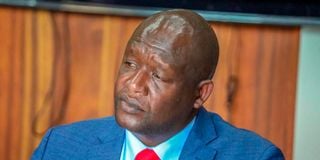
Kericho Governor Erick Mutai will face the Senate plenary next week beginning Wednesday, as he fights to remain in office following his impeachment by Members of the County Assembly (MCAs) last week.
This follows the collapse of a motion to establish an 11-member special committee of the Senate to investigate charges leveled against the governor after the proposal failed to secure a seconder.
As a result, Dr Mutai’s impeachment trial will now be conducted in plenary between Wednesday, August 27, and Friday, August 29, 2025.
Senate Speaker Amason Kingi explained that the motion to establish the special committee—moved by Senate Majority Leader Aaron Cheruiyot—collapsed after Minority Leader Stewart Madzayo, who was expected to second it, declined to do so.
Meru Senator Kathuri Murungi protested the move and called for a review of the Standing Orders, suggesting that if a seconder is unavailable, members should be allowed to bring back the motion later or find an alternative route to reconsider it.
However, Speaker Kingi ruled that while Senator Murungi had raised valid concerns, such changes would apply only in the future.
“The Majority Leader had a seconder, the Minority Leader, who declined to second the motion. He did not appoint any other member to second it. Allow me to read the ruling on the effect of lack of secondment,” Mr Kingi said.
“The motion, having failed to be seconded, is deemed withdrawn. Consequently, the special committee route is abandoned. The Senate will therefore proceed to investigate the proposed removal from office of Kericho Governor Erick Mutai in plenary,” he added.
The Speaker directed Senate Clerk Jeremiah Nyegenye to issue invitations to the parties by August 21, 2025, file responses by Monday next week and circulate the trial programme to senators by Tuesday.
The trial will then proceed in plenary on August 27, 28, and 29, with all 67 senators participating. Only elected senators will cast the final vote to either uphold or overturn the Kericho County Assembly’s resolution.
While moving the motion, Senator Cheruiyot acknowledged that the mood of the House was contrary to the establishment of a special committee to investigate the embattled governor.
He, nonetheless, said there is no better route to handle an impeachment trial with any route returning similar verdicts before.
“We have pursued such matters through both routes, nearly in equal measure. There is no process or route which is flawed. It is the members to determine which route they want,” said the Kericho senator.
“I can already hear what people are saying. I have no peculiar interest in this matter other than justice for the people of Kericho. Reading the mood of the House, I beg to move and request the leader of the minority to second the motion,” he added.
Governor Mutai was impeached on August 15, 2025, after 33 out of 47 MCAs voted to remove him from office. The motion was initiated by Sigowet Ward MCA Kiprotich Rogony.
He has been accused of abuse of office, nepotism, irregular appointments, unlawful dismissal of senior officers, pilferage of public resources, double payments to contractors, and flouting provisions of the Public Finance Management Act, the Constitution, and the County Governments Act.
In October 2024, Dr Mutai survived a similar impeachment attempt when the Senate overturned the Kericho County Assembly’s resolution after it was found that the MCAs had failed to meet the two-thirds threshold required to impeach a governor.
This time, the assembly ensured the threshold was met after a tense, day-long session, during which the governor unsuccessfully sought to persuade MCAs to drop the motion.
Even so, Dr Mutai and his allies have mounted a spirited fightback.
At least 18 MCAs have signed a petition challenging the electronic voting system used during the impeachment, alleging that it was pre-programmed to skew results. They have also written to the Directorate of Criminal Investigations (DCI) seeking a probe into the alleged use of an unauthorised internet-based digital voting system during the assembly proceedings.
"The said system was introduced abruptly on the floor of the House immediately before voting on August 15, without proper procurement process, prior communication, induction, or approval from the Communication Authority of Kenya (CAK),” the letter to DCI stated.
The MCAs stated, “The way the voting process was done using the alleged electronic process raises concerns of illegality, manipulation, and violation of established procedures.”
Further, the MCAs claimed that the use of the digital voting system exposed their personal details, including pay slips and national identity card numbers, thus compromising their data which should be protected.