President William Ruto’ s administration has declared there will be no turning back on plans to lock out political rejects from appointments to plum State Corporations’ boards, as part of efforts to make these appointments more competitive.
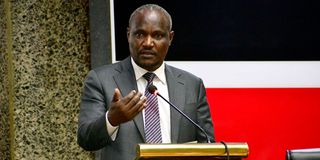
National Treasury Cabinet Secretary John Mbadi stated that the move is part of ongoing reforms targeting the management of specific state-owned corporations under the current regime. He said the appointments would be centralised at the National Treasury rather than being handled by individual line ministries.
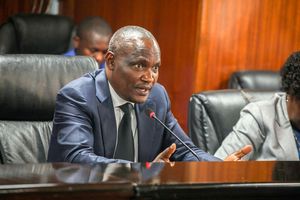
Mr Mbadi informed senators that the proposed changes are part of the Government-Owned Entities (GOE) Bill, 2025, currently before Parliament for consideration.
The Bill seeks to disqualify individuals affiliated with political parties from holding board positions in what will now be referred to as Government-Owned Enterprises. In a major shift from the current practice, Mr Mbadi noted that the proposed legislation introduces a merit-based selection system overseen by an independent panel, aiming to end the trend of appointing unqualified board members based on political connections.
He said that the objective is to replace political patronage with professionalism by promoting merit-based appointments to the boards.
If enacted, the Bill will allow State corporation boards to elect their own chairpersons from among the independent members.
“The process is ongoing. Appointments to the boards are currently political, but we are keen on reforming the management of commercially viable state-owned parastatals. The appointments will be competitive and centralised under the National Treasury,” said CS Mbadi.
He explained that the reforms are part of broader efforts to restructure state agencies, which include merging or dissolving non-commercially viable entities.
Kenya has over 260 state corporations, yet only a few consistently generate profit.
A 2023 Treasury report revealed that more than Sh300 billion was spent on parastatal bailouts over a 10-year period.
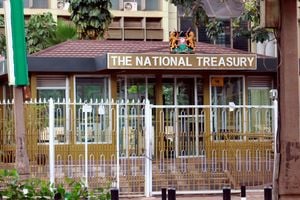
The National Treasury building.
Photo credit: Dennis Onsongo | Nation
Commercial state corporations include Kenya Power, Kenya Ports Authority, Kenya Pipeline Company, Kenya Railways Corporation, Kenya Airports Authority, and Kenya Electricity Generating Company.
These entities are categorised as commercial because they generate revenue for the government and play strategic roles in the economy.
In June, the Cabinet approved the Bill to reform the governance and performance of commercial state corporations in Kenya.
The GOE Bill proposes the establishment of a structured governance framework in which board members are selected through a competitive and transparent process. This represents a significant step toward improving the governance and performance of these entities.
According to a Cabinet dispatch, the proposed law introduces a new category of commercial state corporations to be known as Government-Owned Enterprises (GOEs).
The Bill stipulates that boards will elect their own chairpersons from among independent members. It further bars both the chairperson and independent directors from engaging in activities that may result in conflicts of interest.
The Cabinet stated that these reforms are intended to promote professionalism, transparency, and commercial viability in the management of public enterprises.
The Bill also provides that individuals affiliated with political parties within the past five years will be disqualified from serving as directors.
“A person is not qualified to be appointed as an independent director of a government-owned enterprise if that person has in the past five years been affiliated with a political party,” the proposed law reads.
“The chairperson shall be elected by the board of directors from among the independent directors,” it adds.
Over the years, many election losers have been given a second chance through appointments to government-owned enterprises. Currently, board chairpersons are appointed directly by the President.
State corporations have often served as a vehicle for the government of the day to reward loyalists and cronies with lucrative positions—frequently at the expense of qualified professionals.
These include 2022 presidential candidate David Mwaure, who was appointed chairperson of the Board of Trustees of the National Environment Trust Fund.
There are also former governors Kiraitu Murungi (appointed chairperson of the National Oil Corporation of Kenya), Jack Ranguma (chairperson of the SACCO Societies Regulatory Authority), and David Ole Nkedianye (chairperson of the Wildlife Research and Training Institute) and former Mumias East MP Ben Washiali, named chairperson of the Board of the Tourism Regulatory Authority.
Former Kilifi speaker Jimmy Kahindi was appointed chairperson of the Public Procurement Regulatory Authority Board, among others.