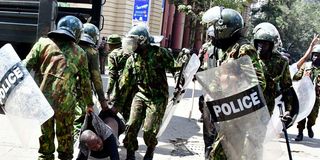
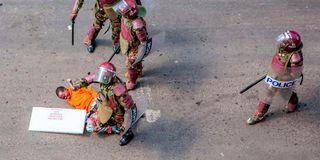
A protestor is carried away by anti-riot police officers during the Anti-Finance Bill demonstrations in Nairobi June 25 2024.

State-sanctioned intimidation, harassment, police violence, restrictions on public participation, punitive laws, and disruption of civic activities are the most common ways the government infringes on Kenyans’ rights, a new report reveals.
Arbitrary arrests, disrupted meetings, and politically engineered barriers were also cited as obstacles to civic freedoms guaranteed by the Constitution.
The report, commissioned by the Defenders Coalition and launched at the Human Rights Academy in Nairobi at the start of the 16 Days of Activism against Gender-Based Violence, documents widespread fear among citizens, activists, community organisers, and journalists.
Titled “Trends in Civic Space in Kenya: An Assessment,” it paints a picture of constitutional freedoms that exist on paper but are undermined in practice.
Covering ten counties—Meru, Nakuru, Mombasa, Nairobi, Busia, Nyeri, Kakamega, Kericho, Kisumu, and Machakos—the assessment describes threats from police, chiefs, intelligence officers, politicians, and mobilised youth groups.
Surveillance, anonymous calls, online trolling, physical intimidation, and arbitrary arrests are routine for those who speak out or mobilise communities.

One in five Kenyans has experienced police brutality, with hundreds killed in crackdowns over the years.
“The results of this study showed that over half (54 per cent) of Kenyans rated the conditions of freedom of association as bad or very bad. Overall, 55 per cent described freedom of expression as bad or very bad, and 56 per cent rated freedom of assembly similarly,” the report says.
Criticising government
Speaking at the launch, Mr Kamau Ngugi, Executive Director of the Defenders Coalition, warned that the State is drifting from constitutional promises.
“The findings show widespread fear, with citizens punished for exercising the freedom of assembly and facing reprisals for criticising government spending, corruption, and mismanagement. The report confirms rights are being violated on the ground and urges the government to honour and implement the Constitution,” he said.
Freedom of expression remains among the most violated rights.
Citizens reported being followed by unknown individuals, activists trailed by unmarked vehicles, and vocal social media users receiving threatening calls. In Mombasa, one informant said:
“We have seen communities muzzled and threatened, defenders followed at night by goons and unmarked vehicles, intimidating people, especially the ones vocal on social media.”
Digital expression is also constrained. Although 65 per cent of Kenyans use digital platforms, only 34 per cent feel safe expressing themselves online. Many said the Computer Misuse and Cybercrimes Act is misinterpreted to punish dissent.
Freedom of assembly is under attack. Peaceful gatherings, including protests, town hall meetings, and press briefings, are frequently disrupted.
“The numbers are alarming: 85 per cent of protestors nationally reported violent dispersals, with Meru at 93.7 per cent and Mombasa 92.2 per cent,” the report states.
A Kisumu community mobiliser explained: “Even after notifying police about a peaceful protest, instead of protection, we are setting ourselves up. It’s like telling them, ‘now you can beat us, tear-gas us.’”
Police beat a demonstrator at a previous protest.
Freedom of association is weakened through profiling and surveillance.
Groups working on land rights, gender justice, or governance reported being monitored or summoned by administrators. Some respondents said joining certain organisations results in being labelled “anti-government.”
Public participation
Access to information, protected under Article 35, is widely denied. In Busia, one respondent said:
“They hide quarterly and financial reports. If I can’t access the information despite my education, what about the ordinary mwananchi?”
Only 27 per cent of Kenyans believe the government respects the right to information, while 65 per cent say crackdowns on access have increased sharply.
Public participation is largely symbolic. Meetings are often announced late, held far away, or dominated by political elites.
“Participation here is a ritual. They come, read documents, listen, and go. Nothing we say ends up in final decisions,” a Meru respondent said.
Discrimination further restricts civic space. Women, persons with disabilities, and sexual minorities reported marginalisation. An activist in Busia noted:
“Women are really discriminated against. PWDs are still hidden at home. Sexual minorities—it is taboo even to discuss them.”
Threats remain widespread: 38 per cent reported being threatened. Journalists described warnings against filming protests. A Meru journalist said: “There is no story worth your life.”

Police officers arrest activist Boniface Mwangi on Kenyatta Avenue in Nairobi on 25 July 2024 during anti-government protests.
Fifteen per cent of respondents have withdrawn from civic activities entirely, while others avoid protests or online engagement. Despite this, 93 per cent believe the state bears primary responsibility for safeguarding civic space.
The report urges the government to halt intimidation, harassment, and excessive force, and to hold abusive officers accountable.
It calls for full implementation of Article 35 on access to information, including proactive disclosure of county budgets, bursaries, and procurement records. Public participation processes should be depoliticised to allow meaningful engagement for women, youth, persons with disabilities, and minority groups.
It also recommends protection of civil society, rights-based policing, digital rights safeguards, oversight of surveillance, and secure reporting channels.
“Kenya’s civic future depends not only on the robustness of its laws but on the willingness of state institutions to respect them, and on the courage of its people to continue demanding the rights already theirs,” the report concluded.
Follow our WhatsApp channel for breaking news updates and more stories like this.