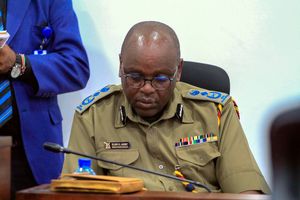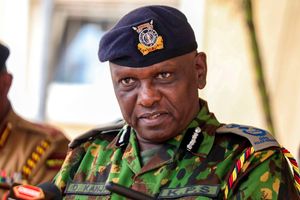
Inspector-General of Police Douglas Kanja.

MPs have dismissed a request by Inspector-General of Police Douglas Kanja to be heard in camera over disputes with the National Police Service Commission (NPSC).
Instead, they issued fresh summons for Mr Kanja, accusing him of frustrating reforms.
The police chief was to appear before the National Assembly Constitution Implementation Oversight Committee yesterday to explain claims of sabotaging the NPSC, which ironically is his employer.
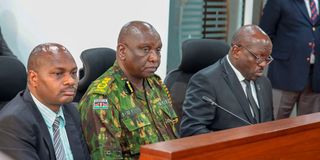
The Inspector-General of the National Police Service Douglas Kanja (centre) CEO of the National Police Service Commission Peter Leley (right) and Commissioner Edwin Cheluget appear before the National Assembly Public Accounts Committee on July 29, 2025.
However, he made a “belated” request to postpone the meeting by 21 days, on condition that it be held behind closed doors.
The committee that is chaired by Suba South MP Caroli Omondi rejected the request and ordered Mr Kanja to appear before it on September 16.
It said the issues raised are of public interest.
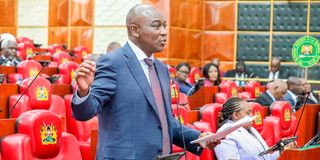
Suba South MP Caroli Omondi makes his contributions during a past session in the National Assembly.
“We have looked at his letter and taken exception to the belated request for rescheduling the meeting. We reiterate that the committee meeting with Mr Kanja will be in the presence of the media,” Mr Omondi said.
The lawmakers faulted the police boss for channelling his request through the Speaker instead of the Clerk as is the tradition, saying he was attempting to manipulate the independence of the committee.
Like his predecessors under the current Constitution, Mr Kanja was accused of dodging the committee sessions, which Mr Omondi said has slowed down reforms 15 years after the promulgation of the Constitution.
Mr Kanja is expected to give reasons he continues to “frustrate” the commission by denying it quorum to execute its mandate.
MPs also want to know why the National Police Service (NPS), which he heads, has not yet embraced the constitutional separation of the command structure from the human resource function.
At the heart of the dispute is the police payroll, which lawmakers say Mr Kanja has refused to hand over to the commission despite making commitments.
The payroll was flagged by Auditor-General Nancy Gathungu in her 2022/23 financial year reports.
“Activities of the commission have been hindered by quorum issues because Mr Kanja and his two deputies do not attend meetings. This is causing anxiety the service. Officers at in low ranks need to feel appreciated and respected,” Mr Omondi said.
Nambale MP Geoffrey Mulanya said there is a reason the Constitution separated the command structure from human resource functions.
“Mr Kanja must come and explain why he is sabotaging the commission and why reforms have stalled. Requesting 21 days is simply buying time,” Mr Mulanya said.
Article 246 of the Constitution established the NPSC and assigned it the mandate to hire, appoint, promote, transfer and discipline police officers.
Though some functions may be delegated, the human resource role – including management of the payroll – is the preserve of the commission.
Mr Kanja told the National Assembly Public Accounts Committee in July that the payroll would be handed over to the commission, but the NPSC is yet to receive it.
Chief Executive Officer of the National Police Service Commission, Peter Kiptanui Leley.
On July 29, NPSC Chief Executive Peter Leley accused the NPS of sabotaging the commission’s constitutional mandate.
His concerns were reinforced by the Auditor-General, who revealed that lack of access to the payroll had prevented her office from verifying the implementation of HR policies – including removal of officers who have left the service through retirement, resignations, dismissals or natural attrition.