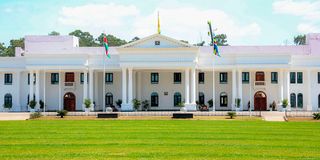
Rights activists have lost a bid to open State House and State Lodges to public protests, after a court upheld legal notices declaring the presidential residences protected areas.
The court dismissed the petition, finding that the activists had not shown how the notices breached the Constitution or the law under which they were issued. It said they challenged the notices but not the Protected Areas Act, including the provision empowering the government to declare premises protected.
"It is not sufficient for a party to allege that a law is either unconstitutional or null and void," the court said, adding that a petitioner must identify the specific provisions being challenged and demonstrate how they conflict with the Constitution.
The petition, filed by the Operation Linda Jamii group against the Attorney-General and the Inspector-General of Police, arose from attempts to demonstrate outside State House Nairobi and State Lodges and to deliver petitions to President William Ruto.
Filed on July 25, 2024, it said planned protests had been stopped despite the activists notifying police commanders and the Inspector-General. They said officers dispersed demonstrators using force and arrested some.
The petition targeted two legal notices. Legal Notice No. 433 of 1989 designates State House in Nairobi and Mombasa, and State Lodges in Kisumu, Sagana, Nyeri, Eldoret and Nakuru, as protected areas. Legal Notice No. 199 of 2020 separately designates Kisii State Lodge.
The activists argued that the designations blocked citizens from assembling, demonstrating and picketing outside government premises to present grievances to the Head of State. They relied on constitutional protections for peaceful assembly, expression and movement, and said the restrictions were unreasonable.
They also questioned the boundaries of the protected sites. They told the court that an inquiry about the areas covered received an unclear response from the Inspector-General, who reportedly said a reasonable distance from the main gates was also protected. The activists argued that unclear boundaries mattered because unauthorised entry attracts criminal penalties.
The Protected Areas Act provides for a fine of up to Sh5,000, imprisonment for up to two years, or both, for unauthorised entry. It also allows police to remove unauthorised entrants from protected areas.
The petitioners asked the court to declare both notices unconstitutional, quash them and stop the State from declaring offices routinely used by public officials protected areas. They also argued that the designations offended constitutional requirements on public service and accountability.
The Attorney-General and the Inspector-General opposed the case, arguing that it was speculative and did not identify specific constitutional violations. The State maintained that protected areas were necessary for public safety and order, and that the Constitution recognised them.
In its judgement, the court examined the purpose of the Protected Areas Act and said the law restricts entry into the designated premises to people with permission, for public safety and order.
It noted that Section 3 allows the Cabinet Secretary to declare an area, place or premises protected where special precautions are needed for public safety and public order. Entry then requires permission from the prescribed authority or another person named in the order.
The court said the law did not impose an absolute ban on entry. "In fact, entry into those areas is not prohibited but is regulated," it said, adding that anyone seeking entry must obtain permission from an authorised officer.
It also addressed the right to protest, holding that "the Public Order Act regulates public gatherings, processions, demonstrations, and picketing to present petitions which is a constitutional right under article 37 of the constitution."
The court added that demonstrations and gatherings must be peaceful, and that protesters could petition the President through other government offices without having to access State House or the lodges.
"Protestors can present petitions to any government offices, including the office of the President and it does not have to be at State houses or State Lodges," it said.
Further, the court found that the petition had not challenged the Protected Areas Act or explained how the legal notices conflicted with it. It also noted that the case did not identify how the 2020 Kisii notice failed to comply with the Statutory Instruments Act.
"The petitioner did not demonstrate that the impugned Legal notices had any constitutionality infirmity," it ruled, reiterating that it was not enough to describe a law as unconstitutional without showing the specific inconsistency.
Katiba Institute and the Law Society of Kenya, listed as interested parties in the petition, did not file responses or participate in the proceedings.