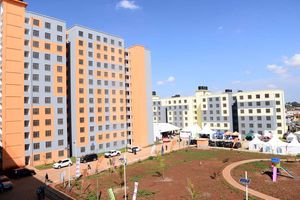
The Environment and Land Court has stopped construction works on a 58-acre Mau Mau freedom fighters’ site in Githunguri, Kiambu County, earmarked for an affordable housing programme, pending determination of a petition challenging the project on heritage grounds.
Justice Jacqueline Mogeni ordered the government and anyone acting under its authority to stop fencing, excavation, construction, occupation and other interference with the land. The court also directed the Officer Commanding Githunguri Police Station (OCS) to supervise and enforce full compliance with the orders.
The dispute concerns land identified as Githunguri/Githunguri/T.801, which the petitioners say is a protected Agikuyu heritage site linked to education and the Mau Mau struggle.
The petitioners state that the site hosts a British-era detention facility where Mau Mau fighters were executed, making the parcel a place of “pain, resistance and sacrifice.”
They allege that work related to the affordable housing project began on February 21, 2026, without community consultation, public participation, or evidence of planning approvals and heritage impact assessments.
The petitioners are Reuben Gichungu, James Nene, Kimani Charagu, an official of the Maina and Mwangi Trust, and Peter Mudinia. They sued the Cabinet secretaries responsible for lands and culture, the Principal Secretary for Housing and Urban Development, the National Museums of Kenya, the Kiambu County Government, the county executive member responsible for lands and housing, the Kiambu County Commissioner and the Attorney-General.
The Kenya Unity for Memorial, Peace Heritage and Cultural Organisation is listed as an interested party.
Government terms petition as 'frivolous'
Agikuyu elders conduct rituals at the Githunguri land on April 6, 2026, amid opposition of the Affordable Housing project.
Photo credit: Pool
The national government, through the Attorney-General, opposed the application, arguing that the petitioners had not produced evidence of constitutional violations or met the test for interim orders. It called the application frivolous and sought its dismissal with costs.
The petitioners trace the land’s history to the early 1930s, when Agikuyu age groups, known as marika, bought it to establish an African institution of higher learning. They say it became a centre of political awareness and education during colonial rule, before the British authorities converted it into a detention facility and gallows during the 1952 State of Emergency.
According to them, the site’s buildings included Kiriri, a girls’ dormitory built to accommodate female students, and residences associated with the late President Jomo Kenyatta and former Cabinet Minister Mbiyu Koinange, who were linked to the institution.
Their case relies on Gazette Notices Nos. 244 and 245, issued on January 14, 2011, under the National Museums and Heritage Act, which declared the site protected. They say the notices gave specific heritage protection to features of the site: the Githunguri Gallows was declared a protected area, while Kiriri and the college residences of Kenyatta and Koinange were declared monuments.
The petitioners argue that the planned housing development threatens this wider heritage landscape. They also cited a 2016 National Museums of Kenya report, a 2017 National Land Commission report, and a 2018 Kiambu County Assembly report and resolution recognising the site’s heritage status.
The dispute concerns land identified as Githunguri/Githunguri/T.801, which the petitioners say is a protected Agikuyu heritage site linked to education and the Mau Mau struggle.
Photo credit: Shutterstock
In ruling on the application to halt construction, Justice Mogeni found that the documents raised serious issues for determination in the main petition.
“The applicants have demonstrated a strong, arguable prima facie case touching on constitutional provisions and statutory obligations,” the judge said.
The court said continued excavation, construction and structural changes could permanently damage the historic landscape and render the petition ineffective. It noted that affordable housing is a policy objective, but said protecting a gazetted heritage site from unlawful destruction pending a hearing was consistent with constitutional values.
“If the respondents are permitted to proceed with excavation, construction, and structural alterations on the 58-acre parcel pending the hearing of the Petition, the historical landscape, memorial structures, and cultural heritage components face immediate and irreversible erasure,” the court said.
It observed that “such physical transformation would render the main Petition entirely nugatory, as no subsequent judicial declaration or award of damages could restore destroyed historical monuments or sacred heritage grounds”.
The judge granted the application and ordered that the status quo before February 21 be maintained. The order bars the respondents, their agents, contractors or anyone acting under their authority from entering, allocating, leasing, changing the land’s use or otherwise interfering with the property and its heritage features.
The parties are required to file and serve pleadings within 14 days, and the case is listed for mention on November 9, 2026, for directions.
The main petition is expected to examine whether the project complied with legal requirements on heritage protection, public participation, access to information, fair administrative action and land-use planning.